The One Page Proposition.
The offer your most important customer would pay more for, and what to do on Monday, on one page the whole team can say out loud.
They already decided what you are worth.
Your most important customer already has an opinion about what you are worth. It did not come from the forty-section account plan. Nobody read that. It came from meetings, renewals, and the moments your team either had an argument for your value, or did not.
We do not start with a template. We start with three days, both of us in the room, and we finish with one page: the proposition, the number, and what to start and stop on Monday.
Three situations this fixes.
Every conversation is about price
Your biggest customer treats you as a supplier. The call lands on price because nobody has given them a better thing to talk about.
Growth has stalled where it matters
The account is "mature". The plan says "retain". A competitor is having the growth conversation you should be having.
The renewal is coming
The tender is coming and the evidence file for your value does not exist. The proposition has to be written down before procurement writes it for you.
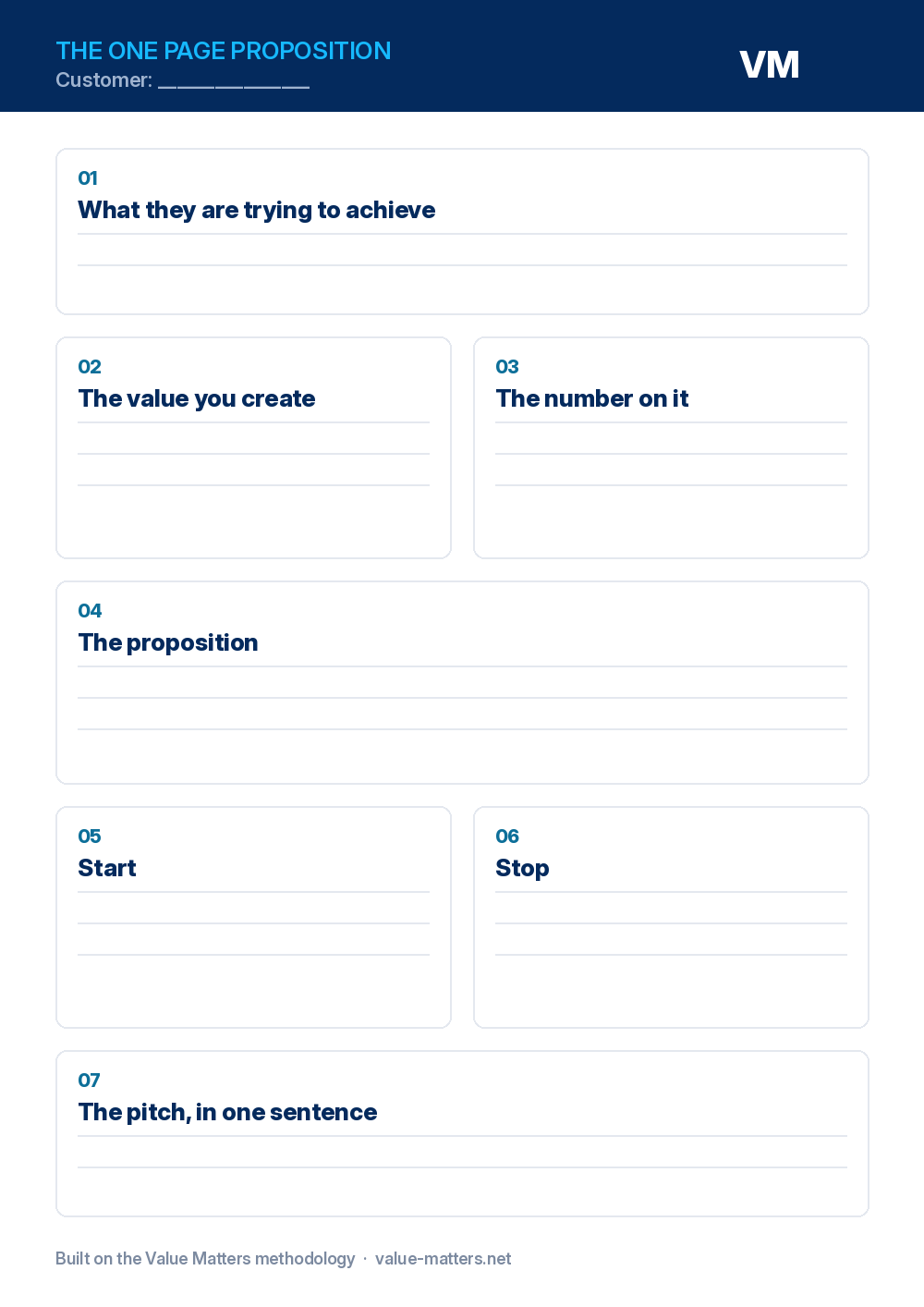
One page. Seven answers.
Not a pack you finish later. The finished page, agreed in the room.
What they are trying to achieve
The customer's real goal, in their words, not your product categories.
The value you create
Named, evidenced, and something a competitor could not copy-paste.
The number on it
The share of wallet you hold, the share available, and the gap worth chasing.
The proposition
The offer they would pay more for, short enough to survive a corridor.
Things to start
The specific moves that build the proposition, with owners.
Things to stop
The work that fills the weekly call and moves nothing.
The pitch
One sentence. If your team cannot say it, your customer will never hear it.
Want number 03 before you talk to us? The Whole Wallet sizes it in a minute.
Four out of five sales organisations rebuild their key account programme every few years. Most of them still cannot say, in one sentence, why the customer should pay more.
Gartner, (re)building KAM programmes for growth, 2021 (the rebuild statistic)
Three days. The pre-work is ours.
Build the picture
Before day one we read the account plans, the QBR decks, the customer's annual report and the public record. We arrive knowing the account. The days are for thinking, not reconstructing.
Their world
What this customer is actually trying to achieve, who decides, and where value is created and lost today. The awkward questions get asked here.
The offer
The whole value system around this customer on the wall by lunch. The proposition by the end of the day.
Make it land
The number, the pitch, the start and stop lists, and who owns what. You leave with the page agreed. Not a report to wait for.
Both of us. In the room.

Mark Davies
Chair of the Association for Key Account Management. Visiting Fellow at Cranfield and Aston. Author of Infinite Value.

Richard Brooks
Author of AI Strategy for Sales Teams (Kogan Page, 2026). Visiting Fellow at Cranfield. He does the pre-work and keeps the page useful after we leave.
The thinking behind the process is the subject of our next book, Creating Customer Value Propositions with AI (Kogan Page, May 2027).
£15,000, fixed.
Both of us. Three days. The pre-work before, and a follow-up thirty days after, once the page has met the customer. One customer per sprint. Depth is the point.
A straight promise: if after the pre-work we do not believe one page can move the number with this customer, we tell you before day one. You owe us nothing.
Tell us about the customer.
A sentence or two is enough. We reply within a working day, usually with three questions.