Sell Me This Pen: Value Selling With the PAINS Method
Why most salespeople fail the 'sell me this pen' test, and how the P.A.I.N.S. value selling cycle fixes it: Problem, Agitate, Indicate, Navigate, Solution.

In Martin Scorsese’s 2013 film The Wolf of Wall Street, based on Jordan Belfort’s memoir, we watch the rise and fall of a stockbroker whose firm, Stratton Oakmont, made its money from fraud, corruption and selling the public investments that would seldom, if ever, pay off. Belfort got rich on the commission from worthless junk stock.
Hardly a gold-standard case study for someone who preaches value-based selling. But bear with me.
There is one scene in that film that explains perfectly why most salespeople fail to get results, and why most strategic selling and key account management programmes fail too. It appears twice.
The pen scene
Belfort is at dinner with some of his team, trying to coach them to sell. They are not getting it. So he picks up a pen, turns to his favourite salesman, Brad, and says: “Sell me this pen.”
Brad takes the pen. “Why don’t you do me a favour,” he says, “and write your name on that napkin?”
“I don’t have a pen,” says Belfort.
“Exactly. Supply and demand.”
It is not value-based selling, but it works. Brad created a need, and urgency, before he said a word about the pen. Most salespeople would have started on the features: the nib, the ink, the weight in the hand.
That is why selling fails. There is no understanding of, or empathy for, what the customer needs. No sense of what they value, and so what they might be willing to buy. I see it every week, whether the thing on the table is a $5 pen or a $500 million power station.
Good selling runs the other way. You find out what the customer values first. Then you position your offer as a way to make things better for them. You offer them an improved future state.
Bad selling is bad business
When you lead with your agenda rather than the customer’s, you lose them. The moment a buyer senses you care more about your numbers than their problem, trust drains away and so does their attention. It becomes painfully obvious that you just want to sell your stuff.
Here is the thing, though. I am not asking you to invent a new product. That would be unreasonable. But adding a few simple processes and services around your core product can make the difference between a sale that commands a premium and one where you compete on price alone. Suppliers who master that difference rarely end up in bidding wars, and rarely fall into the commodity trap.
Think about who you are actually selling to. The board wants a quantified return, clear metrics and strategic impact. The user wants their day made easier, their job more manageable, and to look good in front of their boss. Most deals involve both, and several people in between, which is why mapping the decision-making unit matters so much.
Get that wrong and sales cycles stretch, proposals are ignored, and the deals that do close come at a thinner margin, because when value has not been established price is the only thing left to negotiate.
What copywriters know that salespeople forget
I am a big believer in, and a keen consumer of, the principles of copywriting. Copy is writing that sells. As Copyhackers, the firm Joanna Wiebe founded, puts it, copywriting is using words to get a reader to take action. If it is not selling something, it is not copy.
There are plenty of copywriting frameworks, and one of the most useful is three questions: What? So what? What next?
What is the problem the reader is experiencing? So what is the effect on their business? And what next: what do you have that could fix it or help them manage it?
Most writers, and most salespeople, jump straight to “what next”, to the features of the thing they sell, usually because that is what their targets and incentives reward. The lesson from copywriting is plain. If you want to sell, you start with the customer’s problem, you make the cost of that problem vivid, and only then do you offer a possible solution.
That takes patience, and the skill to work with several stakeholders, because the big problems usually sit deep in the customer’s business, not on the surface where the purchase order gets raised.
So how do you sell that pen?
Behind most lost deals, and most deals won only by cutting the price, is an absence of selling that is truly value-based. To fix that I developed a framework I call P.A.I.N.S. value selling. Sales teams and key account managers can use it, and so can anyone who deals with customers and wants a better outcome for both sides.
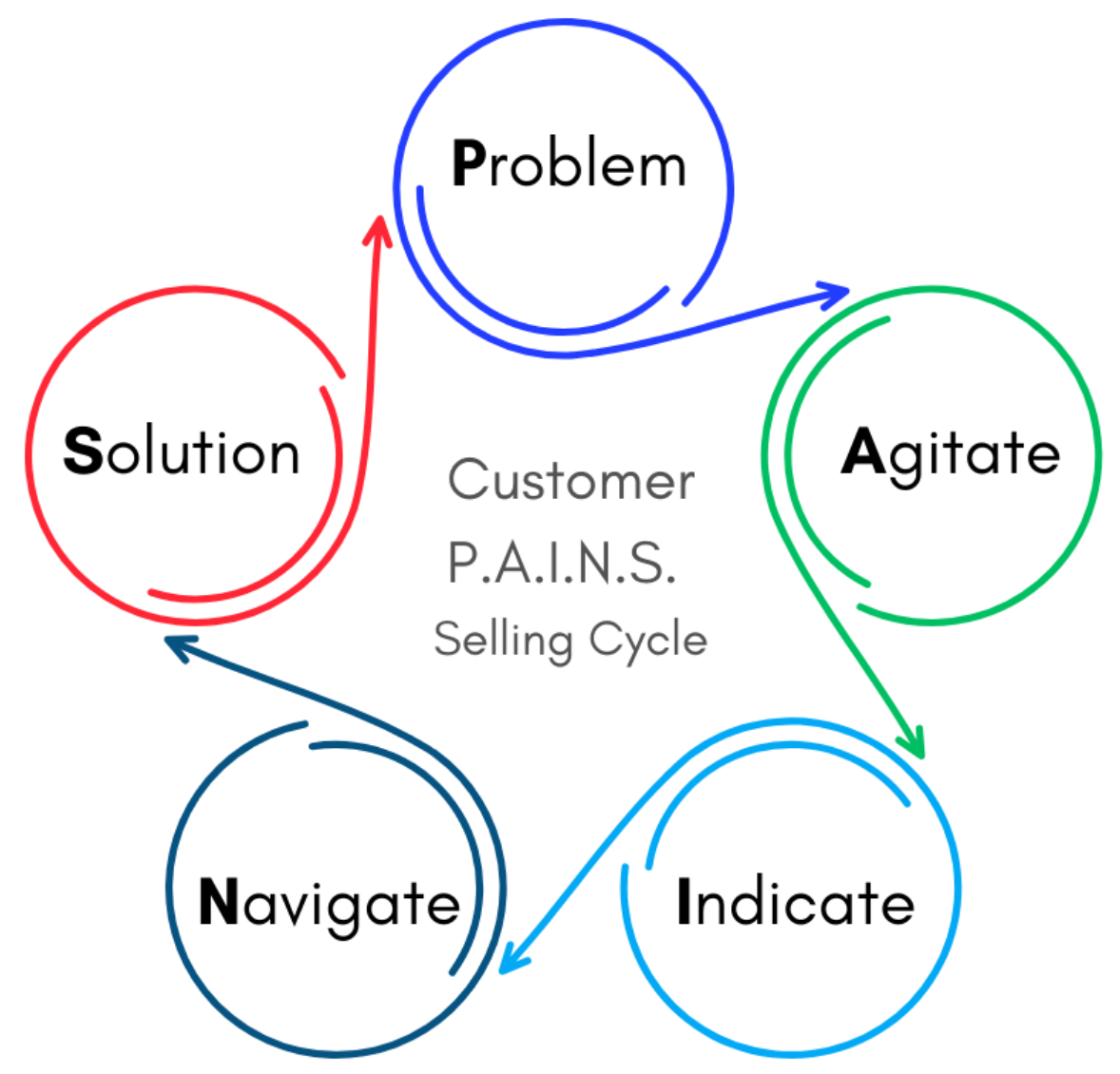 The Customer P.A.I.N.S. value selling cycle (Davies, Value Matters, 2025).
Selling a pen is a simple sale. The customer buys or walks away in a single transaction (although I have been pondering a £150 Apple Pencil for several months, so perhaps not always). B2B selling is usually complex. There are several steps, several conversations, and several stakeholders before anyone makes a final decision to buy.
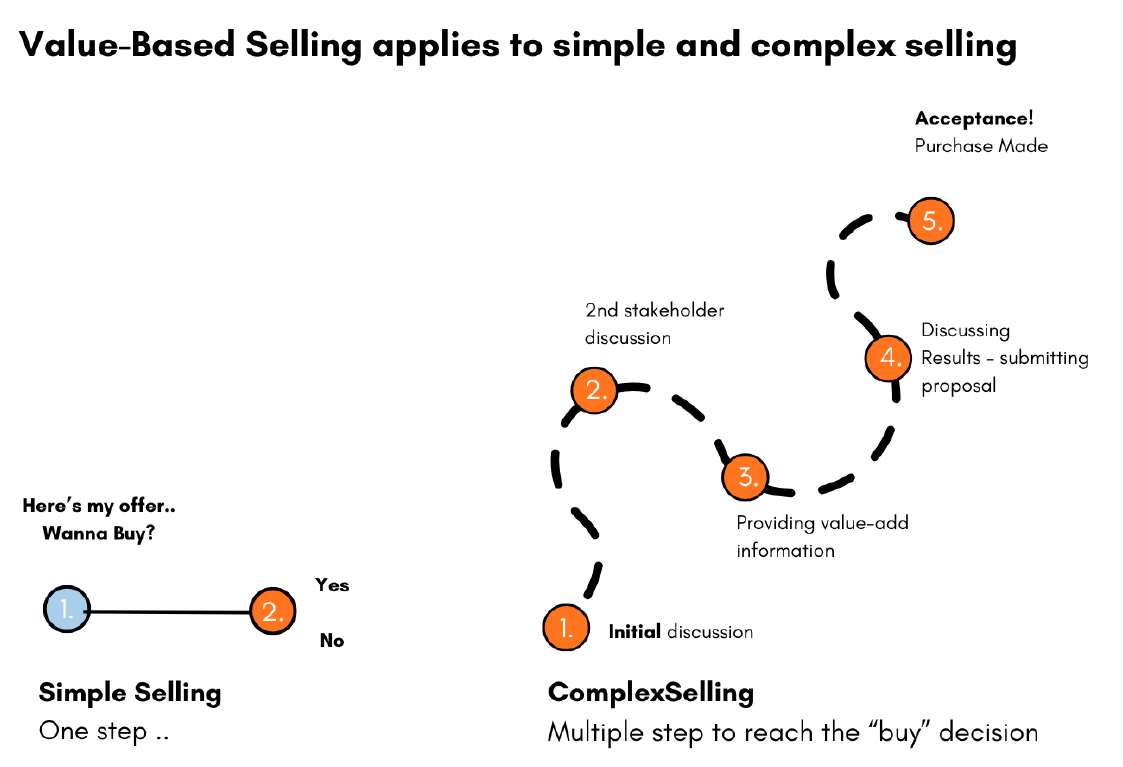 Value-based selling applies to simple and complex sales.
P.A.I.N.S. works for both.
1. Problem: what is the customer’s problem?
Identify and frame an issue the customer faces that you could improve, and that they would value.
Value-based selling starts with what keeps your customer awake at night, which means doing your homework before the first meeting: their industry, their sector’s economics, their competitors. (I set out a fuller method in three techniques to understand your customer.)
Map the people you need to speak to, and how influence works between them. Who uses the solution day to day? Who measures its success? Who controls the budget? Who has a veto?
Then find one person who can act as your sponsor, and ask them to help you meet the key decision makers. A good sponsor understands your offer and their own organisation’s politics well enough to guide you through them.
Over several meetings you will learn what the customer is trying to achieve, and, more importantly, what is stopping them. Those barriers are your “problem”. Now frame them in terms of value. Do not just note that their system is slow. Work out what the slowness costs in lost productivity, missed opportunities and frustrated customers.
A manufacturer might tell you their equipment keeps breaking down. That is a symptom. The problem is that each hour of unplanned downtime costs them, say, $50,000 in lost production, damages their standing with key customers and forces expensive overtime to catch up.
2. Agitate: how painful is this problem?
Calculate the impact the issue is having on the customer’s business, and describe the loss of performance and reputation.
Now help the customer see the problem’s true cost. This is not manipulation or false urgency. It is bringing clarity to pain that usually stays hidden.
Is it stopping them selling to their own customers? Perhaps slow responses are sending prospects to competitors, or quality problems are triggering penalty clauses. Is it making them inefficient? Do the sums. If a manual process needs three extra people at $60,000 a year each, that is $180,000 a year before overheads, plus everything those people could have been doing instead. Is it a reputational or risk issue? Late deliveries get discussed in the trade, and security breaches make headlines.
Look for the managerial knock-on effects too: best people stuck on routine work, management kept reactive, friction between departments.
Describe these impacts and put numbers on them wherever you can. The aim is not panic. It is a clear, shared understanding of why this problem deserves priority. When a customer can see that the current situation costs them $500,000 a year, your $150,000 solution stops looking like an expense and starts looking like an investment with a clear return.
3. Indicate: could there be a better way?
Describe how your offer could improve the customer’s future state.
Notice the word: indicate, not present or pitch. You are not making a formal proposal yet. You are helping the customer picture what their world would look like if the problem went away.
Frame it in outcomes, not features. Instead of “our software processes 10,000 transactions a minute”, try “imagine your team handling peak demand without slowdowns, complaints, or the stress of wondering whether the system will hold.”
Show the tangible impacts (lower cost, more revenue) and do not underrate the intangible ones: less stress, better morale, a stronger reputation.
Talk to different stakeholders, because your solution lands differently in each part of their business. IT cares about reliability and security, operations about productivity, finance about a clear return and predictable cost. Show them the route is achievable without burying them in technical detail.
4. Navigate: sell, continue or stop
Decide the next step together: sell now, keep developing the idea, or stop and look elsewhere.
Think of this as a joint decision point rather than a high-pressure close. There are three possible paths, and the skill is recognising which one you are on.
The first is the one every salesperson hopes for. They buy. But notice that this is only possible because of the hard work in the first three steps.
The second path is more common and nothing to be discouraged by. They are not sure yet, but they like the approach. That means going back to understand the problem more deeply or to refine the offer. In complex B2B sales, expect to go round this loop several times. Each time you get closer to something that genuinely fits.
The third path takes courage and discipline. You stop. There is no interest this time, or not yet. That is not failure. It is good use of your time. And a graceful stop today often opens the door tomorrow, when the customer’s situation changes.
5. Solution: deliver the value you promised
You have the sale. Now implement the solution and deliver what you promised.
Winning the business is the beginning. Now you prove that your value promises were accurate predictions, not clever selling. Put processes in place to measure the impact you are having. That is not only for internal accountability. It is how you show the customer, in terms they can share with their colleagues and their board, that the value arrived. If you promised to cut processing time by 40 per cent, track it and report it. If you indicated savings of $300,000 a year, help them calculate and verify the figure.
Then ask the customer to acknowledge and sign off the value delivered. This is not legal protection. It is shared recognition of success, and it becomes the foundation for the next conversation. A value ledger is a simple way to keep that record over time.
Around and around: the trust advantage
P.A.I.N.S. is drawn as a cycle for a reason. When you deliver what you promised, something valuable happens. The next time you come back, the customer trusts you. They are more willing to tell you about their new problems because they have learned something: when we ask these people for help, they bring solutions that genuinely add value to our business.
So if you see continued opportunity with a customer, protect the next sale. How? Add value. Add value. Add value.
That does not mean constantly selling them more. It means helping them improve their business when there is nothing in it for you right now: an introduction, some benchmark data, a perspective from your work elsewhere.
That is how you stop being a vendor who occasionally sells them something and become the adviser who helps them succeed. Trusted advisers get invited into conversations about new challenges long before those conversations turn into a formal procurement process.
The pen, one more time
At the end of The Wolf of Wall Street, Belfort, now out of prison, walks onto a stage to teach a sales seminar to a room of eager students. His opening line?
“Sell me this pen.”
Fraud is not to be condoned, and Belfort has said as much himself. But the difference between manipulative selling and value-based selling was never in the techniques. It is in the intention and the outcome. Manipulative selling creates value for the seller at the buyer’s expense. Value-based selling creates value for both, through real problem solving.
Do it well, and your customers stop simply buying from you. They start working with you to improve their business.
And that is a pen worth selling.
If this is your problem too, bring this into your organisation as a talk or workshop, or talk to us.
The newsletter this came from
Every fortnight: one idea from the method, worked through properly. Read it where you already are, on LinkedIn, or by email below.
Keep reading
The Johnny Cash Principle
A rockabilly band, a Cotswolds festival, and the moment everybody finally looked up: why every pitch should open with what your audience already knows, and the ABC model that makes it happen.
Five Steps to Sell Anything: B2B Lessons From an Old Vase
For forty years I kept my keys in a rare piece of flambé pottery. What it taught me about hidden value, and five steps to stop B2B value evaporating.