Three Techniques to Understand Your Customer
You cannot solve a problem you do not understand. Three techniques to understand your customer: ten background questions, their outside world, and their inside.

Imagine trying to finish a jigsaw without the picture on the box. You can join a few pieces along the edge, and you might even get a corner done, but you will never see the image. Selling to a key customer without really understanding them is exactly that. You connect a few pieces, you make the odd sale, and you call it a relationship. Underneath, you are guessing, and guessing is an expensive habit in a key account.
Knowing your customer is what moves you from transaction to trusted partner. It lets you anticipate what they will need before they ask, bring them ideas instead of waiting for a tender, and help them hit their own goals. That is the real job of a key account manager. You are not managing an account. You are building a partnership that has to be worth something to both sides.
So how do you get that depth of understanding? I break it into three techniques. First, gather the background, by asking a set of fundamental questions about the customer’s business. Then look outwards, at the industry and the wider forces bearing down on it. And finally look inwards, at the customer’s own strengths and weaknesses, and how they actually compete.
Technique 1: Ten background questions about your customer
Understanding a customer is not the same as collecting data about them. Most account plans are full of data. Very few contain insight, the kind that tells you what keeps the managing director awake. These ten questions are how I get from one to the other.
1. What does their industry ecosystem look like?
Start with the big picture. Which markets does your customer serve? Who are their competitors, their key suppliers, their regulators? Those forces set the context for every decision your customer makes, and when you understand them you can see the pressures coming before your contact mentions them.
2. How does their business model work?
Be clear on how your customer creates value and how they capture it. What is their purpose? How do they make money? Are they growing or struggling? If they are listed, their annual report will tell you more about their strategy in twenty minutes than a year of account reviews. Then you can see where your offer fits, and where it does not.
3. Who are their customers?
Your customer’s customers are the final judges of whether any of this works. Who are they, and what do they need? If you sell to a consumer brand, think about the consumer trends that will move their demand. If you sell to a B2B business, find out what their customers complain about. This is the fifth of our five sources of value for a reason: help your customer win with their customers and you will rarely be asked to justify your price.
4. What do they really need, as opposed to what they ask for?
Do not just accept what customers say they want. The gap between the stated want and the real need is where the richest opportunities sit. You are the expert in your field, which gives you a responsibility to challenge a brief that will not deliver what the customer is actually after. A proper customer needs analysis starts here.
5. Who are the people, and what do they want personally?
Behind every business decision is a small group of people with their own objectives, worries and ambitions. Who are the real decision makers? What does success look like for each of them? How can you help them look good? People buy from people, not from companies, so map the decision-making unit and then think about each person in it as an individual.
6. Where do you stand with them?
Where do you rank among their suppliers? Are you strategically important, or one vendor among thirty? Be honest. You cannot plan a route if you are wrong about the starting point, and most suppliers overestimate how much they matter. If you are not sure, read are you a strategic supplier? and ask yourself the questions in it.
7. What is your track record together?
History matters. What is the story of your relationship with this customer? Are there successes to build on, or a failed project that still hangs over every meeting?
8. How do they see your competitors?
Know who you are up against and how you compare. But do not stop at your own assessment, because it will flatter you. Try to find out how the customer ranks you against the alternatives. That outside view nearly always shows up a blind spot.
9. What is their strategic agenda?
Now join the pieces into one picture of the customer’s strategic challenges and opportunities. This is what lets you have conversations about their business success, not about your products.
10. Where can you actually make a difference?
The big picture matters, but be realistic about where you can change something. Identify the specific points where your offer creates value, then connect that impact back to the strategic objectives you found in question nine. That link is the spine of a good customer value proposition.
Answer those ten well and customer research stops being a data collection exercise. It becomes the thing that gets you better meetings.
Technique 2: Analyse the customer’s external environment with AI
The second technique looks outwards. Two classic tools do most of the work. A STEEP analysis (social, technological, economic, environmental, political) assesses the big macro forces that affect every business. Porter’s five forces assesses the industry your customer operates in: rivalry, new entrants, buyers, suppliers and substitutes.
An AI tool will now produce a first draft of both in minutes, but only if you ask well. If you type “do a STEEP and Porter’s analysis for Jaguar Land Rover” you will get a generic essay that could have been written about any carmaker. The trick is to walk the AI through each step and ask for insight you can act on. You want an analytical partner, not a machine that regurgitates Wikipedia.
Here is how I would set it up for Jaguar Land Rover (JLR). Swap in your own customer.
Setting the stage
Give the AI a role, a task and a format before anything else:
“Act as a market analyst specialising in the luxury automotive sector. Your task is to perform a detailed STEEP analysis for Jaguar Land Rover (JLR). The final output should be a structured report, with each section giving a brief summary, the key factors, and their potential impact on JLR’s business strategy and future profitability.”
Working through STEEP one factor at a time
Then take each element separately, with a follow-up that forces it back to your customer. For technology, for example:
“Examine the technological advances affecting the automotive industry. Focus on electric vehicles, autonomous driving and in-car connectivity. For each, describe its current state and future direction.”
And then the follow-up:
“Specifically for JLR, with Jaguar moving to an all-electric range and Land Rover introducing electric variants, evaluate the technological challenges and opportunities they face. What are the key risks if they fail to innovate quickly enough?”
Do the same for the other four. For social factors, ask about shifts towards sustainability and how attitudes to luxury differ in emerging markets. For economic factors, ask about growth, inflation, consumer spending and currency in the UK, China and the US, then how a downturn would hit a premium brand’s pricing. For environmental factors, ask which emissions rules JLR must meet and what happens if it misses them. For political factors, ask how Brexit changed its supply chain and exports, and which incentives or tariffs could help or harm it.
Walking through the five forces
The industry analysis works the same way. Ask the AI to name JLR’s main rivals (BMW, Mercedes-Benz, Audi) and describe how intense the rivalry is, then how JLR should respond. Ask whether the threat of new entrants is high or low, and make it consider Tesla and the new Chinese EV makers specifically. Ask how much power an individual luxury buyer really has when brand image does so much of the work. Ask about supplier power, and push it on what something like the semiconductor shortage did to a supply chain as complex as JLR’s. And ask about substitutes, which go well beyond other cars: car sharing, better public transport, the used market, ride-hailing.
The prompt that matters most
Two long reports are a starting point, nothing more. The prompt that turns them into something useful is the last one:
“Look at both of these analysis reports. Prioritise the top five external opportunities and the top five external threats for JLR.”
Now you have ten things your customer’s board is worrying about, and you can ask yourself which of them you could help with. Check what comes back: AI gets facts wrong with great confidence, and one out-of-date claim in front of a customer undoes a lot of good work. Our KAM prompt guide has more prompts built the same way.
Technique 3: Analyse your customer’s internal capability
This is the hardest of the three, and the one most account managers skip. It means looking inside your customer’s organisation and judging their strengths and weaknesses as they compete for their own customers. There is no report to download. You have to ask questions, watch what they do, use your judgement and decide how effective they really are.
The traditional tool is Porter’s value chain, which walks through primary activities such as logistics, operations, marketing and service, with support activities such as procurement and HR behind them. It is excellent, and I still use it. But it was built for manufacturers. It focuses on tangible, functional activity and says much less about the intangible assets that drive many businesses now. A technology firm or a professional services business can be enormously strong because of its ideas, often before it has made a sale or a profit, and the value chain has nowhere obvious to put that.
So we developed a broader model of organisational capability, better suited to the customers most of you sell to today. It looks at five areas.
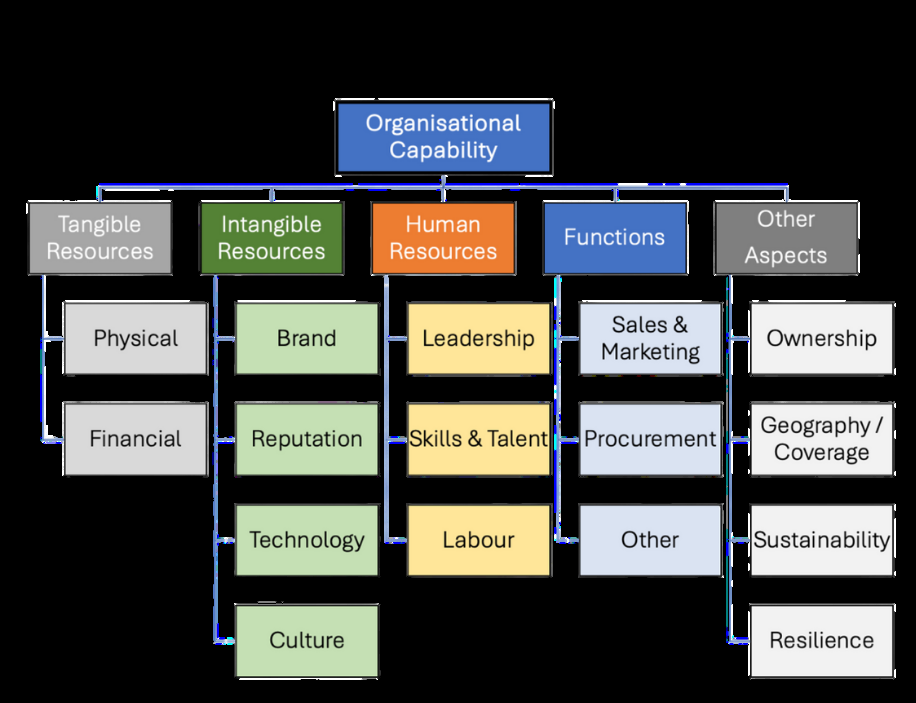 The Value Matters organisational capability model.
Tangible resources are the physical and financial assets: buildings, plant, cash. Intangible resources are often where the real value lies, in brand, reputation, technology and culture. They are hard to copy, which is exactly why they give a business its edge. Human resources covers leadership, skills and talent, and labour. Functions are the core business activities, such as sales and marketing and procurement. And we added a fifth group of other aspects that matter more now than they did when Porter was writing: ownership, geographic coverage, sustainability and resilience.
Used together, these let you judge a customer’s strengths and weaknesses far more completely, and they point you at what makes a firm resilient in a world that keeps changing under it. We have found the model most useful with professional services, financial, technology and pharmaceutical customers, whose value sits heavily in intellectual property and people. If that describes your customers, it will show you things the value chain never would.
Here is the question to take into your next account review. Where is your customer weak, and does anything you sell make them stronger there? If the answer is yes, you have the beginning of a proposition. If you cannot answer at all, you have found your homework.
Where good customer strategy starts
Every good customer strategy and every good value proposition I have seen started with real insight into the customer. None of them started with the product. The three techniques above are how you get that insight, and the output belongs in a living account plan, not a slide you present once and file.
The first time you do this for a customer it will take a while. The second time you meet them afterwards, you will notice something change. They start telling you things they did not tell you before, because you finally asked about the things that matter to them.
If this is your problem too, see the Strategic Customer Planning Tool on the ladder, or talk to us.
The newsletter this came from
Every fortnight: one idea from the method, worked through properly. Read it where you already are, on LinkedIn, or by email below.
Keep reading
The Plan in the Filing Cabinet
Somewhere in your organisation there is a key account plan that nobody has opened since the day it was approved. It does not die from lack of discipline. It dies because no team ever had the hours to keep it alive. Now, finally, something has the time.
Customer Segmentation: The Kingpin of Customer Management
Most companies segment customers on last year's sales, and pay for it. Here is a five-stage method for customer segmentation that looks at future value instead.