Selling Wins the B2B Game, and It Always Did
AI is not killing B2B selling. It is killing transactional selling, and the human conversations left behind are worth more than ever. Five skills that now matter.

Let me start with a confession.
For the last couple of years I have been adding my voice to a growing chorus: that AI and technology are squeezing the life out of traditional selling. That the relationship-driven, persuasion-led salesperson, phone in hand, had had their day.
I was wrong. Or at least, I was telling only half the story.
AI is changing B2B selling at speed, and the old model of feature selling and winning on information the customer did not have is being taken apart. I stand by that. But I missed something, and most businesses are missing it right now.
What is actually dying is transactional selling
The reorder of standard products. The renewal of a routine contract. The processing of repeat business. These interactions are moving fast to online platforms and to machine buying, where a customer’s procurement system talks directly to a supplier’s system and no human is in the loop at all. In some B2B categories that is already how it works. In most, it will be within a decade.
If you still rely on people to handle high-volume, low-complexity customer interactions, that is a serious structural threat. The economics no longer support it, and competitors who have automated those processes will build a cost advantage that compounds every year.
Now look at the other side of the equation. As transactional selling moves to machines, the interactions left for skilled people become, by definition, more valuable. More complex. More consequential. The conversations that cannot be automated are the ones that shape long-term partnerships, sort out difficult situations, open new opportunities and build the kind of trust that makes a relationship hard for anyone else to copy.
The sales profession is splitting in two
The profession is not shrinking. It is bifurcating.
On one side sits automated, efficient, machine-managed transactional exchange. On the other sits high-skill, high-stakes, deeply human strategic selling. The comfortable middle ground, where a lot of sales teams operate today, is the territory under most pressure, and it is being squeezed from both directions at once.
McKinsey’s 2024 B2B Pulse Survey, drawing on nearly 4,000 decision makers across 34 sectors, describes exactly this split: digital channels handle the straightforward interactions (orders, specifications, progress updates) while people with real relationship skills handle the complex ones (Plotkin et al., 2024).
As procurement becomes automated, your ability to stand out on price, specification or delivery terms shrinks, because an algorithm finds the best deal on standardised criteria faster than any human buyer. McKinsey has estimated that generative AI could add between $0.8 trillion and $1.2 trillion of productivity across sales and marketing (Yee, Deveau and Reis, 2024). That is the scale of the opportunity, and the scale of the risk if you wait.
If you compete mainly on transactional terms, you are heading into the commodity trap and a long squeeze on margin. The advantage moves, clearly, to suppliers who offer something the algorithm cannot score: value created together with the customer, capability embedded in their business, insight into their strategy, and a relationship that makes switching a genuinely costly decision.
Your competitors who understand this are already moving. They are investing in AI tools and in the human capability that makes those tools worth having, and they are embedding themselves in their customers’ businesses in ways that create real switching costs: organisational, relational and cultural, not contractual.
So the evolution of selling is not a retreat from the fundamentals. It is a return to them, done at a higher level, with better tools, and pointed at the interactions that actually move the result. The foundation skills of great selling do not become irrelevant. They become the entry ticket.
What this means for you
If you lead a sales team, manage a portfolio of key accounts or run a business that lives on customer relationships, the message is simple. Your ability to compete will fade if your commercial capability does not evolve alongside your technology spend. The two are not in competition. They are inseparable.
Here are the five skills I think matter most.
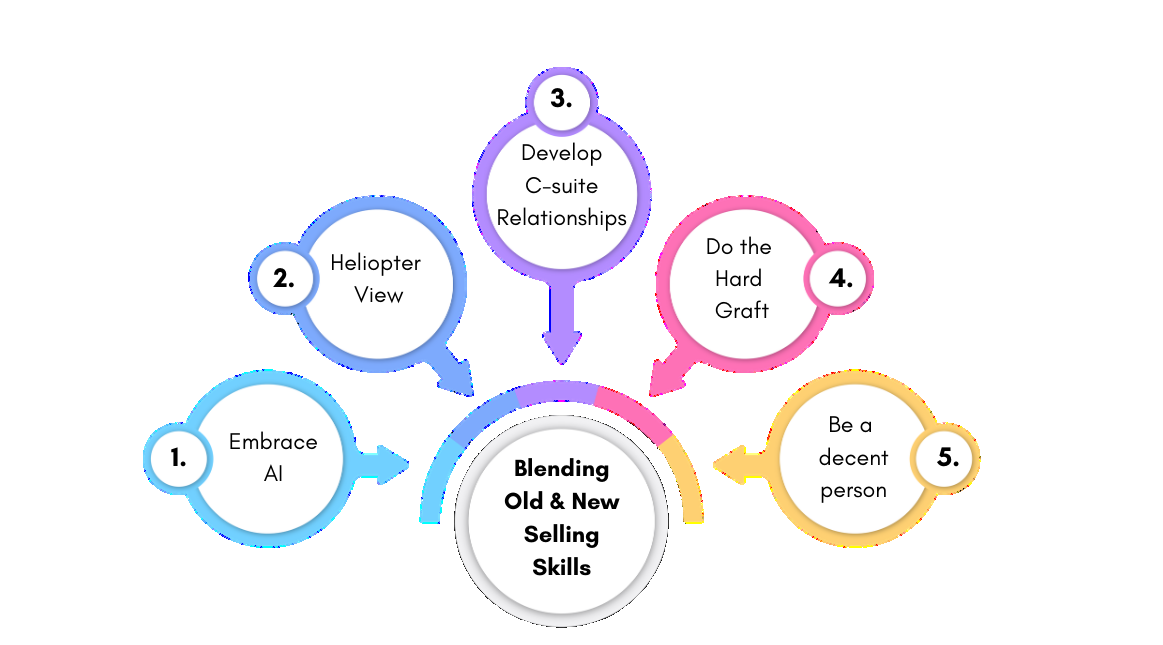 Blending old and new selling skills.
1. Embrace AI, and use the time it gives you back
The key account manager who treats AI as a threat has already lost. The one who treats it as a tool has just handed themselves a big advantage.
AI can lift a substantial load of admin and analysis off a good salesperson. In practice that means faster customer and market research, first drafts of value propositions, stakeholder briefings before meetings, patterns and early warnings pulled out of CRM data, several commercial scenarios generated in minutes, news on customers and competitors as it happens, and a structured summary and action list after every meeting. Our KAM prompt guide shows how to ask for most of these.
What all of that creates is time. Time to think. Time to be present. Time for the human work no algorithm can do, which I wrote about in what the technology cannot do. The question is not whether to use AI. It is whether you spend the time it gives you back on the right things.
2. Take the helicopter view of the whole value ecosystem
Traditional selling focused on the customer. Strategic selling focused on the customer and a few key contacts inside it. The next step goes further.
The most effective key account managers I work with now think in ecosystems. They look at the customer, and also at the suppliers feeding into that customer, the partners around them, the competitors shaping the market, and the regulatory, economic and technological forces pressing in from outside.
None of that is new. What is new is that salespeople are often best placed to do it, because they sit where more relationships and live market intelligence meet than anyone else in the business. The KAM who can line up a supply chain, spot a chance to collaborate and bring several parties together around a shared agenda is doing more than selling. They are becoming indispensable.
3. Build real relationships at C-suite level
This is where the big value opportunities live, and where most commercial relationships stay frustratingly shallow.
Research in the Harvard Business Review makes a useful point here. Hochstein and colleagues measure the health of a B2B relationship on three dimensions: the quality of the relationship, how the customer actually uses what you sell, and whether they realise the value they were promised (Hochstein et al., 2024). Satisfaction scores and renewals alone will not tell you. The value the customer gets, and the relationship that keeps it on track, both need continuing human investment, and much of it at senior level.
C-suite engagement is not schmoozing, and it is not senior access for its own sake. It is about working at the level where strategic decisions are made, where value is properly understood and where the long-term shape of a partnership gets set. That takes credibility, preparation and the nerve to have an honest conversation about what the customer really needs, even when the answer is uncomfortable. Trust at that level follows the logic of the trust equation: credibility and reliability count for little if the customer suspects you are in it for yourself.
It also takes the same investment inside your own business. A KAM without the respect of their own leadership will struggle to carry the customer’s voice to where it needs to be heard.
4. Resilience, tenacity and the willingness to do the hard graft
Selling is one of the most consistently undervalued professions in business. Yet at its heart it asks for something difficult: the ability to take rejection, keep believing, push through resistance and make things happen against inertia. As W. Clement Stone put it, “Sales are contingent upon the attitude of the salesman, not the attitude of the prospect.”
That has always been true. What is changing is the stakes, because the interactions left for you once the routine goes to machines are the harder ones. The complex deals. The difficult stakeholders. The negotiation that broke down and needs rebuilding.
In that world, the capacity to pick up the phone after a bad meeting, to go back to a customer who said no, and to keep momentum through a long and uncertain sales cycle is not a soft skill. It is a core commercial asset. And it cannot be automated.
5. Just be someone people like
This one is easy to underestimate, so I will say it plainly.
There is a temptation right now to describe the future of key account management entirely in terms of strategy, frameworks and technical skill. Those things matter. They are not enough. The academic research on KAM is now substantial (one systematic review covered 104 studies published between 1990 and 2022 (Sandesh, Sreejesh and Paul, 2023)), and my own reading of it is that the capabilities that matter most are the ones built on trust and value, which are exactly the ones a competitor finds hardest to copy.
When things get difficult, customers go towards people they trust, enjoy working with and believe are on their side. Not just competent, but decent. Someone who gets things done without drama, who delivers what they promised, and who runs towards a problem rather than away from it.
Being a reliable pair of hands is not a romantic idea. In a complex B2B relationship, where failure is expensive, it is one of the most powerful qualities you can have. You cannot fake it. You can build it. And no AI will replace it.
Are you selling for the new economy? A ten-question diagnostic
Here is a quick and dirty way to place yourself honestly. Rate each statement from 1 (rarely or never true) to 5 (consistently and deliberately true).
- I use AI tools routinely to prepare for customer conversations: researching stakeholders, analysing the market, briefing myself before meetings.
- I can state the specific, measurable value my customer has received from working with me, meaning what changed in their business, not what I sold them.
- I have active relationships with senior leaders in my key accounts, built on commercial credibility rather than social familiarity.
- I think beyond my immediate customer to their suppliers, partners and competitors when I build my account strategy.
- When a deal stalls or a relationship gets difficult, I lean in rather than pull back.
- Most of my customer-facing time goes on strategic conversations, not transactional or administrative work.
- I co-create solutions with customers: ideas neither of us would have reached alone.
- Customers and colleagues would call me reliable and straightforward, someone who makes difficult things easier.
- I have an honest view of where AI and automation are changing my role, and I am actively changing how I work in response.
- I invest regularly in my commercial craft (reading, reflection, peer learning, formal development), not just in product knowledge.
Add up your scores. 10 to 25: the transactional seller. Your foundations are there, but your commercial model is under pressure and the world is moving faster than your approach. The skills you need are learnable, and the shift is evolution, not reinvention. Start by being honest about where your time actually goes and what your customers really value.
26 to 39: the evolving professional. You are in transition, which is exactly the right place to be. You have good instincts and some strong capabilities, with gaps between how you work now and what the market is starting to demand. Your lowest scores are your development priorities. If you want a fuller picture, the KAM Tri-Skills self-assessment goes deeper.
40 to 50: the strategic value creator. You are selling at the level the market is moving towards. The challenge now is consistency, and helping the people around you make the same shift. You may also be underestimating how rare what you do is becoming.
Whatever you scored, the number matters less than the direction you are moving in.
The bar is rising
Professional selling and key account management are changing, and I think that is good news. The foundation skills (persuasion, resilience, trust, presence, the ability to make things happen when things are complicated) are not becoming less relevant. They are becoming more valuable, precisely because they are the things technology cannot copy.
What is changing is the standard. Selling is on its way to becoming one of the most demanding and sought-after professions in B2B, and the people who master the whole of it, not just the tools, will do very well.
So think about the last training your sales team had. Was it about the products you sell today, or about the seller they need to become?
References
Hochstein, B., Voorhees, C., Johnson, R., McCoy, N. and Mehrotra, V. (2024) ‘Toward healthier B2B relationships’, Harvard Business Review, July to August 2024.
Plotkin, C.L., Stanley, J., Harrison, L. and García de la Torre, V. (2024) Five Fundamental Truths: How B2B Winners Keep Growing. McKinsey & Company, 12 September 2024.
Sandesh, S.P., Sreejesh, S. and Paul, J. (2023) ‘Key account management in B2B marketing: a systematic literature review and research agenda’, Journal of Business Research, 156.
Yee, L., Deveau, R. and Reis, S. (2024) An Unconstrained Future: How Generative AI Could Reshape B2B Sales. McKinsey & Company, 16 September 2024.
If this is your problem too, bring this into your organisation as a talk or workshop, or talk to us.
The newsletter this came from
Every fortnight: one idea from the method, worked through properly. Read it where you already are, on LinkedIn, or by email below.
Keep reading
The Johnny Cash Principle
A rockabilly band, a Cotswolds festival, and the moment everybody finally looked up: why every pitch should open with what your audience already knows, and the ABC model that makes it happen.
Five Steps to Sell Anything: B2B Lessons From an Old Vase
For forty years I kept my keys in a rare piece of flambé pottery. What it taught me about hidden value, and five steps to stop B2B value evaporating.