The Plan in the Filing Cabinet
Somewhere in your organisation there is a key account plan that nobody has opened since the day it was approved. It does not die from lack of discipline. It dies because no team ever had the hours to keep it alive. Now, finally, something has the time.

Somewhere in your organisation there is a key account plan that nobody has opened since the day it was approved.
You may have even written it. Three days on a training course, a template with forty sections, a DMU map built from memory and Post-it notes, a growth ambition signed off by a senior director. But it then went in a “filing cabinet”, and it sat there. Untouched for months.
We have watched this cycle for years. We teach key account planning at Cranfield School of Management, researched it through the KAM Research Club, and sat with hundreds of practitioners who all confess, usually with a slightly guilty laugh. The plan gets done. The plan gets filed. The plan dies.
The profession has diagnosed this problem as a lack of discipline, the wrong template, insufficient executive sponsorship, or even poor training. Every few years a new methodology or technology arrives promising that this time the plan will live, and every few years it goes back into the filing cabinet.
We think the plan does not die because people are undisciplined or the templates are poor. It dies because what a key account really needs is a dynamic, living document, one that changes as fast as the customer’s world changes and briefs the team before a competitor can move. Something closer to a brain than a binder. No team has ever had the hours to maintain that, which is why the plan has always defaulted back to paper. But we are entering the age of the collaborator, and the technology to help is becoming available.
The Age of the Collaborator
Last week we presented at AKAM (Association of Key Account Management) about the opportunity of AI and described the journey our profession is on.
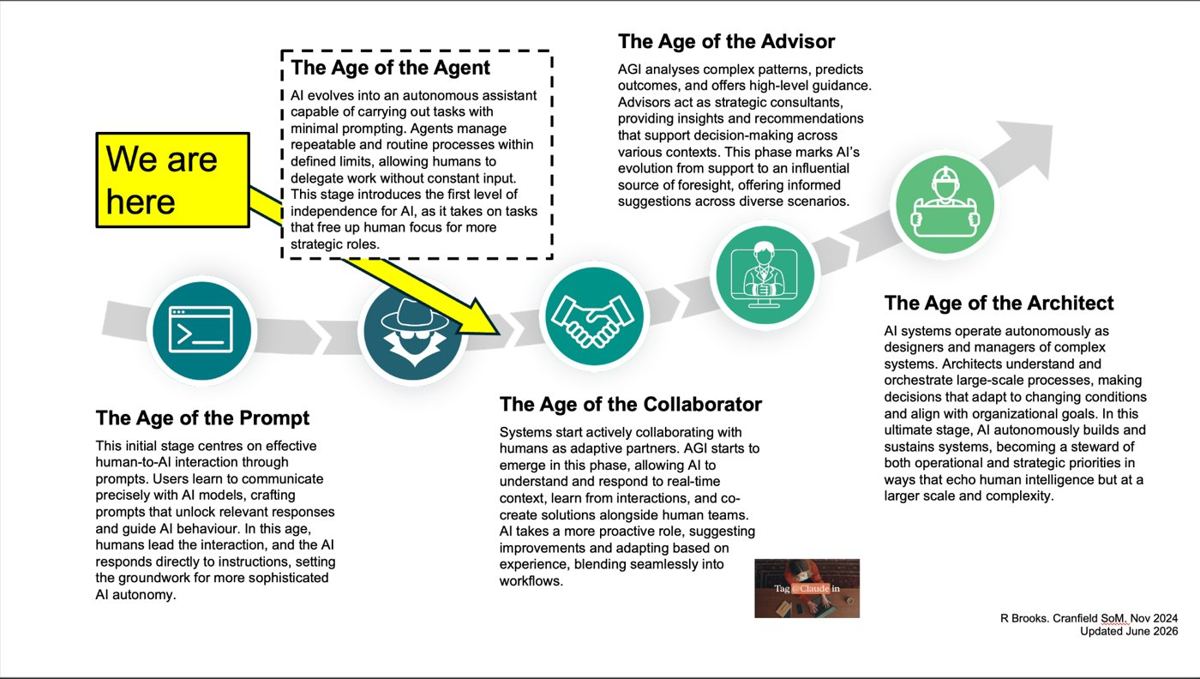
We created this a couple of years ago, which is a long time when compared with how fast technology is moving. Back then we proposed a roadmap that runs through five stages, from the prompt all the way to the architect. The far end of that arrow is informed speculation. The near end is not, and the “we are here” marker has to be moved every time we present the slide deck. First came the age of the prompt, when the skill was learning to ask a chatbot good questions and getting useful answers. We are now well into the age of the agent, where you delegate a goal rather than a task.
The next age is the age of the collaborator. Not you instructing a tool and collecting its output, but you and an AI working together on a shared, persistent piece of work that both of you understand and both of you improve.
We’re seeing the beginnings of the collaboration phase and one of the ideas that’s getting a lot of traction at the moment is the LLM wiki by AI living legend Andrej Karpathy. Instead of re-reading your files every time you ask a question, the AI keeps a set of interlinked pages and updates them as new material arrives. You add the sources. It does the writing. You both read the result. You collaborate. Obviously we’re thinking how this can be used to create dynamic Key Account Plans.
Applied to a Key Account Plan
To build a living plan, you need three distinct layers. These run from your messy raw data up to your structured commercial strategy.
| Layer | Contents |
|---|---|
| Layer 1: Raw Sources | Call transcripts, emails, QBR decks, CRM. |
| Layer 2: The Living Plan | Stakeholder pages, value ledger, opportunities. |
| Layer 3: The Schema | Your B2B sales methodology and rules. |
The Raw Sources
The first layer is the fuel. It is the unstructured data your account team already generates every day. It includes call transcripts, emails, QBR decks, the customer’s annual report, and CRM records.
You do not edit this data. You do not clean it up. You let it accumulate in a single secure folder.
The Living Plan
The second layer is where the synthesis happens. It consists of a series of interlinked pages maintained entirely by the AI.
It contains a page for each member of the decision-making unit. This tracks what they care about, what they said last quarter, and whether their influence is rising or falling. It includes a page for each opportunity thread.
Every page is cross-linked. If a stakeholder changes roles on a call transcript, the system immediately flags which opportunities and strategies are now exposed.
Importantly, it maintains a value ledger. This is the running proof of value delivered and the evidence file that every renewal negotiation needs, yet almost no account team can produce on demand. Proving this continuous, realised value-in-use is what prevents customer churn and drives long-term account profitability (Heskett et al., 1994).
The Schema
The third layer is the schema.
Karpathy describes the schema as the instructions that turn a generic chatbot into a disciplined maintainer (Karpathy, 2026). For a key account manager, the schema is your B2B sales methodology.
It is the framework you teach your team. It defines how you score stakeholder power, how you map the buying center, and how you define co-created value.
Usually, this methodology lives in a slide deck from an annual kickoff. In this model, the schema is a plain text file that tells the AI exactly how to analyse the raw sources. Your framework becomes the executable code for the system. It is applied to every email and transcript, every single week, without you ever having to remind the team. Your intellectual property is finally executable.
The Compound Effect
Albert Einstein called compound interest the eighth wonder of the world. He said those who understand it earn it, and those who do not pay it.
In a living account plan, you compound knowledge instead of cash. Karpathy’s core insight is that the wiki must be a persistent, compounding artifact (Karpathy, 2026). Every source you add makes the next analytical update more accurate. Your curiosity literally earns interest.
This happens through two primary operations:
The Ingest. When a new call transcript lands in the folder, the AI does not just file it. It runs an ingest process against the schema. It reads the raw text, works out what changed, and updates ten or fifteen different pages across your plan in a single pass. If a procurement manager contradicts what they told you in the spring, the system flags the contradiction on the spot. It does not let two versions of the truth sit quietly in separate files.
The Query. When you ask the system a strategic question, it search-queries the plan to synthesise an answer. In a standard system, that brilliant answer is lost the moment you close the chat window. Here, any valuable synthesis, like an ad-hoc competitor comparison or a risk assessment, is written back into the wiki as a new, permanent page.
This process compounds continuously. In month one, the plan only knows what you told it. By month six, the system knows things no single person in your business knows because it holds the entire history of the account at once.
Think of the quarterly business review. Today, preparing for a QBR takes a week of frantic reconstruction. In this model, the QBR prepares itself. The continuous bookkeeping is already done. Your prep meeting is a conversation about strategy and judgment, not a hunt for lost emails.
Where it falls short
Let us be honest about the limitations. This model is completely useless for small, transactional accounts with a single buyer and a price list. There is no scattered knowledge to collate.
Early evidence shows this pattern only pays off when information is complex, fragmented, and spread across multiple heads (blurman-ai, 2026). A simple account does not need a living plan. A key account with twenty stakeholders, five years of history, and data smeared across six systems does.
We must also reject the lazy promise that AI will solve everything. It will not.
AI only supplies the hours. It does the boring bookkeeping that humans naturally abandon. The strategic judgment remains entirely yours. You must still decide which relationships to invest in, which battles to fight, and what the strategy is. The machine is the clerk. You are the strategist. The concept of a private, actively curated knowledge store where the connections between documents are as valuable as the documents themselves is not new. It is the modern realisation of Vannevar Bush’s ‘Memex’ vision from 1945 (Bush, 1945). Bush understood the value of associative trails of information, but he could not solve the problem of who does the manual labor of maintaining them.
Setting this up
The good news is none of this requires an IT project.
You do not need a platform purchase, a six-month CRM integration, or a corporate steering committee. The pattern runs entirely on ordinary files that any human can read. An AI agent running locally on a single laptop with free software can maintain it.
The Blueprint
Most people can do this themselves. You need a laptop, a local directory, and a standard, professional AI interface you likely already use.
This pattern works directly inside Claude Pro (using the Projects feature), ChatGPT Plus (using a custom GPT or Workspace), or Gemini Advanced (using a custom Gem). These platforms allow you to upload your planning rules once as a permanent reference file, so the AI remembers your methodology in every new conversation.
Your local directory should look like this:
/Living_Account_Plan_CLIENTX
    /raw_sources     (unmodified transcripts, QBRs, emails)
    /living_plan     (interlinked markdown pages updated by the AI)
    schema.txt       (your rules)
To run the system, you perform three steps.
1. Define the Schema
Your schema.txt file does not contain code. It contains plain English rules based on your methodology. It acts as the operational handbook for the AI.
A standard schema contains three basic instructions:
Schema Rules for Client X
Stakeholder Rule: Every time a new transcript mentions a contact, update or create that contact’s individual page. Categorise their influence level as High, Medium, or Low. Note their primary personal careabout.
Contradiction Rule: If a newly ingested file contradicts an existing claim in /living_plan, do not overwrite the old claim. Flag the discrepancy explicitly in a “Strategic Alerts” section on the main overview page.
Value Rule: If a source contains evidence of resolved issues, cost savings, or operational improvements, append this immediately to the value_ledger.md page.
2. Execute the Ingest
You open your AI workspace. You upload your schema.txt file and state your goal.
Your prompt to the AI is simple:
“You are the dedicated maintainer of my living account plan. Read the attached schema.txt rules. I am uploading a new raw meeting transcript. Read it, identify what changed, and update the corresponding files in my /living_plan directory.”
3. Browse the Results
The AI returns the updated files. You save them into your folder. You can read them using any standard, free text editor.
As you add more transcripts, the connections grow automatically. The bookkeeping is complete. Your job is to open the files, read the synthesis, and make your strategic decisions.
One account manager can start this week with a single account. You gather your raw materials into one folder, write down your planning rules in a plain text file, and start feeding transcripts to your AI. The plan grows page by page. Within a month, it will hold a deeper synthesis of the account than any single person in your business has ever held at once.
The AI does the filing, the cross-referencing, and the remembering. Your job is to direct the analysis and think about what it all means. The machine is the clerk. You are the strategist. That is what the age of collaboration actually looks like.
We are actively researching this shift for our next book, Creating Customer Value Propositions with AI, publishing in spring 2027 with Kogan Page. As part of that research, we are building and testing practical tools that help key account managers collaborate with AI. Two of these are already live: a diagnostic that shows where value is being created for a customer, and a digital Offer Wheel that builds the value proposition you take to them. The living account plan is the next logical pattern emerging from this work.
For thirty years, we told account managers that the plan was a living document. Then we handed them an administrative maintenance burden that guaranteed it would die. They were never the problem. The filing cabinet was never the problem. It was the place plans went to wait for someone with the time to keep them alive.
Now, finally, something has the time.
References
blurman-ai (2026) Agent Wiki Economics, GitHub Repository, github.com/blurman-ai/archcheck [accessed July 2026].
Bush, V. (1945) ‘As We May Think’, The Atlantic Monthly, 176 (1), pp. 101-108.
Davies, M., Brooks, R. and Holt, S. (forthcoming) Creating Customer Value Propositions with AI. London: Kogan Page (scheduled for publication spring 2027).
Heskett, J. L., Jones, T. O., Loveman, G. W., Sasser, W. E. and Schlesinger, L. A. (1994) ‘Putting the Service-Profit Chain to Work’, Harvard Business Review, 72 (2), pp. 164-174.
Hough, A., Brooks, R. and Vincent, R. (2026) AI Strategy for Sales Teams. London: Kogan Page.
Karpathy, A. (2026) LLM Wiki, GitHub Gist, gist.github.com/karpathy [accessed July 2026].
If this is your problem too, see the Strategic Customer Planning Tool on the ladder, or talk to us.
The newsletter this came from
Every fortnight: one idea from the method, worked through properly. Read it where you already are, on LinkedIn, or by email below.
Keep reading
Customer Segmentation: The Kingpin of Customer Management
Most companies segment customers on last year's sales, and pay for it. Here is a five-stage method for customer segmentation that looks at future value instead.
Three Techniques to Understand Your Customer
You cannot solve a problem you do not understand. Three techniques to understand your customer: ten background questions, their outside world, and their inside.