Are You Selling or Solving? The Four Tensions of KAM
Every key account manager is pulled between this quarter and the next two years. Here are the four tensions that trade tomorrow for today, and how to hold them.

“If we don’t make this quarter’s numbers, we won’t be around to see next year’s strategy anyway. So go and sell.”
If you work in key account management you have heard that sentence, or something very like it, in a pipeline review. And you probably nodded, because it is not wrong. It is just not the whole truth. The same leader who says it will, three months later, ask why the account has stopped growing.
That is the life of a key account manager. You live in constant tension, and I do not mean the kind that gives you a migraine (though that happens too). I mean the productive kind, the pull between competing priorities that sits under almost every decision you make about a customer. Think of a tightrope walker between two towers. Lean too far either way and the whole account strategy wobbles.
In my work with companies across many industries, the pattern I see in the best KAMs is not that they eliminate these tensions. They use them. They know that excellence does not come from picking one side and sticking to it, but from knowing which tool to reach for, when, and in what measure.
The four tensions that sacrifice your tomorrow for today
I first set out these four tensions in Infinite Value (Davies, 2016). Each one runs between two ways of doing business: a product-based model on the left, a solution-based model on the right.
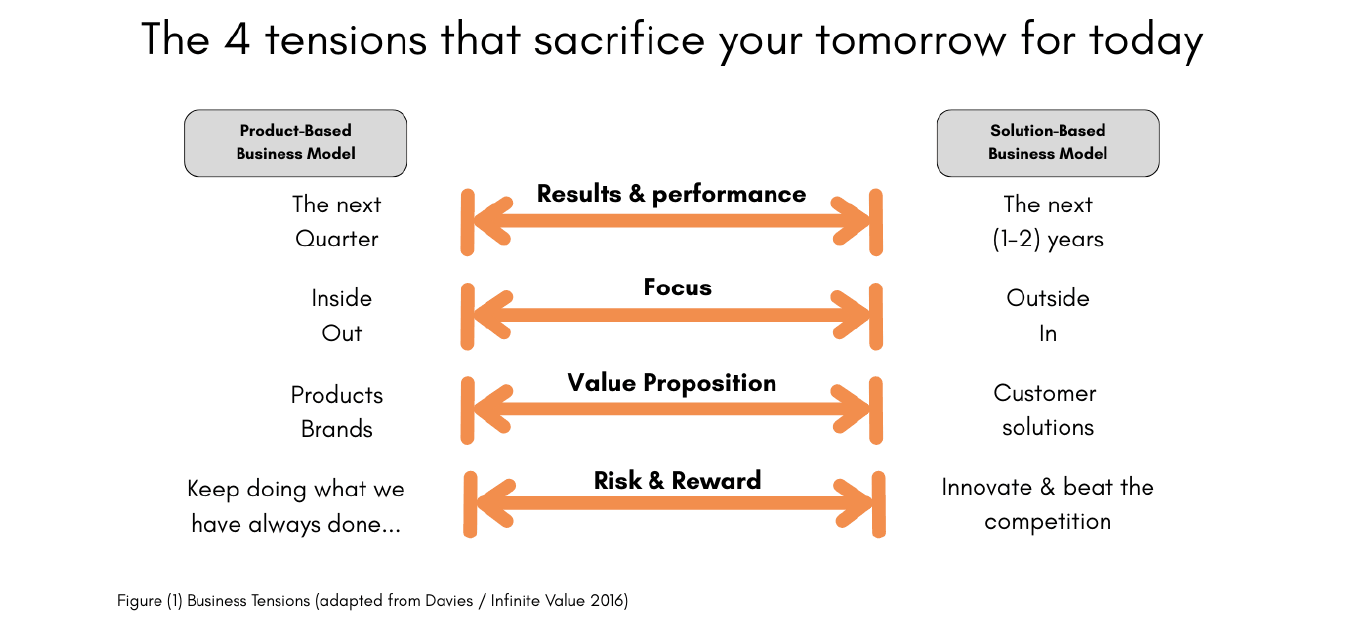 The four tensions, adapted from Infinite Value (Davies, 2016).
Results and performance asks which period you are really working for: the next quarter or the next one to two years. Focus asks whose agenda you are delivering, yours or the customer’s. The value proposition asks how you describe the impact of what you sell, as products and brands or as customer solutions. And risk and reward asks whether you see any need to change at all.
None of them is a problem you can solve once and forget. Barry Johnson called this kind of thing a polarity: two opposites that both matter, where choosing one permanently makes things worse. You manage a polarity. You do not fix it.
Tension 1: results and performance, next quarter or next two years
This is the most immediate tension, and the one you feel in your pay packet. Your leadership team wants results now, and your bonus probably rewards the quarter. Your key accounts, meanwhile, need long-term nurturing.
The short-term pull is familiar. Close the deals that hit the target. Meet today’s needs with today’s products. Fix the problem that landed in your inbox this morning. Push volume through the channels that already work. The long-term pull is quieter: an account plan that follows where the customer is heading, relationships several levels deep on both sides, opportunities that may take two years to mature, and a view of the account’s lifetime value rather than this month’s order.
The best account managers refuse the either/or. They build stepping-stone strategies, where each short-term win is deliberately designed to move the account towards a longer goal, and they are open with both the customer and their own leadership about doing it.
In practice that might mean negotiating a smaller first deal that solves an urgent customer problem, but with a contract that sets out the route to a wider roll-out. Or accepting a thinner margin on the first piece of business to win a foothold that opens higher-margin work later. When they report upwards, they chunk the long game into quarterly milestones, so everyone can see how today’s numbers feed next year’s growth. Nobody has to take the strategy on faith.
Tension 2: focus, inside out or outside in
We know our products are excellent. But does the customer see the same value that we do?
The second tension is about perspective. Are you leading with what you want to sell, or with what the customer needs to buy?
Inside out is comfortable. You lead with features and capabilities, position on your own strengths, look for customers who fit what you already make, and measure success by how much of the portfolio you have placed. Outside in starts somewhere else entirely: with the customer’s challenges and objectives, with solutions shaped around their priorities rather than yours, and with success measured by the outcomes they achieve.
The most effective account managers become bilingual. They speak their own company’s language of capability and the customer’s language of business, and they translate between the two all day. They do not throw away product knowledge; they put it in context. Instead of describing what the product does, they talk about what the customer can achieve with it. And when the standard offer will not meet the need, they argue for change inside their own business. They become the customer’s voice inside their company and their company’s translator to the customer, often in the same week.
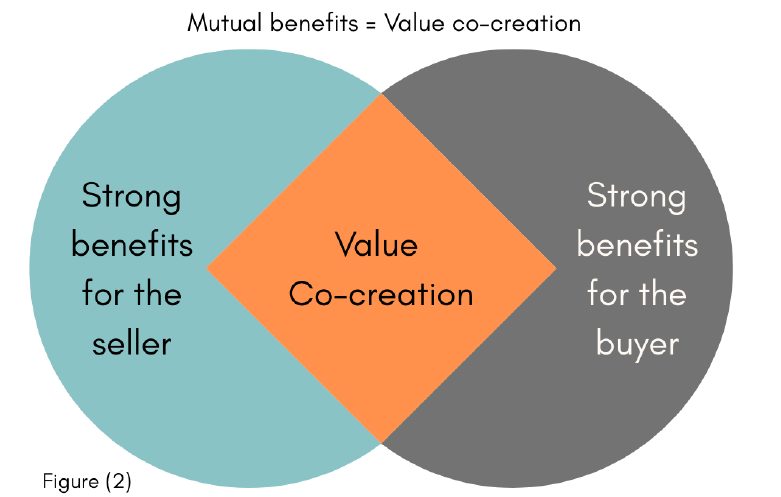 Mutual benefit is where value is co-created.
One practical technique helps here. For your most important opportunities, write a dual-perspective value proposition. On one side, the internal view: what we want to sell and why. On the other, the external view: what the customer wants to buy and why. Where the two align, you have momentum. Where they differ, you have work to do, and now you know exactly where.
Tension 3: the value proposition, products or customer solutions
Our products are excellent. But our competitors have excellent products as well. How do we stand out?
The third tension is about how you frame your difference. Is it product-based or solution-based?
The products and brands approach puts the weight on features, quality and reputation. You compete on product superiority, the conversation centres on specifications, and value is measured by how well the product performs. The customer solutions approach puts the weight on the customer’s business outcomes. You compete on how well you understand their context, the conversation centres on process and business impact, and value is measured by the customer’s own success.
If your products are good, this is where you are most at risk of the commodity trap, because good products are exactly what your competitors also have. High-performing account managers do not abandon their product strengths. They build on them, starting with solid product knowledge and then lifting the conversation quickly to outcomes.
They get good at what I call solution storytelling. The story opens with the customer’s challenge. Your capabilities arrive as plot points. The resolution is a business outcome the customer cares about. Their proposals nest products inside a wider solution that speaks directly to the customer’s priorities (more on this in creating and selling customer solutions).
They also measure both things. Is the product working to specification? And is it delivering the business value you promised? Most suppliers track the first and hope for the second. And they manage expectations on both, being clear about what the product will do technically and what the customer should expect operationally and financially. That clarity is where trust starts.
Tension 4: risk and reward, keep doing it or innovate customer by customer
We are successful today. But will what we are doing keep us successful tomorrow?
The final tension is about change. How far should you change your approach to a key account when the current one still works?
Keeping to what you have always done has obvious appeal: the established sales process, the same service and delivery model, incremental improvements to existing products, and the familiar pattern of relationships and buying. The alternative is to innovate and beat the competition customer by customer, experimenting with engagement models built for a specific account, co-creating new solutions with individual customers, and challenging buying patterns that everyone else takes for granted.
John Kotter put the case for change bluntly in Leading Change: “The rate of change is not going to slow down anytime soon. If anything, competition in most industries will probably speed up even more in the next few decades” (Kotter, 1996).
The best account managers are calculated risk-takers. They do not innovate for its own sake. They look constantly for ways to deliver differentiated value, and they create innovation sandboxes inside their key accounts: controlled spaces where a new approach can be tested without putting the whole relationship at risk. They pilot in one division before rolling out across the group, or set up a small group with customer stakeholders to develop new ideas together.
They manage risk rather than avoid it. They find the likely failure points in a new approach and build safety nets around them, and they are open with customers and colleagues about what they are trying, why it matters and how they will measure it.
Most of all, they change how everyone sees the risk. In a market that moves this fast, standing still is often the riskiest option on the table. The innovation obsolescence cycle does not pause because your current contract is going well.
Finding your balance with a value-based approach
So how do you hold all four at once? The answer I keep coming back to is value. When you focus on creating value for the customer rather than on moving product, each tension becomes easier to carry.
Short-term wins can be shown as the first steps towards lasting value. Inside-out and outside-in meet when you map your capabilities to the customer’s outcomes. Product excellence and solution thinking stop competing once products sit inside an outcome the customer has asked for. And innovation stops feeling reckless when there is a safe space to try new ways of creating value.
None of this removes the tension. It gives you the judgement to know which way to lean this week, with this customer, and to lean the other way next month without losing your footing. That judgement is what we spend most of our time on in the KAM Development Programme, because it is the part no process can do for you.
Where are you leaning right now, on each of the four? Be honest. Most of us, if we look at last quarter’s diary, will find we have been standing on the left-hand tower more often than we would like to admit.
As prices tighten and more of what you sell starts to look like what everyone else sells, getting this balance right stops being a refinement and becomes a question of survival. You will face these tensions with every key customer you have. The only real question is how well you walk the rope.
References
Davies, M. (2016) Infinite Value: Accelerating Profitable Growth Through Value-Based Selling. London: Bloomsbury.
Johnson, B. (1992) Polarity Management: Identifying and Managing Unsolvable Problems. Amherst, MA: HRD Press.
Kotter, J.P. (1996) Leading Change. Boston, MA: Harvard Business School Press.
If this is your problem too, bring this into your organisation as a talk or workshop, or talk to us.
The newsletter this came from
Every fortnight: one idea from the method, worked through properly. Read it where you already are, on LinkedIn, or by email below.
Keep reading
The Johnny Cash Principle
A rockabilly band, a Cotswolds festival, and the moment everybody finally looked up: why every pitch should open with what your audience already knows, and the ABC model that makes it happen.
Five Steps to Sell Anything: B2B Lessons From an Old Vase
For forty years I kept my keys in a rare piece of flambé pottery. What it taught me about hidden value, and five steps to stop B2B value evaporating.