
Creating and Selling Customer Solutions: Five Tips
Is your customer solution really for the customer, or is it your product in a new wrapper? Five tips for creating and selling solutions key customers pay for.

Dear John, it’s not you. It’s me.
That is the letter a great many “customer solutions” send, even though nobody would ever write it down. The word solution gets thrown around like confetti at a celebrity wedding. Of course customers want solutions. They do not want your boring products, they want something that improves their business. So suppliers dutifully roll out solutions for everything, and then wonder why the conversation with the key customer ends up in the same old fight about price and volume.
If that sounds familiar, stop for a moment and ask yourself an uncomfortable question. Are you selling a solution for the customer, or are you rephrasing your usual product and selling that?
Who is your solution really for?
Be honest. Is your offer built around what the customer needs, or around what your company pays you to sell? If your bonus depends on moving boxes of product, it is very easy to convince yourself that more of your product is exactly what the customer needs.
This is the root of the solution problem. Suppliers kid themselves that they are selling solutions when they are really labelling their core products as solutions to suit their own agenda. And the reason is simple: they need to sell more stuff and hit their numbers.
There is nothing wrong with that. Suppliers have targets and they need to sell products. But when the customer sees through the pitch and realises the offer fits your agenda rather than theirs, your position as a supplier gets weaker, not stronger.
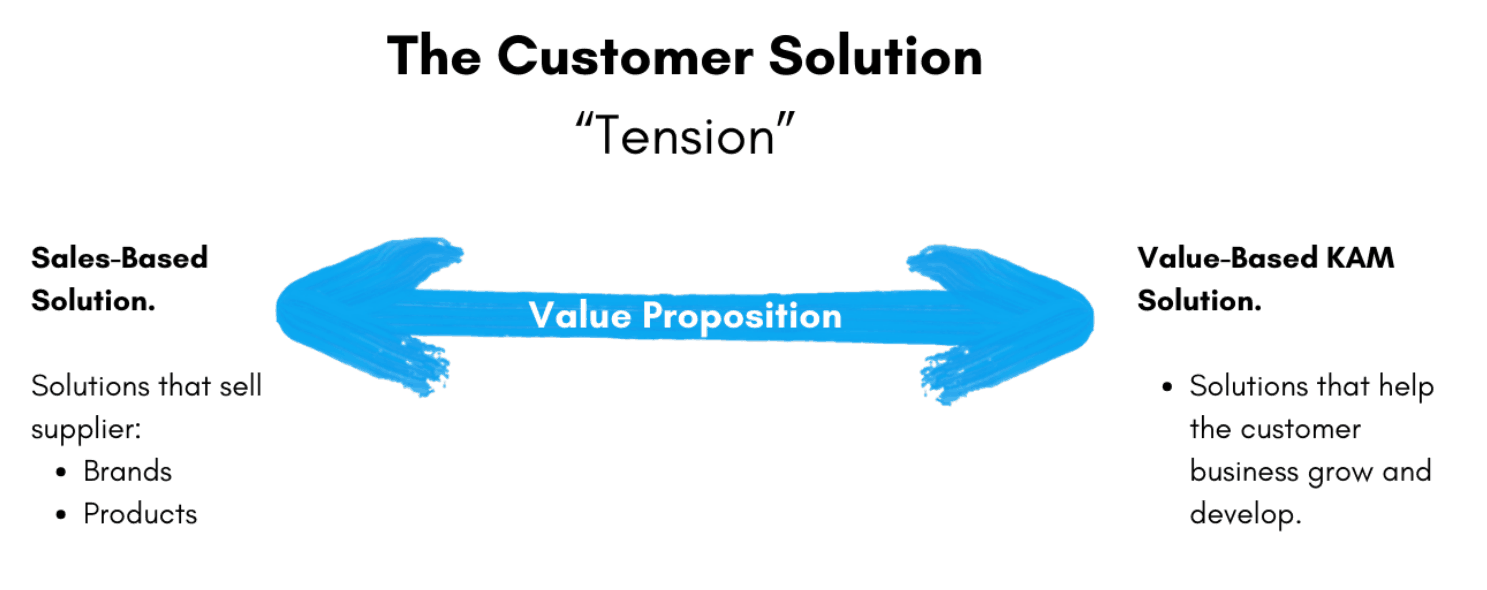 Your customer value proposition always sits between two pulls.
Your customer value proposition is always under tension. On one side sits the traditional sales-based solution: the supplier needs to sell its products and brands. Call it the “me-centric” solution. On the other side sits what the customer actually needs: real help to reach their own business goals. That is the “customer-centric” solution. The two pull in opposite directions, and the tension never goes away.
It would be naive to pretend that every proposition can line up perfectly with every customer need. Life is not like that. The problem is that suppliers forget the customer side of the rope and slide back to selling product, and the slide gets steeper at month end, at quarter end and, above all, at year end.
What happens when you sell a “me-centric” solution
When you take something to market as a customer solution and it is not one, four things tend to follow.
You end up dealing only with the buyer. If your offer is your basic product wrapped in a veil of “advanced service” that adds nothing much to the customer’s business, you are a me-too supplier. Buyers love that, because they can play you off against the others and get better prices and terms. Buyers matter, but they do not run the business. The senior people who create value in the customer organisation need a reason to talk to you, and a relabelled product does not give them one.
Customers start saying “so what?” Promise a solution and deliver benefits that are really for you, and the story wears thin. Sooner or later the decision-makers ask whether they could get the same goods elsewhere. If a competitor has a stronger, genuinely customer-centric offer, that is when you start losing business. We have written about this slide towards price in the commodity trap.
The real solution becomes harder to sell. If you have peddled the solution story without a solution behind it, the customer will take far more convincing when you finally do create something that adds real value. You have spent the credibility you now need.
Trust gets fractured. The trust equation from Maister, Green and Galford puts credibility, reliability and intimacy on top of the fraction and self-orientation underneath (Trusted Advisor Associates). Everything you do that adds value for the customer builds the top line. Everything that is really about your quarter builds the bottom one, and trust falls fast. Add value for the customer, and trust grows. It really is that simple, and that hard.
Five tips for creating and selling customer solutions
These five tips are the foundation for building strong solutions for key customers. In truth they are the foundation for any kind of value-based selling and offer development in B2B.
1. Understand the customer’s big picture
Really understanding a strategic customer is hard work, which is exactly why it so often gets short-changed.
Stand back and look at the whole business, not just the part that buys your products. What is happening in the economy and their industry? What are they good at, and where are they weak? What goals are they trying to hit, and what strategic initiatives are they running to get there? Get your chin off the table and look at the wider business.
If you want to provide a solution, shouldn’t you understand the customer’s problem first? When you understand the customer at a strategic level, you appreciate what they value, and that is how you frame the problem worth solving. It is usually not “buy more of our stuff”. What a shocker.
2. Be an archaeologist, not an architect
Ali Abdaal, the doctor turned entrepreneur and YouTuber, has a lovely way of describing a mistake entrepreneurs make. They have an idea and build a monument, then take it to market to sell. It is their pride and joy, their building, and they are the architect.
That works if you are talented and get it right. But what if your design is not what the market wants? You are left with a solution and no customer.
Ali’s alternative is to be an archaeologist. Archaeologists dig around in the dirt, often digging hundreds of holes before they find anything of interest. Then they dig deep and strike gold (or bones).
So have those conversations with your customer. Dig a hundred holes, or drink a hundred cups of tea, but find the problem that needs solving before you design anything. A structured customer needs analysis keeps the digging honest.
3. Map the decision-making unit
Every customer has people playing a set of roles whenever a buying decision is made: the buyer, the decider, the specifier, the user, the gatekeeper, the budget holder and the influencers. Together they make up the decision-making unit, or DMU. One person may hold several roles, and one role may be shared.
Each of those people has different needs and different motivations. Get to know them, find out what each of them values, and play to it. This is where value lives. A solution that delights the user and means nothing to the budget holder will not get bought.
4. Zipper up
Mapping the DMU is where you start. The next step is to line up the right people on your side with the right people on theirs, like for like. This is called zippering, sometimes known as top-to-top alignment.
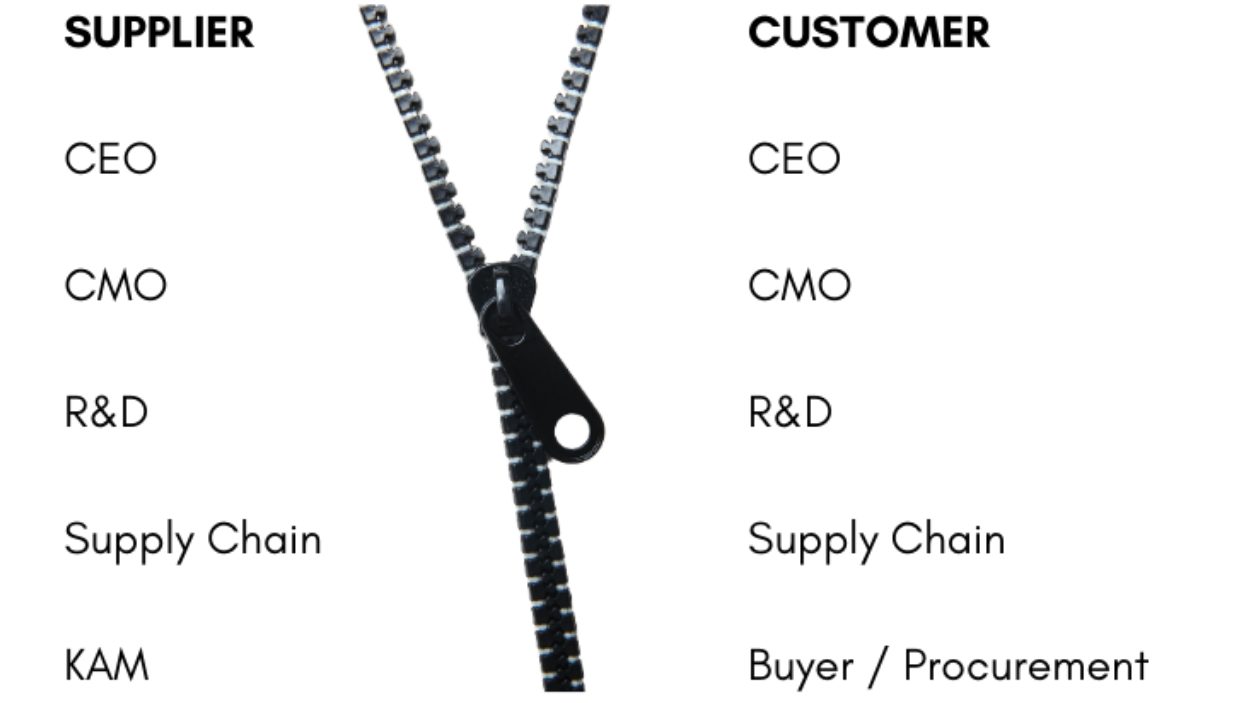 Zippering: matching roles on both sides of the relationship.
The idea is that conversations become more focused on what matters to each person’s professional role. If you want to understand how the customer builds its brand and goes to market, you need to talk to their chief marketing officer or head of sales. As a key account manager you may be very comfortable having that discussion yourself, but think how much stronger it would be with your own most senior marketing executive in the room.
There is a bonus. The customer sees your organisation stepping up the relationship, and sees your leaders with skin in the game. Companies do not buy from companies. People buy from people.
5. Think big picture, small picture
The idea that you will build a completely new offer for every key customer can feel overwhelming and impractical. That is because it is.
Here is the secret: you do not have to. When you create a solution for a customer, in my experience 80 to 90 per cent of it will be your usual core offer of products and services. The difference comes from how you tailor the rest of what you have. Look at commercial terms, service levels and rebates. Look at how you reach and serve the customer, through which channels and networks. Consider joint promotions that help the customer reach their own markets, access to your technical and commercial people, and processes that make you easier to work with than anyone else.
There are countless ways to build a solution that adds value to the customer’s business without wrecking your cost to serve. The Offer Wheel is our way of laying them all out so you can see which ones matter to this customer.
Are customer-centric solutions worth the effort?
Two examples from organisations I have worked with directly or coached.
A chemical management supplier working with an aerospace parts manufacturer won its biggest solutions programme in Europe. It did it by spending several months on site, with no order and no payment, tracking the customer’s processes and learning exactly what senior management wanted. The solution that came out of it was a cost improvement programme: less waste, lower spend on expensive cutting tools, better product quality and better health and safety. None of that was “buy more chemicals”.
A large engineering services group looked across its many divisions and asked what its key customers actually needed. Instead of each division selling on its own, they started bringing divisions together to pitch a broader offer. It worked so well they began generating more sales than they could handle, and the reason was that they had organised the solution around the customer’s needs rather than remaining a loose cluster of divisions that did not talk to each other.
Solutions pay when the customer sees value in the offer and is prepared to reward the supplier for it. You will know you have got there when you can honestly send the other letter. Dear John, it’s not me. It’s all about you.
If this is your problem too, score your account with the Value Edge Diagnostic, or talk to us.
The newsletter this came from
Every fortnight: one idea from the method, worked through properly. Read it where you already are, on LinkedIn, or by email below.
Keep reading
What is this customer actually worth to you?
Revenue tells you what a customer paid you. It says nothing about what they spent. The gap between the two is your share of wallet, and most account teams cannot state it within twenty points.
Problem Framing: Define the Problem Before the Solution
Most lost proposals were lost before they were written, because nobody defined the customer's problem. Problem framing fixes that, and here is how to do it.