The Power of Channels: Why and When to Use Channel Partners
How much of your revenue reaches customers through someone else? Why channel partners matter, when to use them, and how value leaks out between the links.

Here is a question worth sitting with for a moment. What percentage of your revenue reaches your target customers directly? And what percentage travels through someone else first: distributors, contractors, resellers, agents, channel partners of one kind or another?
For most of the senior leaders I work with in B2B, somewhere between 20 and 60 per cent goes through third parties. I have seen businesses where the figure is far higher. In some, every single transaction flows through a supply chain partner. Not one pound, dollar or euro reaches the end user without passing through another company’s hands.
Now for the uncomfortable part. In most of those cases, nobody in the chain is having a value conversation. Not a real one. They are discussing price, fees, contract terms and delivery dates. The careful, differentiated value proposition you built for the end user? By the time it has passed through two or three intermediaries, it has been quietly taken apart.
So before we get to how to manage channel partners well (that is the subject of the companion piece, building a competitive advantage with channel partners), it is worth asking two more basic questions. Why use channels at all? And when should you go through a partner rather than direct?
Why use channel partners at all
Channels exist because they solve real problems for a supplier. As a larger business trying to extend its reach, you need cost-effective distribution, a way to extend your brand into places you cannot cover yourself, and fast access to markets that would take years to build from scratch. A good partner gives you all three.
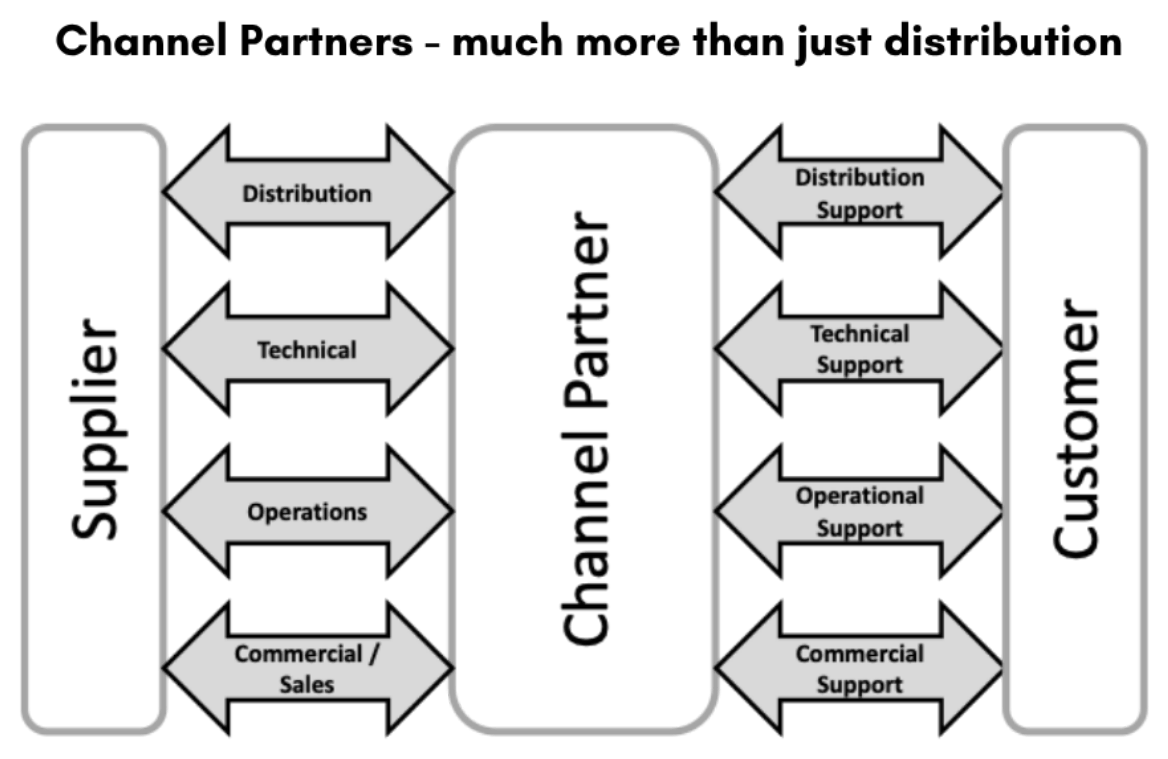 Channel partners do much more than distribute.
But look at what the partner actually does for the customer. It is rarely just logistics. A good partner provides technical advice, operational support, installation and service, and the commercial relationship itself. In many markets, the partner is the face the customer sees every week. You are the logo on the box.
And your partners have needs of their own. Many are entrepreneurial small and medium-sized businesses. They need strong brands and valuable products to make money, and they need commercial and technical support from you to do it well. You are thinking corporately, about coverage and brand consistency. They are thinking entrepreneurially, about margin and growth. I call this the channel tension, and it is healthy, provided both sides know it is there.
Which leads to a question every supplier should be able to answer and very few can: what are you to each other, exactly? Customers? Suppliers? Competitors? Partners? Often the honest answer is “a bit of all four”, and that is precisely why so many channel relationships underperform.
When to go through a partner, and when to go direct
The decision starts with some hard questions about your own reach. Which end customers must you access? Where are they? Do you have the commercial, technical, operational and logistical capability to serve them yourself, and at what cost? And what behaviour do you need from a channel partner that you are not getting today?
If the honest answers show you cannot reach a segment profitably on your own, a partner is the obvious route. If a customer is strategically important and the value at stake is high, you may need a direct relationship as well, even if the order still flows through the channel. Most suppliers end up with both, and the skill is in knowing which customers need which. That is a portfolio decision, not a logistics one, and it belongs in the same conversation as deciding which customers are key.
There is a useful way to think about it from the other side of the table. When I was a buyer, I was perfectly happy to let contractors handle around 80 per cent of what went into a new building. Walls, drains, the commodity items. I did not want a relationship with the drain supplier. But for the few items that were mission-critical, I wanted to know who made them and what they would do for me. The same is true of your customers. Where your product is critical to them, the channel alone is not enough.
The mechanics of value erosion
Think about what happens inside a supply chain. Each business has its own commercial priorities, its own margin pressure, its own relationship with the next link. A distributor on a thin margin, contracted to a larger integrator, who is squeezed by a design-and-build contractor, who is fighting to keep a fixed-price project on budget. None of them is thinking about the end user. They are thinking about the company immediately above or below them. And the one tool every one of them reaches for is price.
This is not because they are bad people or short-sighted businesses. It is because nobody has given them a reason, a language or a model to do anything different.
The result is what I call value fragmentation. The impact-based story you tell your most important direct accounts does not survive contact with the supply chain. It gets ground down into a product specification and a negotiated fee.
That matters more than most sales leaders realise. If your channels compete on price, your brand competes on price. If your channels position your offer as a commodity, it is treated as one, and you are in the commodity trap whether you chose it or not. All the work you are doing to move conversations upstream, to reach senior customer executives, to build long-term value-based relationships, is being undermined downstream by commercial dynamics you may not even be watching.
What a pharmaceutical facility taught me about channels
In 1995 I was Engineering Director of a contract pharmaceutical manufacturer. We had secured investment for a significant new facility, and we needed to specify and install a Building Energy Management System (BEMS), which is effectively the brain of the site. Given the scrutiny of the US Food and Drug Administration and its good manufacturing practice rules, choosing the right system was not just an operational decision. It was a commercial and regulatory one. Get it wrong and the whole project slips, and in pharmaceutical manufacturing the cost of delay is not measured in engineering fees. It is measured in millions.
To reach the BEMS maker, I had to work through three layers of supply chain.
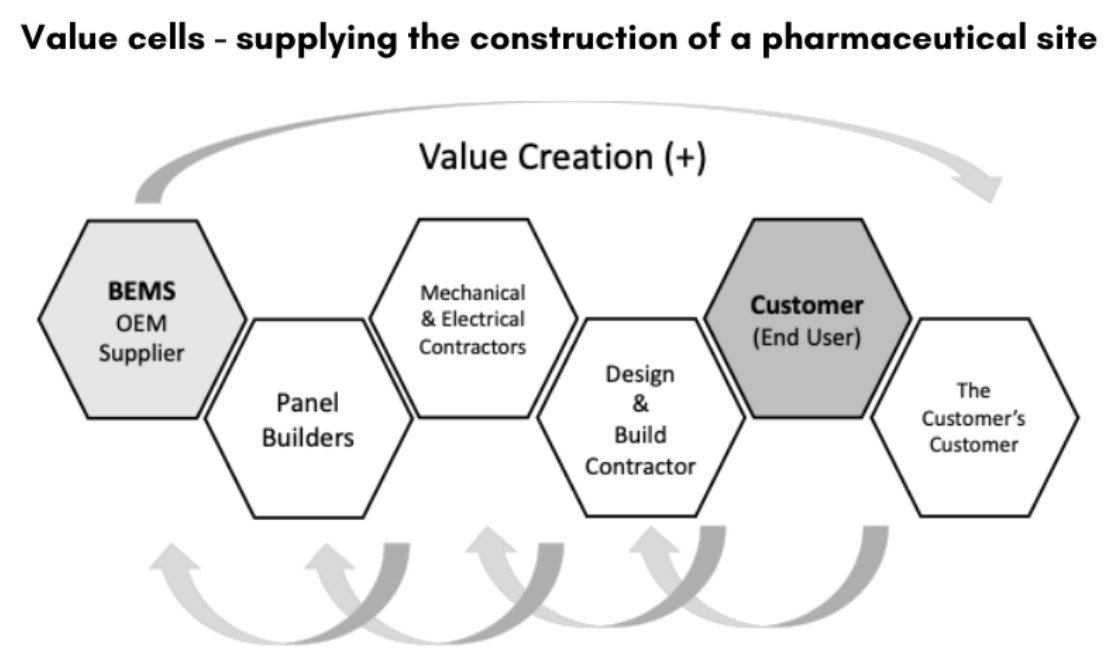 Value cells in the construction of a pharmaceutical site.
The BEMS supplier made world-class hardware and software. The panel builders built and installed the control systems. The mechanical and electrical contractor looked after the building utilities. The design-and-build contractor managed the whole project. Each relationship had its own contract, and every contract was focused on cost.
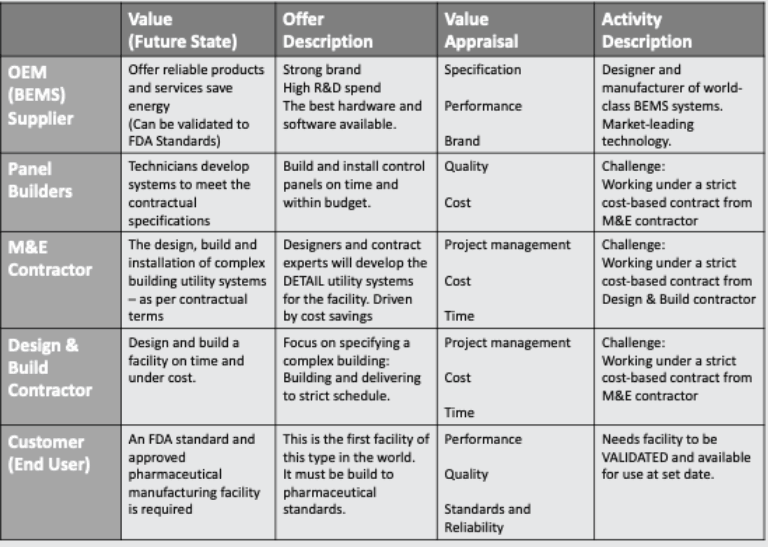 Each link valued something different, and only the end user was thinking about validation.
Nobody talked to me about long-term value. Not once. Nobody said, “If this system fails and delays your FDA approval by two months, what does that cost you?” Nobody said, “If it performs perfectly and your validation runs on time, what is that worth to you compared with the fee?” Nobody turned a £100,000 engineering contract into a conversation about risk and return on a £20 million facility.
I would have paid two or three times the contracted fee for a supplier who really understood what was at stake. That value was sitting right there. Nobody reached for it.
Fifteen years later, that same BEMS supplier commissioned me to assess its supply chain. I interviewed panel builders, contractors and channel partners across the network. They were professional, skilled businesses. But the conclusion was unavoidable: nobody in the chain was thinking beyond the company they were directly contracted to serve. The end user, and the full value-in-use calculation, had disappeared from view.
That story is not unusual. I have seen versions of it in pharmaceuticals, engineering, technology, professional services and facilities management. I suspect you will recognise something of it in your own market.
Value is benefits minus total cost, at every link
The value equation underneath all of this is simple. Value is the impact you create for a customer minus the total cost of ownership. And the five sources of value, top-line growth, bottom-line efficiency, business reputation and continuity, strategic and advisory support, and meeting consumer needs, do not only apply to your direct customers. They apply at every stage of the chain.
Every link in the chain has a customer. Every customer has things they value. The question is whether anyone in the chain is asking what those things are.
When nobody asks, value becomes finite and the conversation shrinks to price. When someone really asks, with curiosity and commercial intelligence, value becomes infinite. The conversation opens up. Relationships deepen. Margins hold. In my experience the difference is not the industry, and it is not product complexity. It is intention and capability.
From distribution mechanism to value-cells
That is the shift I want you to take away. Stop seeing your supply chain as a distribution mechanism and start seeing it as a network of value-cells. A value-cell is a partner that understands your end-user value proposition, can articulate it in its own words, and reinforces it every time it talks to a customer. It is a commercial, technical and sometimes operational partner that speaks your value language and knows how to use it.
I first developed this thinking in a chapter for Malcolm McDonald on Value Propositions (McDonald and Oliver, 2018), and it builds on the value-based model in Infinite Value (Davies, 2016). Building a network of value-cells does not happen by accident, and it does not happen just because you appointed the right distributors. It takes deliberate investment and a structured approach, which I set out step by step in the companion piece.
For now, go back to the number you thought of at the start. Whatever share of your revenue passes through other hands, picture the end user at the far end of that chain, sitting where I sat in 1995, ready to pay more and waiting for someone to ask.
References
Davies, M. (2016) Infinite Value: Accelerating Profitable Growth Through Value-Based Selling. London: Bloomsbury.
McDonald, M. and Oliver, G. (2018) Malcolm McDonald on Value Propositions: How to Develop Them, How to Quantify Them. London: Kogan Page.
If this is your problem too, see the Strategic Customer Planning Tool on the ladder, or talk to us.
The newsletter this came from
Every fortnight: one idea from the method, worked through properly. Read it where you already are, on LinkedIn, or by email below.
Keep reading
The Plan in the Filing Cabinet
Somewhere in your organisation there is a key account plan that nobody has opened since the day it was approved. It does not die from lack of discipline. It dies because no team ever had the hours to keep it alive. Now, finally, something has the time.
Customer Segmentation: The Kingpin of Customer Management
Most companies segment customers on last year's sales, and pay for it. Here is a five-stage method for customer segmentation that looks at future value instead.