How Customer Value Propositions Power B2B Growth
Customers do not buy products or services. They buy better futures. How a customer value proposition gets the boardroom leaning in, and how to write one.

Picture the boardroom of your most important customer. Procurement is focused on price. Your champion from operations is nodding along. The chief executive looks distracted. Then you say one sentence: “What we are really offering is to improve the future state of your business.” And everyone leans forward.
That moment is what a good customer value proposition does. Of the five themes of customer management I have been writing about, this is the one I have left until last, and I think it matters most, for a simple reason. The value proposition describes what the customer actually buys. Get it right and you are off to the races.
So when you pitch, which do you want: a customer who leans in, or one who zones out? Customers do not buy products or services. They buy better futures.
Why most B2B suppliers stay stuck on price
Warren Buffett, quoting his teacher Ben Graham, put it best in his 2008 letter to shareholders: “Price is what you pay; value is what you get.” Everyone in business knows the line. Very few B2B suppliers escape the pull of price competition anyway. They sit through endless procurement rounds against rivals who will cut margin to the bone, and they wonder why careful proposals lose to cheaper ones.
The answer is that a value-based business is not a sales method or a set of frameworks. It comes down to one thing: showing how you will improve the future state of your customer’s business in ways that matter to them.
I worked with a manufacturer of pharmaceutical equipment whose customers made tablets and capsules. They thought they were selling machines. Their customers were buying confidence: that the production line would run, that quality would hold, and that the regulator would never have cause to ask awkward questions. When the supplier moved its proposition from “precision engineering” to “guaranteed production continuity”, sales cycles shortened, margins improved and the relationships deepened.
That is not clever marketing. It is understanding what the customer needs, and therefore values, and positioning your offer as the bridge between where they are now and where they want to be.
Cost, price and value: three words that get muddled
Three words dominate every B2B negotiation, and they are used interchangeably all the time: cost, price and value. The muddle is not just a matter of vocabulary. It is why so many promising supplier relationships decay into arguments about price.
An industrial automation company spent months on a proposal for a large car maker. Their solution promised real gains in production efficiency, downtime and quality. The procurement manager’s first question was: “What is your margin on this equipment?” From that moment they were defending their costs and explaining their pricing, against suppliers with similar-looking equipment at lower prices. They lost, with the better solution.
What went wrong? They let the three words blur. Cost is what it takes you to make and deliver the offer. Price is the figure you put in front of the customer. Value is the total impact the customer gets from adopting it. Keep them apart in every conversation, and you keep the discussion on value. I explain the relationship in more detail under price, cost and value.
There is a fourth word to hold alongside them: risk. A customer takes a risk every time it switches to something unfamiliar, and you take one every time you launch a new offer or take on a new customer. Price with both in mind; that is the heart of value-based pricing.
The account managers who win these conversations have learned to move them from fee-wrestling to value-building. Every procurement conversation is a value conversation in disguise. When a customer fixates on price, it is usually because nobody has helped them see the full value on offer.
What a customer value proposition actually is
Ask ten managers to define a value proposition and you will get ten answers. That ambiguity is commercially dangerous.
A genuine customer value proposition is not a capability statement. It is a clear, specific description of an improved future that a supplier offers to a particular customer: exactly how that customer’s business will be different, and better, as a result of working with you.
Value propositions work at three levels. At corporate level, the value you offer shows up in the brand. At divisional level it becomes specific to market segments. The real power arrives at the level of the individual customer, where the proposition is about one customer’s outcomes. That progression matters because senior executives do not buy cybersecurity software, consulting or industrial equipment. They buy business outcomes.
Today a peacock, tomorrow a feather duster
There is an old saying on Wall Street: “Today a peacock, tomorrow a feather duster.” However good your current offer, the ground can move under it fast.
Some years ago I worked with a company that provided maintenance and operational support to chemical processing plants. Business was good. Then the recession arrived, and their customers no longer wanted more efficiency. They wanted less capacity. The company chose to reinvent itself. Instead of optimising five sites for each client, it helped clients consolidate onto three sites running at higher utilisation. The proposition moved from “operational optimisation” to “flexible capacity management”.
The suppliers that last treat innovation in their value propositions as a core capability, not an occasional project. They keep looking for new ways to create value, test them with customers they trust, and refine them as they learn.
The value equation: making value tangible
Every B2B purchase comes down to a simple sum. Value is the impact you create minus the total cost of owning your offer. Like most simple ideas, its power lies in applying it rigorously.
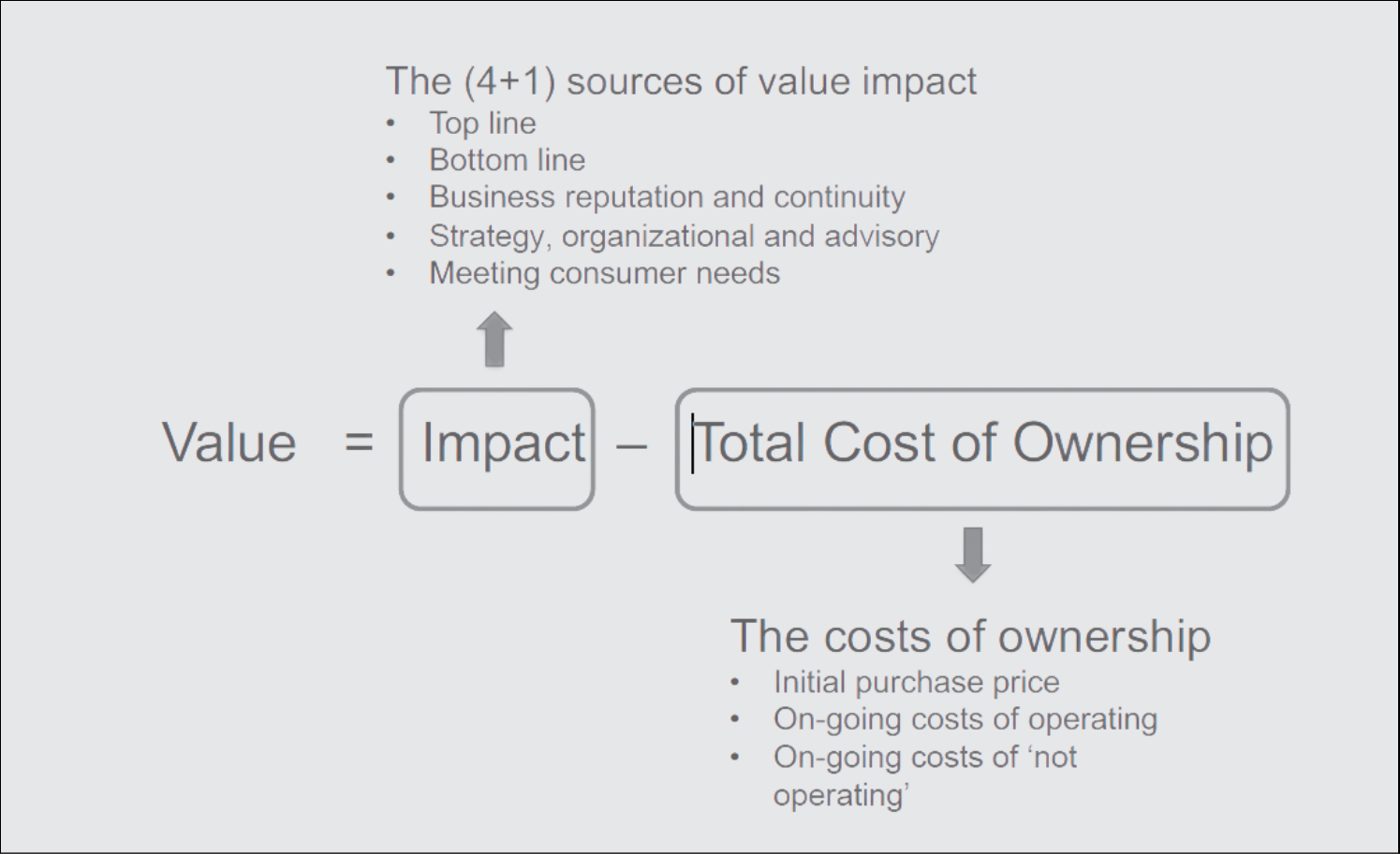 The value equation: impact minus total cost of ownership.
An aerospace component maker was bidding to supply hydraulic systems for a new aircraft. Its price was around a third higher than the nearest competitor’s, and on cost-plus thinking it should have lost. It won, by helping the customer work through the whole equation. The systems needed servicing less often, which cut maintenance cost and time on the ground. They came with diagnostics that made predictive maintenance possible. Above all, they were lighter, and weight on an aircraft is fuel burned every day for decades. Set against that, the higher purchase price stopped mattering. That was not creative accounting. It was an honest analysis of the value created.
The five sources of value
Impact comes from the five sources of value. Four sit inside the customer’s business: growing revenue (the top line), reducing cost (the bottom line), protecting reputation and continuity, and strategic or advisory help. The strongest propositions usually combine several.
A packaging equipment supplier used to compete on technical specifications. When it looked at its impact across the four, it found its equipment let customers launch new product variants faster (top line), cut packaging waste (bottom line), gave better protection against contamination (continuity), and produced data that helped shape packaging strategy (advisory). Its conversations moved from specifications with operations managers to business impact with the executive team.
The fifth source sits outside the customer altogether. Your customer grows by selling to its own customers, and at the end of every chain is a consumer: you and me, buying in shops and online. Understand what that end consumer values and help your customer deliver it, and you are creating value at the point where their growth actually comes from. The companies with world-beating brands understand this instinctively. If you want to see how much it is worth, Interbrand’s annual Best Global Brands ranking is a good place to start.
Total cost of ownership
When a customer judges suppliers on purchase price alone, they have misunderstood the economics of their own decision. Helping them see the total cost of ownership is not a sales trick. It is a service.
I once worked with a chemical company choosing pumps for a new production line. Procurement favoured a supplier whose pumps were much cheaper to buy. Over the equipment’s working life the picture reversed. The cheaper pumps needed more maintenance, used more energy and wore out sooner, and they needed specialist technicians, where the dearer ones could be looked after by the plant’s own staff. Over the life of the line, the “expensive” option was the cheaper one by a wide margin.
For services, the equivalent is the total cost of partnership: the customer’s own time spent briefing you, coordinating with you and keeping you aligned with what they are trying to achieve.
How to write a compelling customer value proposition
A global engineering consultancy kept losing bids despite excellent technical capability. Its proposition read: “We deliver world-class engineering expertise and innovative solutions for complex infrastructure challenges.” Accurate. Utterly generic. Working together, we rewrote it as: “We enable your infrastructure investments to deliver measurable community benefits six months ahead of schedule while maintaining costs within approved budgets.”
The second version talks about the customer’s outcomes, not the supplier’s abilities, and it speaks directly to the two things infrastructure clients lose sleep over: delays and overruns. Getting there took real work on what the customer valued, why the project mattered to them and how they would measure success.
A strong proposition is built from five blocks.
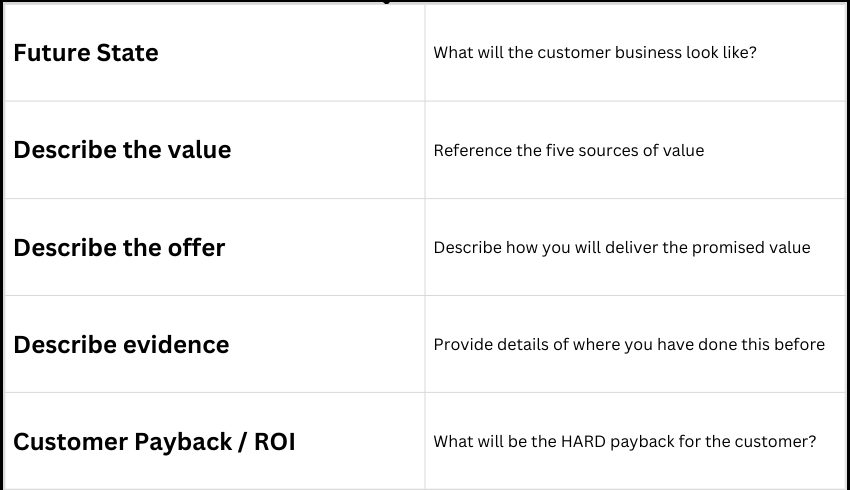 The five building blocks of a customer value proposition.
Lead with the future state: which part of the customer’s business will change, and what will it look like? Then bring it to life with the value, drawing on the five sources; your offer might grow the customer’s sales by giving them consumer insight, for example. Next, describe the offer itself: the products, services, people, processes, channels and commercial terms that will deliver what you have promised. Then give the evidence: where have you done this before, and why should this customer trust you? Finally, do the payback sums. You expect to charge more than your competitors, so make it easy for the customer to buy by doing the maths for them.
If you want a structure to write into, our One Page Proposition template follows the same logic.
Your customers are not buying what you are selling
They are buying what your offer makes possible for them. That sounds like a play on words until you watch it change a meeting. The procurement manager still asks about margin. The operations champion still nods. But the chief executive stops looking out of the window, because for the first time someone is talking about the business she is trying to build.
If this is your problem too, score your account with the Value Edge Diagnostic, or talk to us.
The newsletter this came from
Every fortnight: one idea from the method, worked through properly. Read it where you already are, on LinkedIn, or by email below.
Keep reading
What is this customer actually worth to you?
Revenue tells you what a customer paid you. It says nothing about what they spent. The gap between the two is your share of wallet, and most account teams cannot state it within twenty points.
Problem Framing: Define the Problem Before the Solution
Most lost proposals were lost before they were written, because nobody defined the customer's problem. Problem framing fixes that, and here is how to do it.