Consultative Selling: The 10 Dirty Little Secrets of B2B
None of the ten secrets of B2B consultative selling is complicated. The dirty part is how few companies act on them, and what that costs in margin and loyalty.

Here is the dirty little secret about the secrets of B2B consultative selling: none of them is a secret. Every sales director I have worked with could recite most of them. Very few companies act on them consistently, and that gap, between knowing and doing, is where the money goes.
Working with B2B businesses of every size, I have seen the same ten truths separate the companies that grow with their best customers from the ones that slide into discounting. They are basic principles, widely misunderstood and poorly applied. The best companies grab them by the throat and prosper. The rest watch their offers turn into commodities.
At the end of each one I have left a question. Answer it honestly for your own business before you read on.
1. Value creation is everything
The best companies know their job is to create, sell and deliver genuine value. That sounds obvious, and yet most businesses still confuse features with benefits, and benefits with value. A feature is what the product has. A benefit is what it does. Value is what it is worth to this customer, in their business, measured in their terms.
Real value starts with a deep understanding of who your customer is and what they actually need to succeed. Not what they say they want in the tender, but what they need. That takes curiosity, and it takes a willingness to dig beyond the conversation you have every quarter with the same buyer.
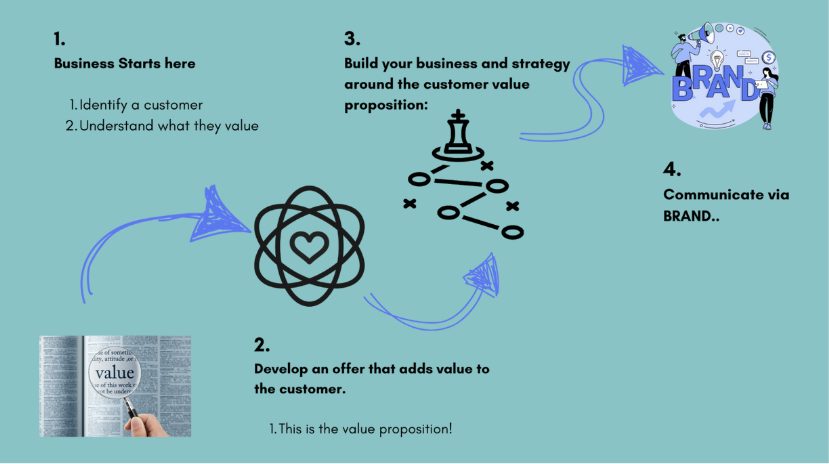 Every business starts in the same place: a customer, and what they value.
The principle behind any business is simple. Know your customer and what they value. Develop an offer that meets those needs (that is your customer value proposition), then build the company to deliver it. Only then does the brand have something true to say. Pricing, marketing and sales conversations all follow from that first step. Skip it and everything after is guesswork.
Your question: do your customer conversations start with your agenda (what you want to sell) or theirs (the problems they need solved)?
2. Go beyond customer-centricity and be value-centric
Most companies understand customer-centricity, at least in theory. The best are value-centric, which is a different thing.
Your business sits between your suppliers and your customers. Customer-centricity looks one way. Value-centricity looks both ways. When you work backwards from what a customer needs and then ask which of your suppliers’ capabilities could help meet it, you create something a competitor cannot copy by cutting its price. You stop pushing whatever is in the catalogue and start assembling resources from right along your value chain to solve a specific customer’s problem.
Companies that miss this squeeze their suppliers, and every penny taken out of a supplier’s margin is often a penny of innovation that never reaches the customer.
Your question: are you drawing on your suppliers’ capabilities to build something unique for your customers, or squeezing them for their lowest price?
3. Build KAM capability that fits your business
The most successful companies do not copy a key account management programme from someone else. They build one around their own business model, their own market position and their own customers.
Generic KAM produces generic results. Your strategic customers have specific expectations of working with you, and your approach should reflect that. The principles are universal: select the right customers, understand them deeply, plan with them, organise around them. How you apply those principles should look and feel like your company, your culture and your values.
A programme that feels borrowed is treated as another corporate initiative, and corporate initiatives fade. I have written separately about why companies keep rebuilding their KAM programmes, and a borrowed template is one of the commonest reasons. If you want the research grounding for doing it properly, Diana Woodburn and Malcolm McDonald’s Key Account Management: The Definitive Guide, drawn from their work at Cranfield, is where I would start.
Your question: does your KAM programme feel as though it was built for your company, or could it belong to anyone?
4. Success requires inter-organisational “zippering”
The lone hero salesperson belongs to another era. Complex B2B deals now involve many decision-makers with different priorities and different fears. Gartner’s research on how B2B customers buy describes buying groups that are growing in number and spread across functions, each doing its own research with its own goals.
The best suppliers respond by “zippering”: deliberately connecting experts in their own business with their counterparts in the customer’s. Your product manager talks to their operations team. Your technical specialist talks to their engineers. Your executives build relationships with their leadership. Each tooth of the zip adds strength, and each one brings back intelligence that a single account manager could never gather alone.
It also makes you very hard to displace. When many people across the customer’s decision-making unit work well with your team, the relationship no longer hangs on one contract or one person.
Your question: how many meaningful connections exist between your business and each of your strategic customers? Count them.
5. Problem framing comes before solution selling
You cannot build an effective solution if you do not know what problem you are solving. Everyone agrees with that, and yet sales teams jump straight to the pitch every day.
There are really only two ways to sell. You can talk at the customer about your products and services, which is your agenda. Or you can listen, research and frame the problem before you propose anything, which is theirs. The second is the heart of consultative selling, the approach Mack Hanan set out in Consultative Selling more than fifty years ago: you are selling improved customer outcomes, not products.
The critical step is not only understanding the problem but framing it in a way the customer recognises as theirs. When they say “yes, that is exactly what we are struggling with”, they are already getting ready to hear your answer. A well-framed problem does half the selling for you. I go into how to do it in problem framing.
Your question: do you spend more time explaining your solutions, or exploring and framing your customer’s problems?
6. Manage the big picture and the small one
Strong B2B suppliers move easily between strategy and execution. At one level they understand industry trends, the customer’s business model and how their offer creates advantage. At the other they are masters of detail: implementation plans, account-specific measures, who does what by when.
Customers trust suppliers who can do both. Plenty paint a compelling vision and cannot deliver it; others are superb on the specification and have no idea why it matters to the customer’s board. Your key account managers need to be comfortable discussing five-year objectives in the morning and technical detail in the afternoon, and to connect the two for the customer so they can see how this week’s work supports next year’s goals.
Your question: can your team connect day-to-day actions to the customer’s long-term objectives, fluently and without notes?
7. Plan, up to a point
Account planning is essential. The best companies also understand its limits.
They build plans that set out objectives, stakeholders and opportunities, and then treat those plans as living documents rather than tablets of stone. They review them, feed new information in, and change course when the customer’s world changes. That avoids two opposite dangers: having no plan, which makes you reactive, and being enslaved to an out-of-date one, which makes you rigid. Most account plans I see suffer from the second, filed after the annual review and never opened again, which is the story of the plan in the filing cabinet.
Customers do not expect you to predict the future. They expect you to respond intelligently when it arrives.
Your question: do your account plans give clear direction and still leave room to adapt when new information emerges?
8. Strategic and critical thinking are core skills
The best B2B companies treat strategic and critical thinking as core skills for everyone in front of customers, not as traits reserved for senior leaders.
Key account managers have to reconcile tensions across boundaries (between their company and the customer, between functions) and across time (this quarter’s numbers against the three-year relationship). Strategic thinking lets them spot patterns in a market, anticipate what a customer will need next and see how their offer creates an advantage. Critical thinking lets them question assumptions, weigh evidence fairly and find the root cause rather than the symptom. Together they are what move someone from order-taker to trusted adviser.
The companies that have these skills develop them deliberately, through coaching and real work on real accounts, and reward people for using them.
Your question: how deliberately do you develop strategic and critical thinking in your customer-facing teams?
9. Selling is a valued and respected skill
The best B2B companies treat selling as a profession, not a necessary evil or a support function to the “real” business.
Selling well takes expertise, emotional intelligence and persistence. Too many businesses quietly rank it below product development, operations or finance, and that bias builds walls between departments that should be working together. The strongest companies see that an innovative product with nobody able to sell it is an expensive hobby.
The key account manager’s role has grown to include leadership and strategy, and rightly so. The ability to “make rain” and win business is still a highly valuable skill, and it should never be underestimated.
Your question: is selling genuinely valued in your company’s culture, or is it quietly treated as less important than other functions?
10. They develop eight strategic selling skills
The top-performing B2B companies systematically build eight skills in the people who manage their most important customers.
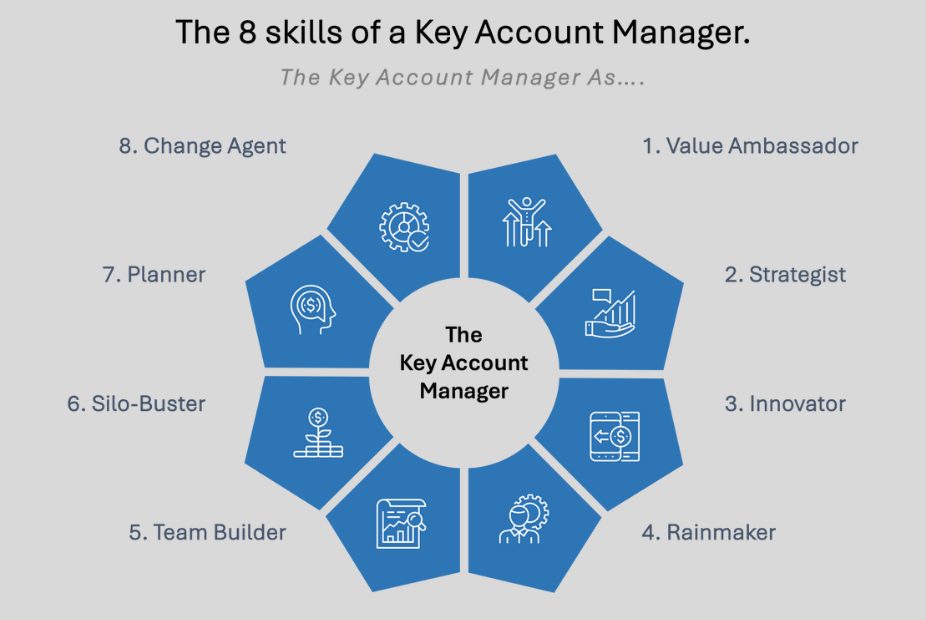 The eight skills of a key account manager.
The value ambassador understands value and how to build offers around it, and becomes the person others look to for that way of thinking. The strategist sees both the big picture and the detail, and aligns what the customer needs with what the company can do. The innovator creates and tests new ideas and builds the business case that proves their worth. The rainmaker sells in both directions, persuading colleagues inside the business as well as pitching to customers, formally and informally.
The team builder pulls together the cross-functional team an account needs and gets it working as one. The silo-buster builds relationships across the organisation, handles its politics and presents with confidence to senior leaders, including the board when it matters. The planner has the discipline to turn plans into action, manage complex initiatives and deliver the value that was promised. And the change agent leads, coaches and mentors others, creating conditions where people can do good work despite complexity, pressure and paradox.
None of these develops by accident. The companies that have them build deliberate development paths, coach and train against them, and measure progress. I look at each in more depth in the eight competences of key account managers, and if you want to see where you stand today, the Tri-Skills self-assessment takes about ten minutes. It is also the backbone of our KAM development programme.
Your question: how systematically are you developing these eight skills in your customer-facing teams?
The thread that runs through all ten
Read them back and you will see one idea wearing ten different coats. Understand the customer deeply, then build everything, from your offer to your plans to your people, around the value you can create for them. The companies that do this stop being suppliers and start being the partner the customer rings first.
Which of the ten are you already living? And which one, if you are honest, did you recognise with a small wince?
If this is your problem too, bring this into your organisation as a talk or workshop, or talk to us.
The newsletter this came from
Every fortnight: one idea from the method, worked through properly. Read it where you already are, on LinkedIn, or by email below.
Keep reading
The Johnny Cash Principle
A rockabilly band, a Cotswolds festival, and the moment everybody finally looked up: why every pitch should open with what your audience already knows, and the ABC model that makes it happen.
Five Steps to Sell Anything: B2B Lessons From an Old Vase
For forty years I kept my keys in a rare piece of flambé pottery. What it taught me about hidden value, and five steps to stop B2B value evaporating.