The 8 Competences of Great Key Account Managers
Your best salesperson may be your worst key account manager. The eight competences that separate KAMs who grow strategic accounts from those who struggle.

A while ago I worked with a manufacturing company that had just promoted its star salesperson to key account manager. Let’s call her Joan. Joan was brilliant. She hit 130% of quota year after year, customers loved her, and she had a gift for closing deals that made the rest of the team look like amateurs.
Six months into the new role, Joan was miserable. Her key accounts were stagnating. Internal stakeholders were frustrated. And for the first time in her career, Joan was failing.
What happened? The company made the classic mistake. It assumed that being great at frontline sales meant she would be great at key account management. Joan is not an isolated case. I have watched this story play out many times.
They promoted a sprinter and asked her to run a marathon. Or more accurately, they promoted a sprinter and asked her to coach the team, design the training programme and manage the logistics of a multi-year expedition. Same sport. A very different game.
What we actually ask key account managers to do
Let’s be brutally honest about it.
We want them to think like strategists, seeing patterns across complex systems and understanding how the customer’s business really works. We want them to sell like rainmakers, converting opportunities into profitable revenue while dealing with ever more sophisticated buying committees. We want them to innovate like entrepreneurs, finding answers to problems that have no playbook. We want them to manage like general managers, coordinating resources and delivering results through departments they do not control.
Then, and this is where it gets interesting, we want them to build relationships across organisational boundaries, influence people who do not report to them, and deliver value to stakeholders they have never met. Oh, and we would like all of that to show up as profitable growth, customer retention and competitive advantage, following a Value-Based KAM Framework with a lot of moving parts.
No pressure, eh?
Then we act surprised when traditional salespeople struggle. We wonder why they cannot “step up”, bring in consultants and build more elaborate planning templates, and still miss the point: key account managers are not salespeople with bigger territories. They are hybrid professionals who work at a different level altogether, and the sooner we accept that, the sooner we can build key account management programmes that work.
The eight core competences of a key account manager
Over two decades of working with key account managers across dozens of industries, I have found eight competences that separate the ones who succeed from the ones who struggle. I first set them out in Infinite Value, and they fall into two groups of four: a strategic quartet and an operational quartet.
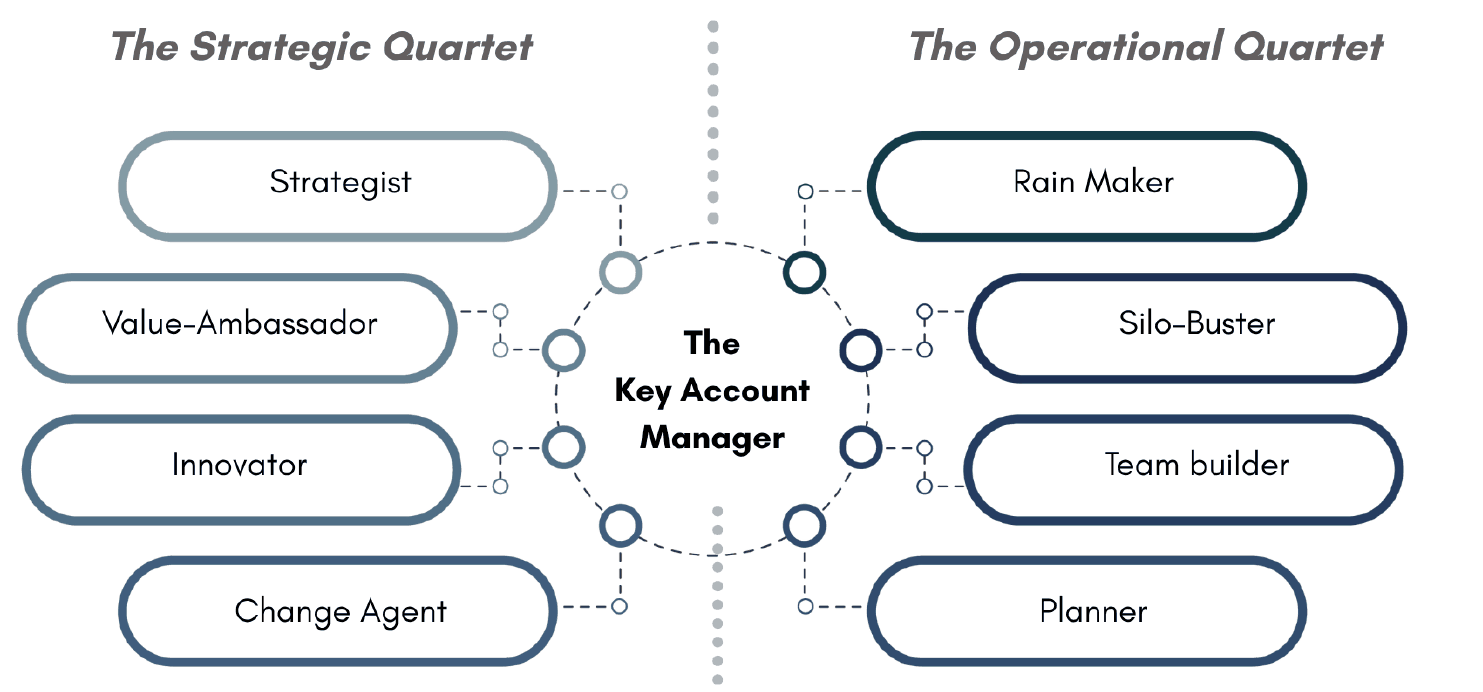 The strategic and operational quartets (source: Davies, Infinite Value).
The strategic quartet
1. Strategist
This is not about knowing your product line. It is about thinking at the level of the system: how the customer’s business works, where their industry is heading, and how the pieces fit together. When a strategist looks at a customer, they do not see a sales opportunity. They see a complex system with its own challenges, constraints and possibilities.
2. Value Ambassador
This one is subtle but crucial. A value ambassador represents and creates value for several stakeholders at once, not just their own company’s proposition but real business value for people with different priorities. They translate between worlds. They can explain to the customer’s finance director why something matters financially, to the operations team why it matters practically, and to the chief executive why it matters strategically. Same solution, three different conversations, and every one of them rooted in a clear customer value proposition.
3. Innovator
Key accounts do not respond to standard offers. If you are treating them like every other customer, you are doing it wrong. Innovators develop new approaches for problems that are unique to one customer. They are comfortable with ambiguity and can say, “We’ve never done this before, but here’s how we could make it work.” The catalogue does not bind them.
4. Change Agent
Here is something most KAM training misses entirely: half the job is managing change inside your own organisation, and inside the customer as they adopt what you have sold them. You are forever asking colleagues to do things differently, bend a process or put resources somewhere new. Managing change is not a nice-to-have. It is a survival skill. Change agents know how to build coalitions, handle resistance and make things happen without formal authority.
The operational quartet
5. Rainmaker
Yes, you still need to sell. But rainmakers do not just close deals. They turn complex opportunities into profitable revenue over long periods, running sales processes across buying committees they may not fully see. They keep momentum through long cycles and know when to push and when to wait. This is not transactional selling. It is strategic revenue generation, and it starts with knowing the decision-making unit better than your competitors do.
6. Silo-Buster
Show me a KAM programme that works and I will show you key account managers who can operate across departmental boundaries. Silo-busters get things done in matrix organisations. They build bridges between departments that rarely talk, and they translate between languages, because engineering speaks differently from finance, which speaks differently from operations. They make cross-functional working look easy, even though it is anything but.
7. Team Builder
Here is the rub. Key account managers lead teams they do not manage. You are coordinating people from other departments who report to other managers, have other priorities, and may not even agree that this account deserves special treatment. Team builders lead without authority. They create clarity, build trust and keep people aligned when those people have every reason to focus on something else.
8. Planner
With everything else going on, someone still has to manage the complexity. Planners do not just make plans; anyone can fill in a template. They keep strategic coherence across dozens of initiatives, hundreds of interactions and constantly shifting priorities. They know what matters now and what matters next quarter. They can zoom in and zoom out, and they keep the plates spinning without looking frantic. The output is a living account plan, not a document in a drawer.
Why this list should make you uncomfortable
Look at those eight again. Notice anything?
These are not the skills we associate with sales. They belong to general management. That is exactly the point. A key account manager is running a business within a business, responsible for strategy, operations, innovation and results across a portfolio that can be worth millions. They need to think like owners, not employees.
That is an opportunity and a challenge. The opportunity is that good key account managers build valuable, transferable skills. I have watched many move into roles such as sales director, chief operating officer and even chief executive. KAM is a leadership development programme disguised as a sales role. The challenge is that you cannot promote your best transactional salesperson and expect success. The skills, the mindset and the measures are all different.
The foundation underneath
Beneath the eight competences sits a layer of ordinary business skills that somehow gets overlooked: financial analysis, negotiation, presentation, project management and business acumen. Add communication, resilience and an unwavering desire to understand problems. These are not extras. They are the entry ticket.
The encouraging part is that many salespeople already have these skills. They have simply never been asked to use them at this level. I have met salespeople who can read a balance sheet but have never had to, and who could present to a board but have only ever pitched to procurement. The capability is there. It is just dormant.
Build from sales, not around it
Many companies go the other way and hire general managers, planning to teach them to sell. It rarely works. General managers, however smart, often lack the relationship instincts and commercial drive the role needs. You can teach strategic thinking. It is much harder to teach real customer focus and the ability to build deep, trusted relationships.
Salespeople can make exceptional key account managers, but they need help, guidance, training and support to make the transition. Start with your best relationship builders and business developers, then deliberately develop their strategic thinking, innovation and change management. It is easier to teach a great salesperson to think strategically than to teach a strategist to build customer relationships.
Be clear, though. This is not a six-month course. It takes years, because you are changing how someone thinks about the role. Key account management is a profession in its own right, with its own professional body in AKAM, and it deserves development to match.
What this means for you
If you are a key account manager, you may be feeling validated, overwhelmed, or both. Look at the list. Who has all of those?
The good news is that you do not need to be world class at all eight. You need to be competent in all of them and excellent in a few. Treat the list as a development map. Where are you strongest? Where are the gaps? Which competences matter most for the accounts you have right now? Then build deliberately, one competence at a time. The eight have since grown into the twelve sub-skills of the KAM Skills Tri-Stack, and the KAM Tri-Skills self-assessment will show you your own profile against it.
If you are a sales director, this list should change three things. Recruitment: stop hiring key account managers the way you hire salespeople. Look at project managers, business analysts and product managers who have customer instincts and commercial drive. Development: build these competences over years, closer to an MBA than a sales course, which is what our KAM development programme is designed to do. Measurement: if you only measure revenue and margin, you miss most of the value. Strategic impact, innovation and cross-functional collaboration matter as much as the P&L.
Business leaders, not salespeople
Here is the shift that makes everything else possible. You are not developing salespeople. You are developing business leaders who happen to focus on key customers.
Let that sink in. It changes the career path, the pay, the support and, above all, the respect. Key account managers are not “just salespeople”. They do one of the most complex jobs in business.
What happened to Joan
After six months of struggle, Joan’s company finally recognised that the problem was not Joan. The problem was that it had never equipped her for the role it was asking her to do.
It brought in coaching aimed at her two biggest gaps, strategic thinking and change management. It changed her measures to reflect strategic impact, not just quarterly revenue. And it gave her air cover to experiment and, occasionally, to fail.
Eighteen months later, Joan is not just succeeding. She is developing ideas her competitors cannot match, her strategic accounts are growing at around 30% a year, and she is mentoring three other key account managers along the same path.
Same person. Different context. Completely different outcome. And somewhere in your business, right now, there is probably another Joan, six months into the role, wondering what she is doing wrong.
If this is your problem too, see how we build the capability properly, or talk to us.
The newsletter this came from
Every fortnight: one idea from the method, worked through properly. Read it where you already are, on LinkedIn, or by email below.
Keep reading
Why you keep rebuilding your KAM programme
Four out of five sales organisations rebuild their key account programme every few years. The rebuild is treated as a failure of effort. It is almost always a failure of capability.
Five Steps to a High-Impact KAM Training Programme
Most key account management training fails because it treats KAM as a sales technique. Five steps to a KAM training programme that changes how people work.