The Missing Function Costing B2B Companies Millions
Most B2B firms have no one who owns how key customers are managed. Why you need a customer management centre of excellence, and ten steps to build one.

Ask a B2B leadership team who owns the way the company manages its key customers, and watch them look at each other.
Sales will say it is sales. Marketing will point at the brand. The business unit heads will say each of their accounts is different. Finance owns the numbers, procurement owns the suppliers, HR owns the training budget. Nobody owns the standard. And so every key account manager invents their own way of doing the most important job in the business.
The research says this is common. In one survey of strategic account management, 89 per cent of companies expected their use of strategic account plans to increase, yet 48 per cent said their process lacked effectiveness (Mercuri International and RAIN Group, reported by Global Partners Training). B2B International found that only 14 per cent of large B2B companies are truly customer-centric, with the customer experience deeply ingrained in the culture. Everyone wants more of it. Very few are organised to deliver it.
The gap, in my experience, is a missing function.
What is a customer management centre of excellence?
You will hear it called many things: Commercial Excellence, Sales Enablement, Revenue Operations, a KAM Excellence team. The name matters less than the mission, which is always the same. It is the team that designs how your business identifies its key customers, allocates resources to them, builds customer value propositions for them and captures value across the whole relationship.
Think of it as the architect’s blueprint for how you engage your most valuable customers. Instead of leaving key account management to individual interpretation, the team sets the standards, provides the tools and training, and makes sure the approach is consistent from one account to the next. It is the bridge between the strategy on the boardroom slide and what actually happens in the customer’s office on a Tuesday afternoon.
What it costs you not to have one
Look again at that account management research. Of the companies that said their strategic account management was ineffective, 42 per cent blamed their own structures, systems and processes, and 36 per cent blamed a lack of cooperation between groups inside the company. Only 32 per cent said they knew enough to build and communicate the value they could bring to a strategic account. McKinsey found something similar: only 14 per cent of sales executives believe their people are effective at value selling (McCrory et al., 2016).
Execution is the other gap. In Bain’s 2025 survey of around 1,300 senior commercial executives, 82 per cent of companies said they run sales plays, but only 21 per cent realise the full value from them. The winners in that survey (the upper quartile on revenue growth) delivered twice the average growth of their industries, and what set them apart was a disciplined, repeatable commercial system: targeted sales plays, intelligent pricing, and sustained investment in coaching, segmentation and AI (Bain & Company, 2025).
The upside is real and it can come quickly. Strategy&, PwC’s strategy consultancy, reports seeing commercial excellence programmes add 3 to 5 percentage points to profit margins within six months. Given that key accounts can represent 30 to 50 per cent of revenue and margin for many B2B companies (McCrory et al., 2016), it is hard to think of a better place to spend management attention.
Professor Malcolm McDonald, Emeritus Professor of Marketing at Cranfield School of Management, put the absurdity of it better than anyone:
“The profit and loss statement has just one line that describes how many sales the organisation has made. That is the revenue line. However, there are 500 lines after that, all describing costs. Guess where leaders focus their effort? On the 500 cost lines. But without a strong revenue line, there is no business! It is one of the great mysteries of business.”
Ten steps to build a customer management centre of excellence
Building this function is no longer optional. Here is the roadmap I use, and it leans heavily on John Kotter’s work on why transformation efforts fail (Kotter, 2007), because that is exactly what this is.
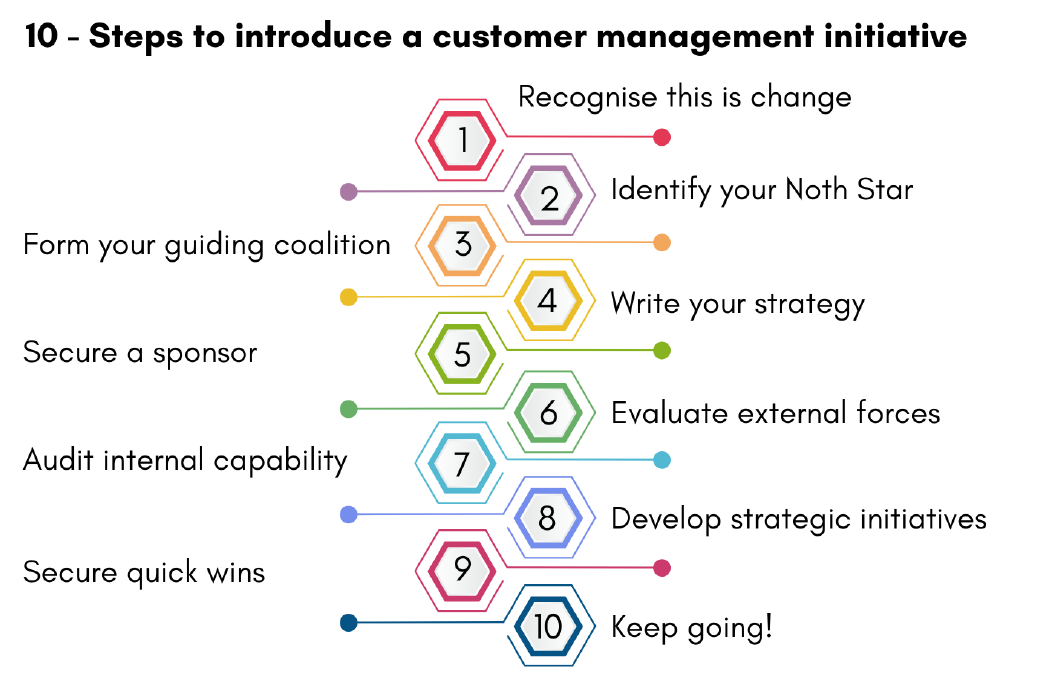 Ten steps to introduce a customer management initiative.
1. Recognise this is organisational change
You are not just creating a new team. You are building an organisational capability, and you may end up reshaping your business model. Kotter found that well over half the companies he studied failed in the very first phase, establishing a sense of urgency. So do not underestimate this. People will resist, existing power structures will push back and comfortable routines will fight for survival. Treat it as a multi-year programme of change, not a quick fix.
2. Identify your North Star
Set a big, audacious goal that will persuade the leadership team to invest. Frame it in terms executives care about: delivering the strategy, accelerating revenue growth, beating competitors. It has to be ambitious enough to inspire and credible enough to fund.
This is Kotter’s urgency in practice. He argued that change does not get going until around three-quarters of a company’s management is honestly convinced that business as usual is unacceptable. Be specific. “Increase key account revenue by 25 per cent within 18 months” beats “improve customer management” every time.
3. Form your guiding coalition
You will not get a team of full-time executives on day one, so build a strong part-time coalition from the functions that matter: sales, marketing, business unit heads, product management, finance, legal and your best key account managers. Kotter’s research shows that change fails without a powerful enough guiding team.
Choose people with two kinds of knowledge: deep understanding of customers, and a feel for how your own organisation really works. Change needs political skill as much as commercial skill. Meet regularly (every six to ten weeks to begin with) to build trust and shared commitment. The coalition has to work across the normal hierarchy. That can feel awkward. When the existing structure is not delivering, it is necessary.
4. Write your strategy
Write a short, high-level strategy that brings different views together and gives everyone the same story. It is not bureaucracy. It is your plan and your rallying cry. It should answer four questions: what customer management capabilities will we build, how will they create competitive advantage, what resources and time will it take, and how will we measure success?
5. Secure executive sponsorship
Recruit a main board member to champion the work. Your sponsor must publicly back the goal and actively coach and guide you through the strategy and its delivery. Their visible commitment signals that this matters and gives you cover when you meet resistance.
Without a board sponsor, the initiative will stall the first time it collides with a departmental priority or a difficult quarter. Choose someone with real influence, not a figurehead. They will open doors, break logjams and make sure the resources arrive. Our Strategic Customer Forum exists for exactly this conversation at leadership level.
6. Evaluate external markets
Analyse what is happening outside: the macro forces (social, technological, economic, environmental and political), how your customers are changing, what your competitors can do today and who might arrive tomorrow. This is what builds the case for why the capability matters.
Think two to five years ahead. Wayne Gretzky’s line about skating to where the puck is going, not where it has been, applies here. For many businesses, a strong customer management capability may be the only way to compete in a market where AI is taking over the transactional work and relationships and value creation matter more than ever.
7. Audit your internal capability
Now be brutally honest about your own strengths and weaknesses. Do you really know who your strategic customers are? How good is your customer classification? How well do you manage channels and distributors? How do you select and develop account managers? How good are your account plans, your data, your value propositions, your coaching, your value selling? How customer-centric is the business as a whole?
Benchmark against competitors and against what customers expect. Do not worry if you cannot answer half the questions. Finding the gaps is the point. And you do not need to be excellent at everything, only at the capabilities that give you an edge.
8. Develop five to eight strategic initiatives
The audit will show the gaps between where you are and where your goal says you need to be. Pick five to eight high-impact initiatives that close the most important of them, and make those your focus for the next twelve months.
Plan in twelve-month horizons with a twenty-four-month view, and review regularly, because markets move. Do not spread yourself thin. Each initiative needs a named owner, measurable outcomes and a deadline. Typical examples are introducing living account plans, value-based selling training, a customer segmentation framework, coaching capability, or better data and analytics.
9. Secure quick wins
Do not try to boil the ocean. Pick one strategic customer and apply the new approach properly: build the strategy, execute it with discipline, deliver measurable commercial results and write down how you did it. A deep dive on a single key customer is often the right place to start.
Quick wins prove the approach, win over sceptics and give you real examples for the wider rollout. One organisation I worked with increased sales to a single account by 75 per cent in six months by applying a new KAM planning method and a customer value proposition framework. When they took the results to the senior team, the response was immediate: “We want this across our top twelve customers.” Suddenly the customer management team had traction, support and a budget.
10. Keep going
Markets keep changing, and faster than they did. Do not declare victory too soon. That is the seventh of Kotter’s eight errors, and it kills more change programmes than almost anything else. Keep the team, keep refining the standards and build the capability into the way the business works.
Kotter’s point is that change sticks only when it becomes “the way we do things around here”, and that takes years. Celebrate the wins, then use them to take on bigger challenges. It is a large part of why so many KAM programmes get rebuilt: they were run as projects with an end date, when they needed to be a permanent capability.
Would you benefit from a customer management function?
Answer these ten questions honestly and score one point for every “yes”.
- Do your top 20 per cent of customers generate 60 per cent or more of your revenue?
- Do fewer than three-quarters of your account managers produce effective strategic account plans?
- Do you lack a documented way of classifying customers by strategic value and growth potential?
- Would most of your account managers struggle to set out a differentiated value proposition for each strategic customer in under five minutes?
- Do you lack documented standards and methods for how key customer relationships are managed?
- Do sales, marketing, product, finance and customer service work to different KPIs on your strategic accounts?
- Is there no structured programme for developing account managers, covering coaching, training and career progression?
- Would you struggle to measure the impact of your customer management approach on win rates, retention and growth within accounts?
- Are customer sophistication, competition or margin pressure increasing in your market?
- Is growing revenue from existing customers one of your top three strategic priorities?
0 to 3: you probably have strong customer management capability already. Keep improving and keep an eye on the market. 4 to 6: there are significant gaps, and a customer management centre of excellence would make a measurable difference. Consider a pilot with your top five to ten accounts. 7 to 10: capability gaps are holding back your growth, and you need a systematic approach soon. The good news is how much untapped potential that represents.
The question for your next board meeting
Most B2B businesses either have no formal customer management function or run one poorly. Build it properly, following the principles of good change management, and it becomes an advantage your competitors cannot copy quickly, because it lives in how your people work rather than in a product anyone can buy.
So next time the board spends an hour on the cost lines, ask who in the room owns the revenue line. Then wait, and see who answers.
References
Bain & Company (2025) The B2B Growth Divide: What Sets Winners Apart. Commercial Excellence and Revenue Growth Agenda 2025.
B2B International (n.d.) Six Steps to B2B Customer Experience Excellence.
Global Partners Training (2022) 10 Best Practices for Strategic Account Management Programs, citing research by Mercuri International and RAIN Group.
Kotter, J.P. (2007) ‘Leading change: why transformation efforts fail’, Harvard Business Review, January 2007.
McCrory, W., Paulowsky, R., Valdivieso de Uster, M. and Viertler, M. (2016) How to Unlock Growth in the Largest Accounts. McKinsey & Company.
Strategy& (2013) Commercial Excellence Programs: A Way for B2B Companies to Pursue Growth in Hard Times. PwC.
If this is your problem too, see how we build the capability properly, or talk to us.
The newsletter this came from
Every fortnight: one idea from the method, worked through properly. Read it where you already are, on LinkedIn, or by email below.
Keep reading
Why you keep rebuilding your KAM programme
Four out of five sales organisations rebuild their key account programme every few years. The rebuild is treated as a failure of effort. It is almost always a failure of capability.
Five Steps to a High-Impact KAM Training Programme
Most key account management training fails because it treats KAM as a sales technique. Five steps to a KAM training programme that changes how people work.