Five Steps to a High-Impact KAM Training Programme
Most key account management training fails because it treats KAM as a sales technique. Five steps to a KAM training programme that changes how people work.

For over twenty years I have had a front-row seat to an uncomfortable truth: most key account management training does not work.
Not because the content is wrong, and not because the trainers lack skill. It fails because it treats KAM as one more sales technique, something you can master in a two-day workshop with a deck of slides and a nice lunch.
It is not. Key account management is strategy, customer by customer. It is the discipline of understanding what your most important customers actually need (not what you want to sell them), building offers that meet those needs, and then delivering measurable value that compounds over time. Done well, it changes not just individual account managers but whole companies.
I have led KAM teams and built in-company training for major blue-chip businesses. For sixteen years I co-directed the Cranfield KAM Best Practice Research Club and the Cranfield KAM open programme at Cranfield School of Management. Across hundreds of cohorts, the patterns that separate programmes that transform from programmes that merely inform have become very clear. This is my blueprint for the first kind.
Start with a question that makes sales leaders squirm
What happens when your key account managers focus only on selling more of what you already have?
You commoditise yourself. You train your people to have transactional conversations about features and price. You compete on discounts. And eventually your most strategic customers start treating you like every other supplier.
The best KAM programmes do not begin with your product catalogue. They begin with a different question: what is the customer’s strategy, and what do they need to achieve it? That shift, from “what are we selling?” to “what does the customer need?”, is the difference between a vendor and a strategic partner.
What every high-performing KAM programme needs
Before the five steps, the non-negotiables.
A good programme gives key account managers a standard process. Not a rigid script, but a repeatable path from customer insight to value delivered, which becomes the backbone of how your company approaches key accounts. It needs a system to capture insight, because information evaporates unless someone writes it down. It needs a common language, so that sales, operations and finance can follow the same customer business case. And it has to lift people’s thinking from “how do I close this deal?” to “how do I help this customer reach their three-year objectives?”
Then there is AI. It is no longer optional. AI now runs through every strategic and operational activity in a business, and key account management spans both. It belongs woven through every phase of the programme, not bolted on as a module at the end.
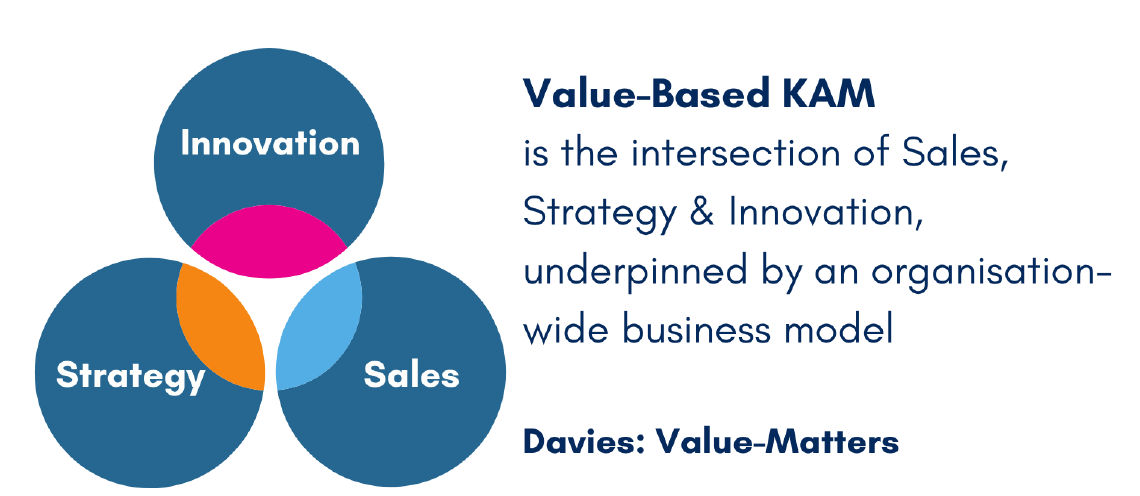
Finally, the programme should take people round a complete cycle in three phases. First, understand the customer and develop a unique offer. Second, sell that idea, internally to your own leadership (you will need investment) and externally to the customer. Third, capture the value you promised: measure it, report it, get the customer to sign it off, and go round again. We call this the Strategic Customer Planning Cycle, and its power is that it compounds. The more value you prove, the more the customer trusts you. The more they trust you, the more they share. The more they share, the more value you can create.
Where KAM training goes wrong
I have seen the failure patterns too, and they are remarkably consistent.
The process is too heavy. Not all key accounts are equal, and a process designed for a £50 million pharmaceutical account will crush a key account manager handling a £2 million regional customer. Smaller businesses and smaller accounts need lighter models.
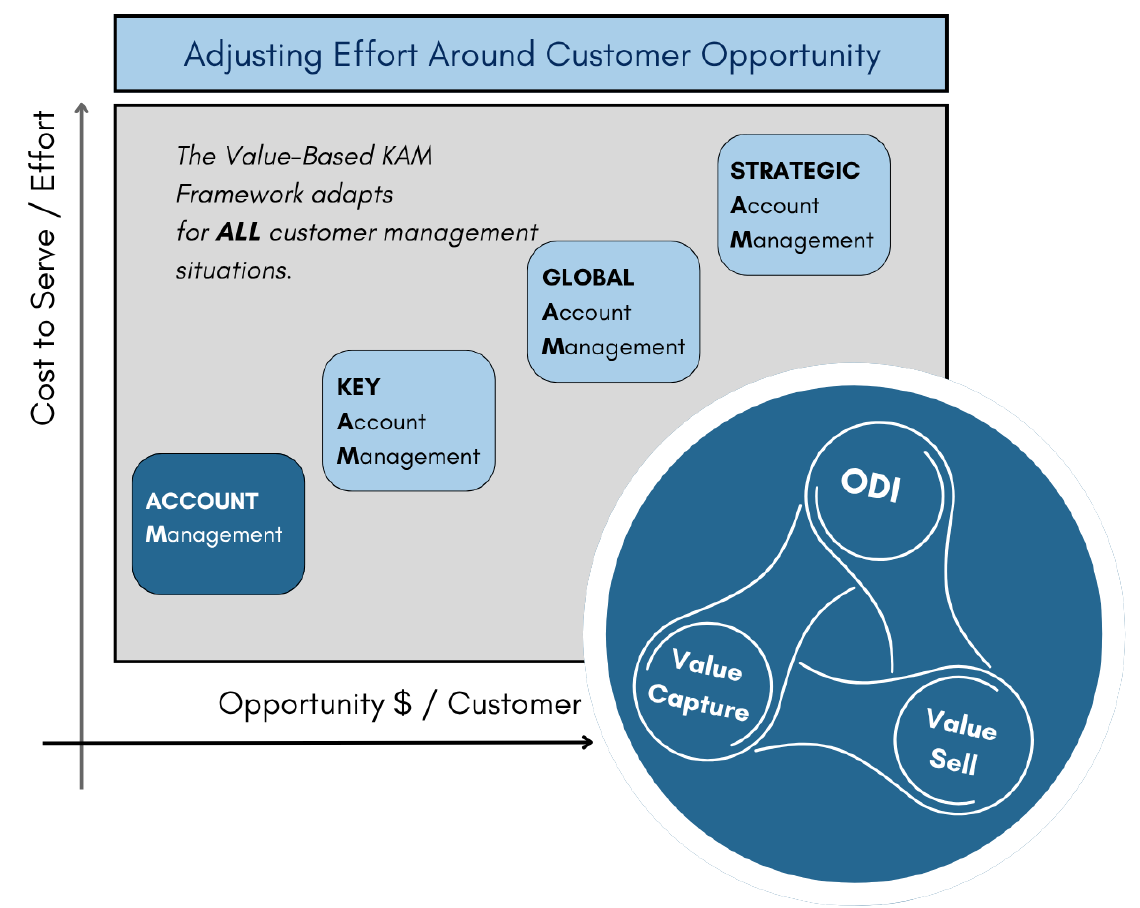 The same cycle adapts from account management to strategic account management, with effort matched to opportunity.
It is treated as sales training. When learning and development teams position KAM as “advanced selling”, they miss the point entirely. It is about business strategy and customer value creation, not closing techniques.
Leaders are not aligned. When senior people do not understand or support the approach, key account managers get caught between two worlds. They learn strategic principles in the classroom, then go back to a business that rewards only short-term revenue. That dissonance kills adoption faster than anything else, and it is the main reason I see companies rebuild their KAM programme every few years.
No offer gets developed. Here is a brutal truth: if your key account manager cannot state a unique customer value proposition, they have nothing to sell. Yet many programmes skip offer development entirely, even though it is the most important capability of all.
What success looks like
When KAM training works, you can hear it in how people talk. They think about the customer’s business rather than next quarter’s target, and they stop being intimidated by titles and start being guided by insight. Customers buy because you have created something worth buying, not because they have been worn down. And the economics follow: sales rise and cost to serve falls, because resources go to high-opportunity accounts rather than being spread thinly across everyone.
So how do you build a programme like that?
Step 1: Understand what each delegate needs
This is easier inside a single company and harder on an open programme with businesses of mixed sizes. It is critical either way.
Before the programme starts, hold an individual call with each participant. Ask about the customers they manage, the challenges they face, what they have tried before and why it did or did not work, how much they already use AI, and what success would look like for them. Speak to their leaders too if you can: what are the business priorities, and what would make this programme a win from where they sit?
Then set pre-work that matters. Ask each participant to choose one key customer to work on throughout the programme and begin researching it before the first session. KAM is strategy customer by customer, so people learn by applying the framework to one real account. Real work, real stakes, real learning.
That one-to-one call pays enormous dividends: it signals that the programme is serious and surfaces problems early.
Step 2: Build the offer, starting with the customer’s strategy
The first phase is Offer Development and Innovation: understanding the customer deeply enough to build a unique offer.
Start with their strategy. Not your strategy for them, theirs. Where are they trying to go? What keeps their chief executive awake? Which measures define success? Then ask what they need to deliver that strategy, moving beyond surface needs (“they want lower prices”) to strategic ones (“they need to cut supply chain risk while entering three new markets”).
AI belongs here from the first hour. Teach participants to use it to research the customer’s industry and competitive position, to read annual reports and investor material at speed, to spot trends and disruption in the customer’s market, and to generate hypotheses about unmet needs. Our KAM prompt guide is a good starting point.
Map the decision-making unit. Who are the key stakeholders, and what does each one care about? How does your case for the finance director differ from your case for the head of operations? Do you even know these people?
Then comes the critical work. How might your capabilities meet those needs in a way competitors cannot match? Key account managers have to think beyond the catalogue. It is not easy. It is also not optional. Without a unique offer you have nothing strategic to sell.
Step 3: Sell the idea twice
A great offer is worthless if you cannot sell it, and most people miss the fact that you have to sell it twice.
First, internally. Your key account manager will need investment: resources, a tailored solution, pricing flexibility, technical support, an executive sponsor. That means pitching to your own leadership with a business case and a clear return. Many account managers are comfortable with customers and terrified of presenting to their own vice president; a good programme deals with that head on.
Second, externally. Who needs to be in the room? What objections will come up? How do you frame the value for each stakeholder? The principle we teach is simple: different conversations, with different people, about different things. The conversation with a customer’s CFO about financial risk is nothing like the one with their head of operations about process efficiency. Same offer, different angle, different language. Teaching people to handle that complexity is what separates good KAM training from great.
Step 4: Capture and prove the value delivered
This is where accountability arrives. Did you deliver what you promised?
Track the measures that matter to your own business: revenue, margin, share of wallet, account profitability. You are not a charity, and the commercial results must be there. Just as importantly, track the measures that matter to the customer. Did you cut their operating costs by the 12 per cent you projected? Did you speed up their time to market? Did quality improve?
Then get the customer to sign it off. Hold formal reviews where you present the value delivered and the customer confirms it.
This completes the cycle. Value delivered and proven becomes the foundation for the next strategic conversation. It is how trust compounds and how you earn the right to the next level of partnership.
Step 5: Design for transformation, not information
This last step is not about content at all. It is about structure and support, and if you get it wrong everything else collapses. My original list for this step ran to twelve points. They come down to five.
Run it over weeks, not days
Transformation takes time. People need space to apply ideas, hit obstacles and come back with questions. A condensed two-day workshop creates the illusion of progress without the reality of change. Blend online delivery with a few face-to-face sessions for the peer learning a screen cannot give.
Make the account plan the coursework
Participants should build a real strategy for their chosen account throughout the programme, each module adding another layer, so that by the end they hold a complete plan they can actually implement. Review every assignment and give feedback. That is coaching, not grading: where is the thinking strong, where are the gaps, which questions have they not yet asked?
Give people the tools, and time for the unexpected
Do not make participants reinvent the wheel. Give them templates for internal pitches, executive summaries, customer review presentations and account plans. Schedule regular open “surgery” sessions, because real-world application always throws up questions the curriculum did not anticipate.
Tackle leadership alignment openly
The hardest part of implementing value-based KAM is not the method. It is aligning leadership with principles that may challenge current practice. Talk about it. Prepare participants for it. Where you can, bring their leaders into parts of the programme.
Keep going after the last session
Learning does not stop when the programme does. Map out the skills people need to reach real mastery, which is what the Tri-Skills self-assessment is for, and give alumni somewhere to keep asking questions, sharing insights and meeting face to face. Build a community of practice, not a certificate.
The talent question
Every principle here is built into our KAM Development Programme, because we learned them the hard way, one cohort at a time.
Your key accounts are your biggest growth opportunity. The real question is whether you are developing the people who will capture it, or sending them on another two-day course and hoping. Most companies are still doing the second. Think about the best key account manager you have ever worked with. Did a workshop make them, or did years of real accounts, good coaching and someone who believed in them?
If this is your problem too, see how we build the capability properly, or talk to us.
The newsletter this came from
Every fortnight: one idea from the method, worked through properly. Read it where you already are, on LinkedIn, or by email below.
Keep reading
Why you keep rebuilding your KAM programme
Four out of five sales organisations rebuild their key account programme every few years. The rebuild is treated as a failure of effort. It is almost always a failure of capability.
Five Warren Buffett Principles for Key Account Managers
Warren Buffett's philosophy was never about the money. Five of his principles map closely onto what separates good key account managers from great ones.