The Value-Based KAM Framework: 3 Phases, 7 Steps
Most key account programmes get rebuilt every few years. The Value-Based KAM Framework gives key account managers three phases and seven steps to grow sales.

Here is a number that should make every sales director pause. Gartner found that 79% of sales organisations have rebuilt their key account programmes at least once in the past seven years because the programme was underperforming. Four out of five. If you have lived through one of those rebuilds, you know how it goes: a new launch, new templates, new training, and eighteen months later the same quiet disappointment.
And yet key account management has never mattered more. We work in a VUCA world, volatile, uncertain, complex and ambiguous. Product life cycles are shrinking, customers are more demanding and more aggressive in what they expect, and the traditional ways of managing strategic relationships are simply not working.
So this piece is practical. It sets out a roadmap to get your programme out of the group that keeps rebuilding. I call it the Value-Based KAM Framework.
Why the old approach keeps failing
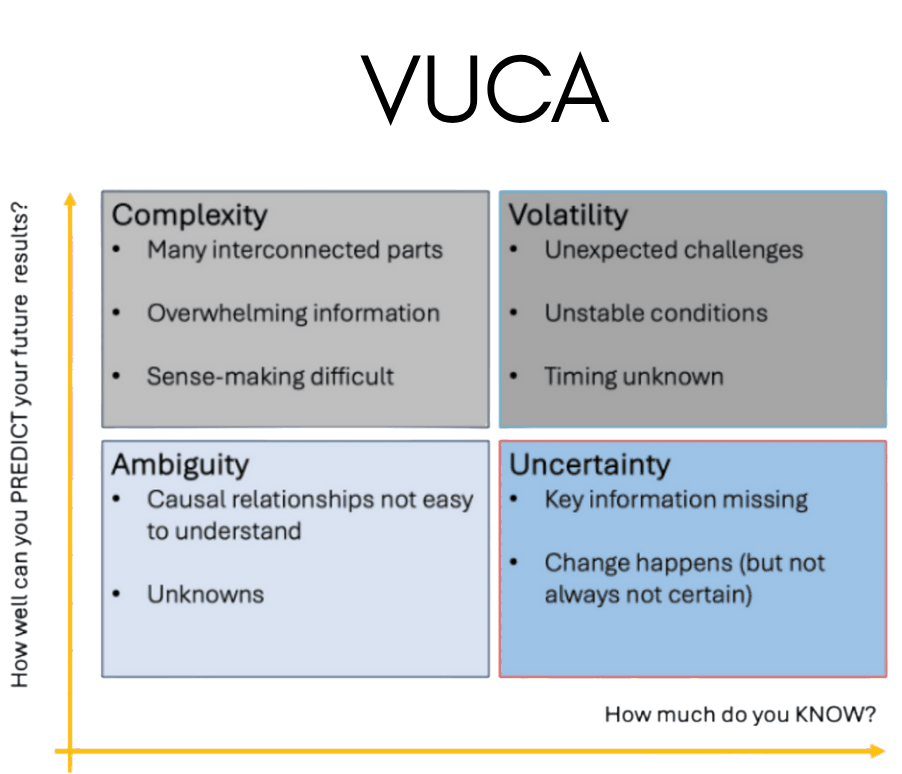
In Thank You for Being Late, Thomas Friedman boils the turbulence down to three accelerating forces. The first is Moore’s Law, the doubling of computing power and halving of its cost, and with AI the technology is moving faster than ever. The second is the Market: look at the chaos caused by the tariff uncertainty pushed around the world through 2025. The third is Mother Nature: fire, drought, flooding and soaring temperatures are having a long, draining effect on businesses and people alike.
None of those forces is slowing down, so strategies across every supply chain need constant review and adjustment. Your key account managers are the people who have to interpret all of this for your most important customers, and they need a guide. The Value-Based KAM Framework is that guide.
Beyond the four blocks
In my paper Rethinking KAM I described four building blocks of a high-performing, value-based business.
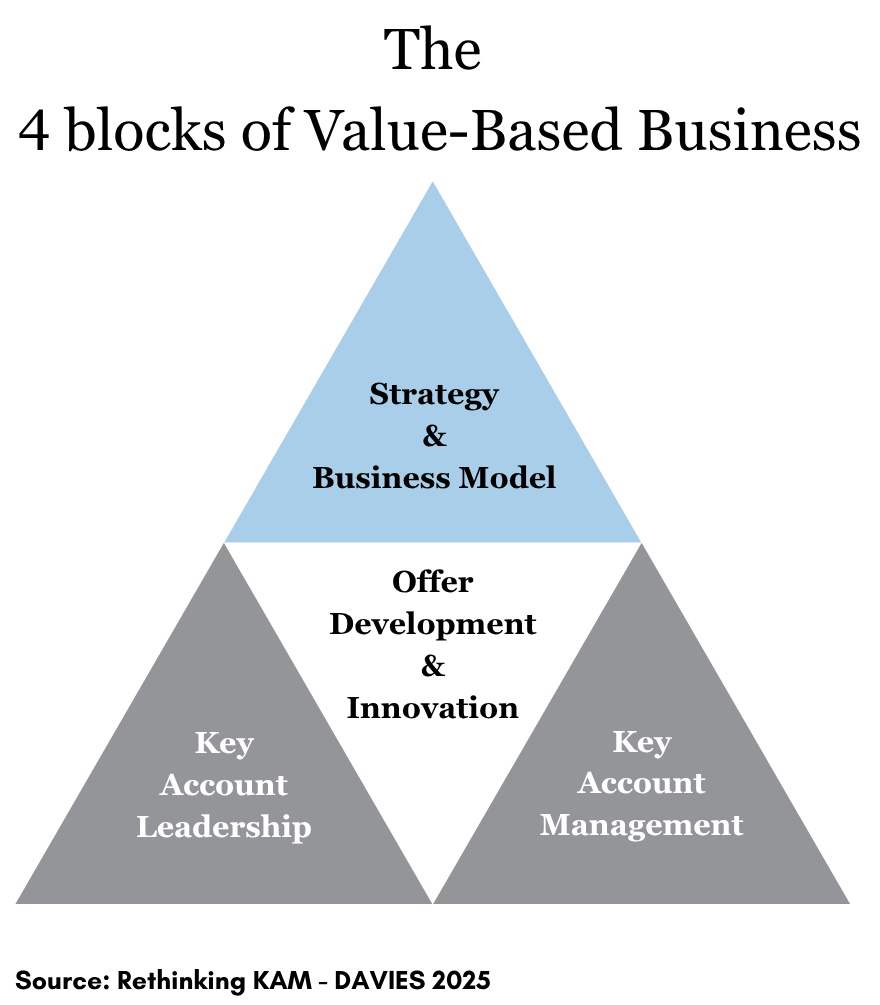
Offer development and innovation is the most important thing. Value-based key account management is carried out by the people who make hard things happen. Key account leadership is the hardest thing, because it means aligning a whole organisation to think, support and operate in a way that makes value-based business possible. And strategy is the roadmap leadership writes to get from here to there. The same argument runs through our Four Things overview deck.
But a framework without implementation guidance stays theoretical. What the four blocks tell you is to stop treating KAM as relationship management with better account plans, and start treating it as a systematic way of creating, selling and delivering measurable value your competitors cannot match. What they do not tell your key account manager is what to do on Monday morning. That is the job of the framework that follows.
Your secret weapon: the key account manager
If you want to move your business to value-based KAM, your best chance lies with your key account managers. They are your secret weapon, but only if you give them a method.
The Value-Based KAM Framework gives practising key and strategic account managers a systematic approach built around three phases and seven steps. It is designed to be used, not admired, and every technique in it has been tested with real customers in difficult markets.
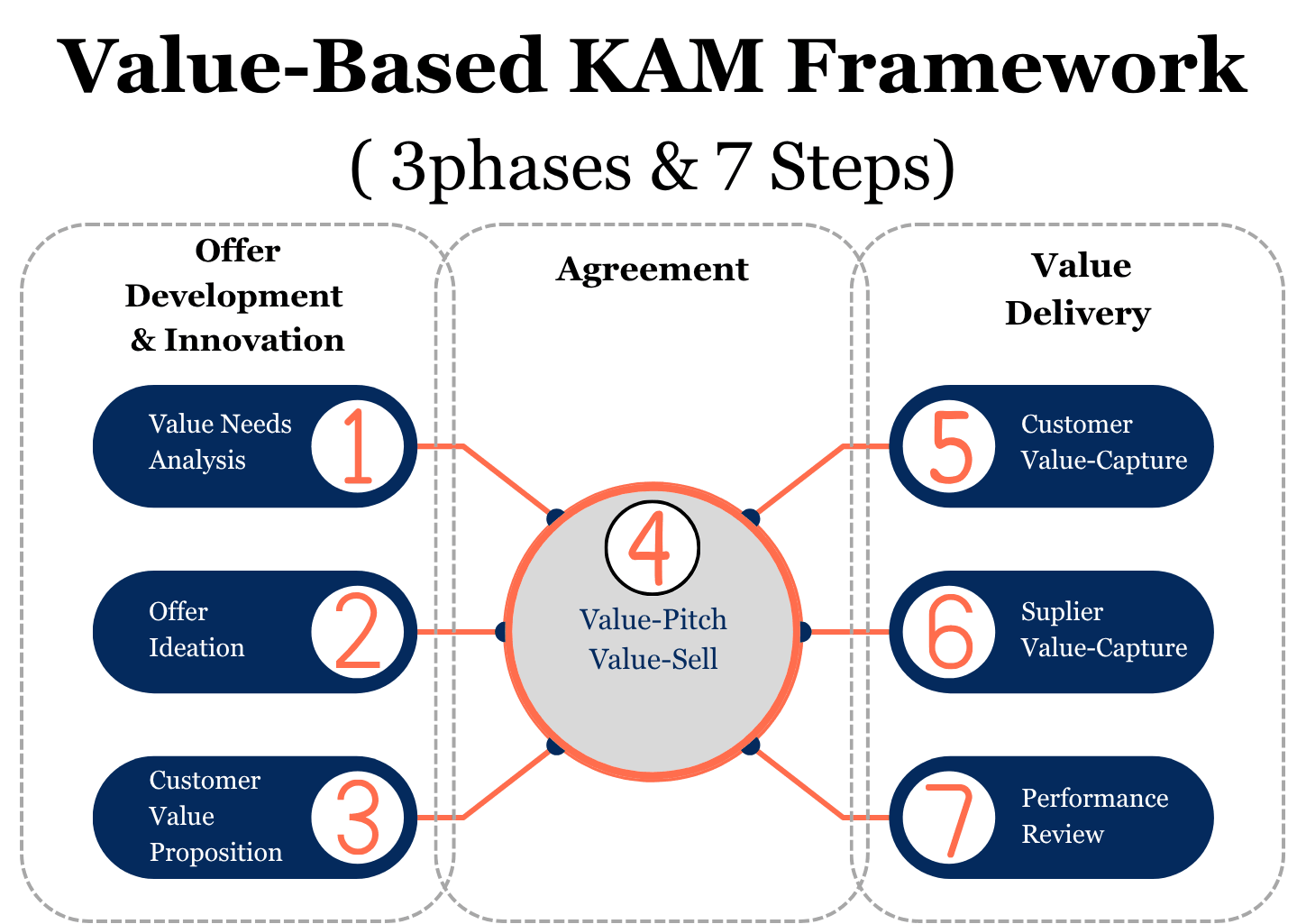
The first phase is offer development and innovation: understanding the customer deeply, using innovation techniques to create offers nobody else could make, and expressing them as high-impact customer value propositions.
The second is agreement. No matter how strong your value proposition, you still have to sell it, first inside your own business and then to the right leaders in the customer’s.
The third is value delivery. Value-based business does not stop at the sale. You and your customer both want to see the promised results, and too many suppliers never measure and report the value they deliver, so it simply evaporates.
Each phase has its own outputs and its own tests of success, and a key account manager needs all three to be effective.
Phase 1: Offer development and innovation
Step 1: Value needs analysis
This is where serious KAM begins. Establish where your customer is today as they pursue their strategic and operational goals, and how well your current offer serves them.
The breakthrough comes when you describe a compelling future state: what could the customer’s business look like if they accepted your offer? The gap between where they are now and that future state is your opportunity. Make the future state strong and attractive, better than your competitor’s picture, and something the customer sees as both tangible and worth reaching for.
Step 2: Offer ideation
Your offer is everything you use to deliver value: products, services, commercial terms, access channels, people, processes and brand messages. There is a whole suite of techniques for this stage, and it is where real competitive advantage is made. Get offer ideation right and you build an engine that keeps winning durable business. The principle is simple even if the techniques are not: a standard offering rarely wins strategic business.
Step 3: Customer value proposition
Your offer and your customer value proposition are not the same thing. The offer contains all those elements. The value proposition sits on top of it like an executive summary, communicating a complex offer briefly and with impact.
It should fit on one page, and it takes time to get right. It is not marketing copy. It is a strategic document that guides your whole approach to the customer, and it should answer one question: what will be different for this customer if they choose us?
Phase 2: Agreement
Step 4: Value pitching and value selling
This is where KAM gets interesting, because you are selling to two parties and you have to win with both.
Value pitching means selling the idea to your own business first. Why? Because your idea may contain things your business cannot support. It may not be profitable, sustainable or significant enough. Is the juice worth the squeeze? That is the purpose of the 3M test. Good key account managers lead internal teams to build the proposition, sell it upwards, and line their leadership up behind it. If investment is needed, they write the business case and make the pitch.
Value selling means taking the idea to the customer. As a rule, the greater the value, the harder the sale. If you are asking for sign-off on a big investment that pays back in cash flow or increased sales, you are selling to senior people, the C-suite and divisional heads, not a local buyer or a site manager. It is a complex, cross-functional sale that can take months, and it needs investment and a highly capable key account manager to lead it. As I wrote in Infinite Value, value-based selling means “different conversations, with different people, about different things.”
Develop your internal selling skills as seriously as your customer-facing ones. Half of value-based KAM happens inside your own building.
Phase 3: Value delivery
The sale is not the end of the work. The key account manager still owns this business and has to make sure every promise is kept.
Step 5: Customer value capture
Delivery gets easier as the value proposition gets stronger, because a strong proposition names the measures that will be tracked. If you promised to cut energy costs, raise machine availability, reduce downtime or reduce scrap, those are your customer value measures. They are not arbitrary. They are the outcomes you committed to, and capturing them is how the customer comes to believe the next proposition.
Step 6: Supplier value capture
The same applies in the other direction. If you promised your own business more sales, better margin, fewer debtor days or a stronger relationship, measure those too. Remember the internal business case you made in step 4? Now prove it worked.
Step 7: Performance review
Coaching key account managers is critical and rarely done well, which brings us back to key account leadership, the hardest thing. Each strategic customer deserves a regular performance review that combines hard sales data with the softer measures: how strong the relationships are, how well you understand the customer, and whether you are generating ideas that beat the competition. It closes the loop customer by customer, and it looks at the whole supporting team, not just the key account manager.
Build measurement and review in from day one. Value that is not measured and communicated fades from the customer’s memory.
Why this matters now
The environment is not getting simpler. Customers are more sophisticated and have more choice than ever, and KAM built around relationship management and account planning alone is not enough.
Paolo Guenzi of Bocconi University captures the core problem: “If I create a solution for my customer, paradoxically I create a problem for my own company.” Most businesses are built to market and sell products. Value-based KAM builds strategy around each customer, and that is a different business model. The framework is the systematic approach that makes the change survivable.
Behind each phase and step sits a portfolio of techniques and models, from value needs analysis to offer ideation tools, from internal selling to value measurement. You do not need all of them on day one.
Start with one customer
Pick one strategic customer. Apply the framework step by step. Measure what happens. Then spread it across the portfolio. This is not about perfection from the start. It is about getting a little better, customer by customer.
Your key account managers really are your secret weapon. Somewhere in your business there is one who already does most of this by instinct, and has never been given the words for it or the backing to do it properly. Start with them.
If this is your problem too, see how we build the capability properly, or talk to us.
The newsletter this came from
Every fortnight: one idea from the method, worked through properly. Read it where you already are, on LinkedIn, or by email below.
Keep reading
Why you keep rebuilding your KAM programme
Four out of five sales organisations rebuild their key account programme every few years. The rebuild is treated as a failure of effort. It is almost always a failure of capability.
Five Steps to a High-Impact KAM Training Programme
Most key account management training fails because it treats KAM as a sales technique. Five steps to a KAM training programme that changes how people work.