Seven Reasons AI Makes Key Account Management More Critical
AI is dismantling traditional B2B selling. The same forces are making strategic key account management more valuable than ever. Here are seven reasons why.

Somewhere this week, a buyer will read a supplier’s proposal and suspect, correctly, that a machine wrote most of it. Somewhere else, the buyer’s own software will have already compared that proposal against eleven others, stripped out the pricing logic and drafted a counter-offer before anyone on either side has had a coffee.
AI is not just changing how we sell. It is taking apart the foundations of traditional selling. And here is the paradox most B2B leaders have not yet faced: the same technology is making strategic key account management more valuable than it has ever been. Not “premium relationship management”. Not “high-touch sales”. The real thing, built on value creation.
If you still treat KAM as the account team that takes the customer to dinner, you are about to watch your margins go the same way as your feature list.
The acceleration nobody was ready for
Remember when a competitive advantage lasted eighteen months? Then twelve? Now you can measure it in weeks.
Your proprietary process gets described on LinkedIn by someone who sat in on your webinar. Your innovative feature is table stakes by the time the brochure is printed.
AI did not create this acceleration. It just put its foot on the pedal. Product-based differentiation is fading fast. Feature-benefit selling is being automated. The quarterly business review is being replaced by AI-generated insights and automated check-ins. The question is no longer whether AI will change B2B selling, because it already has. The question is what happens to the humans in the equation.
I think the answer is good news for the right people. Here are seven reasons.
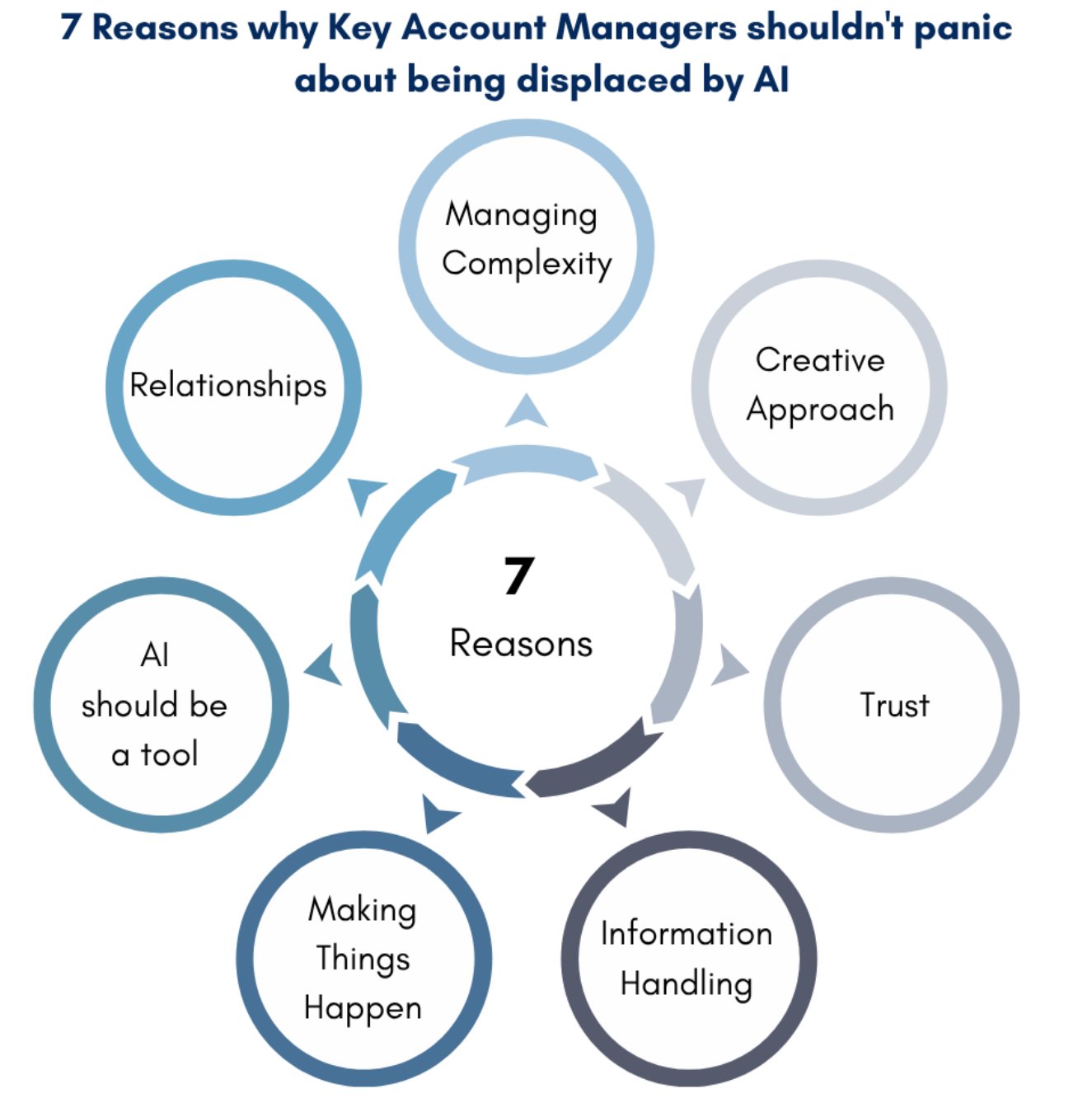
1. AI optimises, but people manage complexity
AI is brilliant at processing data, spotting patterns and proposing the best answer inside defined parameters. What it cannot do is read the messy, political, emotionally charged reality of how businesses actually make big decisions.
When a procurement director is being pushed by private equity owners to cut costs by 15% ahead of an exit, no algorithm can read that room. When a chief executive’s reputation rests on a change programme that everyone privately thinks is badly conceived, the model will not pick up the unspoken dynamics.
Strategic key account managers work in the gap between what the data says should happen and what can actually happen, given the politics, the egos and the culture. That gap is not closing. AI is making it wider.
Think of it this way. The flight computer can tell you the optimal glide path. But when both engines failed over New York in 2009, it was Captain Sully Sullenberger who decided to put the aircraft down on the Hudson. Your KAM is the pilot, not the autopilot.
2. Value creation needs co-creation, not automation
Sustainable advantage in B2B does not come from what you sell. It comes from what you create with your customers, in ways competitors cannot easily copy.
Value-based KAM means working with a customer to develop things neither company could build alone. That is not customising a product. It is embedding your capabilities in their operations so deeply that switching suppliers would mean rethinking part of their business model.
AI can optimise the processes that already exist. It cannot run the joint innovation workshop, the cross-functional session where your engineers and theirs argue their way to something new, or the slow joint problem-solving that produces what strategy researchers call causal ambiguity: value your customer cannot quite explain, but knows they cannot do without.
3. Trust does not scale through algorithms
The trust equation, from Maister, Green and Galford’s The Trusted Advisor, puts it as arithmetic: credibility plus reliability plus intimacy, divided by self-orientation (Trusted Advisor Associates). AI can help with credibility (the data) and reliability (the consistency). It does nothing for intimacy, and it has no way to lower self-orientation, because it has no self to set aside.
When a customer faces a decision worth millions with incomplete information, they do not want to rest it on a machine’s recommendation. They want a person who understands the weight of it, who will stand in front of the board if it goes wrong, who has skin in the game.
You build that kind of trust not by being perfect but by being accountable. AI suggests. People own the outcome. That difference matters more as the decisions get bigger.
4. AI democratises information, KAMs provide insight
We have moved from information asymmetry, where suppliers knew more than customers, to information overload, where everyone is drowning in data and starving for insight.
Your customers do not need more data. They need someone who can read market signals, join the dots across industries, challenge their assumptions and show them opportunities they are missing. That is the offer development and innovation engine at the heart of value-based KAM. It is not about having better products. It is about having better questions, and better insight gathered from working across many customers and markets.
AI analyses. A strategic KAM combines that analysis with context and creative problem-solving, and to the customer it can feel like magic, because it solves problems they did not know they had.
5. Execution is still a human problem
Strategy consultancies learned this decades ago. The strategy is rarely the hard part. Getting people to carry it out is where things fall apart.
AI can write a brilliant implementation plan. It cannot manage the change, align the stakeholders, soften the cultural resistance or handle the politics needed to bring that plan to life.
Value-based KAMs do not just sell solutions; they make them happen. They line up the internal champions, deal with the blockers, manage the senior egos and keep momentum going when implementation gets hard, which it always does. That capability is what separates KAM programmes that succeed from the many that quietly fail, and it is very hard to automate.
6. AI raises the bar, so KAMs must master it
Here is the flip side. KAMs who refuse to use AI will not survive. The contest is not people against AI. It is strategic people using AI against everyone else.
The best KAMs will use it to research customers and markets in hours rather than weeks, to test several solution scenarios before the first meeting, to track the value they deliver with far more precision, and to spot expansion opportunities hidden in the pattern of an account. Above all they will use it to clear the administration off their desks so they can spend their time thinking. Creative work gets more productive; productive work gets more creative.
So look honestly at your own team. Are your KAMs using AI to become strategic advisers, or are they still building slide decks by hand that a machine could draft in seconds? Our KAM prompt guide is a practical place to start, and the five ages of AI will show you where your sales team actually sits on the curve.
7. Competitive advantage lives where algorithms cannot reach
The most powerful advantage you can build is causal ambiguity: value that competitors can see but cannot replicate, because they cannot work out what produces it. I have written about KAM as a hidden competitive advantage before, and AI only sharpens the point.
In a strong strategic account relationship, the value comes from years of accumulated knowledge about the customer, from relationships across many people in both companies, from processes that run through several departments, from a shared history of innovation that builds on itself, and from a cultural fit that has grown over countless small interactions. None of that appears on a specification sheet. None of it can be reverse-engineered, and none of it can be automated.
As AI makes products easier to copy, it makes strategic relationships harder to replicate, because the human complexity only grows as the routine transactions get automated away.
Why traditional selling is already finished
Look at what is happening on the buyer’s side. Procurement teams now have tools that read supplier proposals faster than people can, expose cost structures buried in complex pricing, generate counter-offers designed for maximum savings, and run tenders in ways that strip out any relationship advantage. Increasingly, the buyer is software. We call it machine buying, and if your value proposition fits neatly into a standard RFP, you are now competing against it. And you are losing.
At the same time, the feature race has become a treadmill you cannot win. Traditional selling assumed you could stay different on product long enough to build a relationship. By the time you have built it now, the difference has gone.
And information asymmetry, the old engine of selling, is gone as well. Your customers have instant competitive analysis, real-time price benchmarks, automated vendor comparisons and AI-generated alternatives. If your approach depends on the customer not knowing something, AI has already broken it. You may not have felt it yet, because buying cycles lag behind the technology.
So what survives total transparency? Value that is genuinely unique to one customer relationship. Value that cannot be compared, because it is not available anywhere else. That is not traditional selling. That is strategic key account management.
Automate or elevate
B2B companies are splitting into two groups. One is automating everything it can, treating customers as transactions and accepting commoditisation as inevitable. The other is elevating its key customer relationships, investing in strategic KAM, and building advantages that get stronger as markets become more automated.
Both work for a while. Only one lasts. Automation leads to margin pressure and a constant hunt for cost, which is fine if you have enormous scale; for everyone else it is a spiral. Elevation is harder and costs more up front, but it creates a position that becomes more valuable over time, not less.
The KAMs who thrive will think strategically, facilitate innovation with customers, manage change inside two organisations at once, advise like a consultant, and use AI for the analysis, research and routine communication. They will work at board level, not because they are senior, but because they are solving board-level problems. And they will follow a method: develop an offer the customer could not get elsewhere, sell its value in a way every stakeholder recognises, and then capture and prove the value that was delivered.
Put simply, and it is the thread running through what the technology cannot do: the machine does the search, and you make the decisions.
The twenty per cent
Everyone is panicking about AI replacing people. Meanwhile, the companies building real strategic account capability are creating an advantage that grows as automation spreads. As transactions are automated, relationships become the differentiator. As products commoditise overnight, co-created value becomes the moat. As information becomes free, insight becomes priceless.
AI has not killed the key account manager. What it has done is reveal that a great deal of what we used to call KAM was transactional selling with nicer dinners.
The part that was genuinely strategic has just become the most valuable capability in B2B. Which part are you?
If this is your problem too, start with the free KAM Prompt Guide, or talk to us.
The newsletter this came from
Every fortnight: one idea from the method, worked through properly. Read it where you already are, on LinkedIn, or by email below.
Keep reading
What the Technology Cannot Do
Last Thursday at the IET we showed a room of business owners a tool that draws a customer value proposition in seconds. Then we showed them the slide that matters more: the four things it will never do for you.
The Johnny Cash Principle
A rockabilly band, a Cotswolds festival, and the moment everybody finally looked up: why every pitch should open with what your audience already knows, and the ABC model that makes it happen.