KAM and Causal Ambiguity: Your Hidden Competitive Edge
Competitors can see your key account relationships but cannot copy them. That is causal ambiguity, and KAM may be the last advantage that resists imitation.

Your R&D breakthrough? Your competitor has just hired the engineer who developed it.
Your efficient production method? There is a consultant selling a playbook on it.
Your customer service approach? Three rivals are already copying it.
When products turn into commodities almost overnight and innovation cycles shrink from years to months, what is left to set you apart? My answer is something that happens at the boundary between your business and your most important customers. Your competitors can see it. They know it gives you an edge. They cannot work out how to copy it. Strategists call it causal ambiguity, and in most B2B suppliers the thing generating it is the key account management programme.
Where the idea of causal ambiguity comes from
The term comes from Steven Lippman and Richard Rumelt, whose 1982 paper on uncertain imitability asked why some firms stay more profitable than their rivals when, in theory, competition should wipe out the difference. Their answer was that the causes of success are often ambiguous, even to the firm enjoying it, so nobody can reliably copy them. Rumelt went on to write one of the best strategy books I know, Good Strategy/Bad Strategy.
Causal ambiguity exists when competitors cannot pin down exactly why a firm succeeds. They see the results. They cannot untangle the web of relationships, habits and processes that produces them.
Think of a master chef. You can get hold of the ingredients list, and you can reverse-engineer most recipes. What you cannot get is the timing, the small adjustments to heat, the hundred judgement calls the chef makes without thinking. You can stand in the kitchen and watch, and still miss the subtleties that make all the difference.
When everyone can copy everything
Look at the pressure most B2B suppliers are under. Product innovations get reverse-engineered within months. Manufacturing processes are standardised across global supply chains. Technology platforms are increasingly interchangeable. Price moves are matched almost as soon as competitors spot them, and with a big enough marketing budget even brand positioning can be imitated. Transparency, technology transfer and people moving between firms mean traditional advantages wear away faster than they used to.
The problem is not only that advantages are temporary. It is that the path to creating them is increasingly visible. When competitors can watch what you do and reproduce your methods quickly, you end up in an exhausting race where staying ahead means constant reinvention.
So is there any advantage that resists the copycats?
The transparency trap
Without causal ambiguity, your business falls into what I call the transparency trap: every competitive move you make is visible, and therefore copyable. It shows up in five ways.
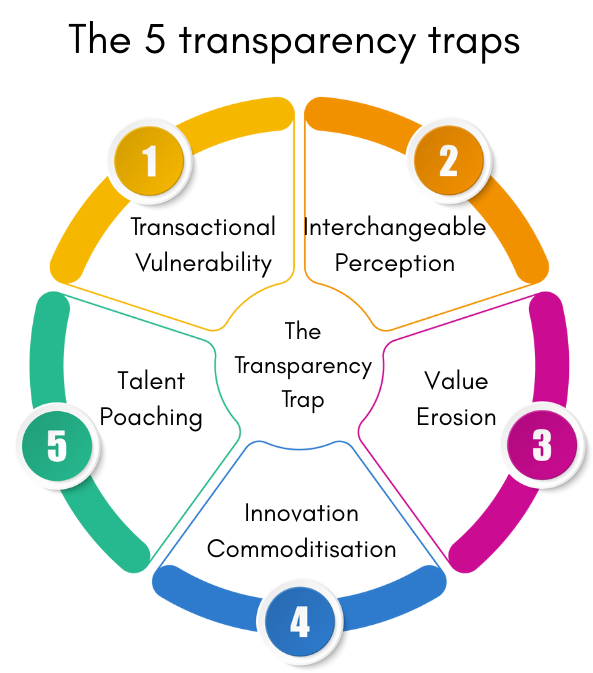
The first is transactional vulnerability. A relationship built only on product features and price puts no barrier in a competitor’s way. A slightly better price or a marginally better specification is enough to move the business.
The second is interchangeable perception. Without deep relationships across the customer, you become one more vendor in their system, easy to replace when the next aggressive competitor comes knocking. This is the road into the commodity trap.
Third comes value erosion. As competitors match each visible part of your solution, the value the customer sees in it shrinks, and you pay for the relationship in price concessions.
Fourth, innovation commoditisation. Even your most creative solutions become industry standard as others observe and copy them, which leaves you in a permanent innovation sprint.
And fifth, talent poaching. If your customer relationships depend on standard, easily understood processes, a competitor can simply hire your people and run your playbook.
The result is shrinking margins, more customer churn, rising acquisition costs and, worst of all, a slow slide into being one interchangeable option among many. In transparent markets, advantage is temporary at best and an illusion at worst.
Why KAM is your causal ambiguity engine
This is where strategic key account management stops being “just a sales approach”. Product innovations and operational efficiencies can be copied. Done well, KAM creates exactly the causal ambiguity that protects you from imitation, and it does so in five ways.
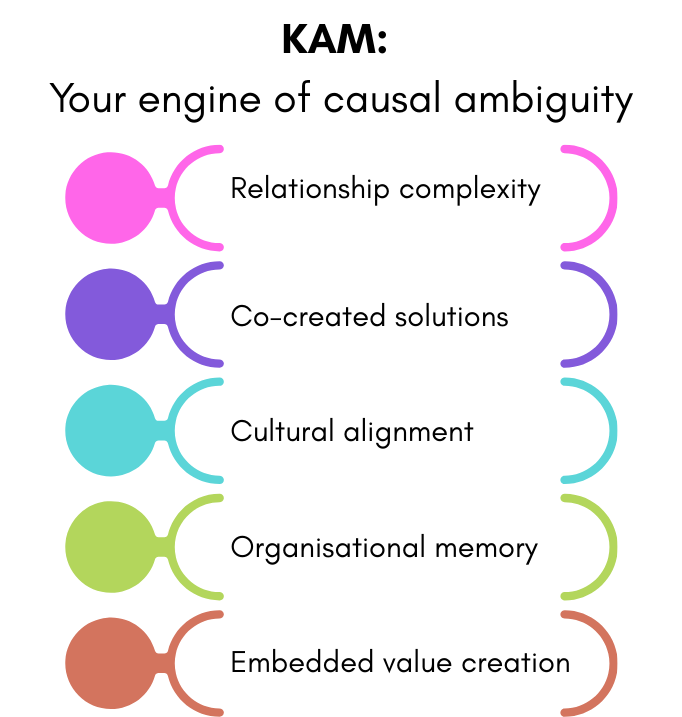
Relationship complexity
Real KAM is not one relationship between the account manager and the buyer. It is a web of connections between many levels and functions in both businesses, across the whole decision-making unit. Some of it runs through formal channels and a lot of it does not. Much of what it knows is tacit and will never be written down, and it grows through countless small interactions and moments of trust. From outside, a competitor sees that you have “good relationships” with the customer. What they cannot see is the history and the trust that hold those relationships up.
Co-created solutions
The strongest KAM programmes stop selling ready-made solutions and start building value propositions with each key account. Those solutions grow out of the specific context and history of that relationship. They carry tacit knowledge from both sides, they create interdependencies that are hard to unpick, and they evolve through a process no playbook records. A competitor can see the result, but they cannot reconstruct the path to it, and they do not have the trust needed to co-create at that level.
Cultural alignment
Over time, good KAM builds quiet alignment between supplier and customer: a shared language, compatible working rhythms, values that fit. It develops slowly, it lives as much in what is left unsaid as in what is said, and it produces an intuitive understanding that no process manual captures. A competitor notices that your teams work well together. They do not see the years it took.
Organisational memory
Mature KAM builds a shared history between the two businesses: projects delivered together, problems solved, growth achieved. That memory is spread across many people on both sides, formal knowledge mixed with informal insight, and it creates shortcuts that let problems get solved fast. A competitor sees that you resolve issues quickly. They cannot see the pattern recognition that years of partnership have given you. This is why I push so hard for a living account plan rather than a document that dies in a drawer.
Embedded value creation
In the most advanced relationships, your way of creating value becomes part of how the customer runs. The boundary between your processes and theirs blurs. You build interfaces unique to that customer, and some of the value you create never shows up in the formal transaction at all. A competitor can tell that the customer values you. They cannot see how far your processes have grown into theirs, or the switching costs that creates, well beyond anything in the contract.
The KAM paradox: visible yet inimitable
Here is the fascinating part. KAM operates in plain sight. Your competitors know you have key account managers. They can watch your customer meetings. They might even hire some of your team. And they still cannot recreate the relationships, the shared history and the embedded processes that make your programme work.
John Rollwagen, the former Cray Research chief executive, is often quoted as saying that the secret of business is to focus relentlessly on your “unfair advantage”, the thing you do that others don’t. KAM is an unfair advantage of an unusual kind. Product advantages disappear with the next innovation cycle. Process advantages get benchmarked away. Technology advantages erode as platforms standardise. Even your internal culture can be studied and imitated. But the relationship you have co-created with a key customer does not live in your business or in your processes. It lives in the chemistry between two organisations, and that is very hard to steal.
Five steps to build your causally ambiguous advantage
1. Think in ecosystems, not programmes
Stop treating KAM as a sales programme. Map every connection between your business and each key account, then deliberately build new ones across functions and levels. You want more relationships, yes, but above all more varied and more interconnected ones.
2. Make tacit knowledge travel
Account plans and strategy documents are not enough. Find ways to pass on the unwritten understanding your business has about each key account: the personalities, the preferences, the expectations nobody says out loud. Shadowing, mentoring and regular storytelling sessions about key accounts all help, precisely because none of it fits neatly into a CRM field.
3. Co-create at several levels
Go beyond “voice of the customer” surveys. Involve key customers in early product development, joint process improvement and shared innovation workshops. The aim is solutions neither business could have built alone, which is the heart of creating and selling customer solutions.
4. Look after the relationship’s memory
Capture the history of each key relationship, not just the transactions but the stories, the problems overcome and how the relationship has changed. Some businesses give someone the job of relationship historian for their most important partnerships. It sounds indulgent until that person’s knowledge walks out of the door.
5. Measure relationship quality, not only results
Add measures of relationship quality and embeddedness to revenue and growth. How dense are the connections? How well does information flow? How good are you at solving problems together, and what has joint innovation delivered for both sides? These are leading indicators. They show causal ambiguity building before it reaches the financial results, and they sit naturally beside the question of whether your strategic customers trust you.
The last moat
Your key account management programme may be the last real moat around your business. Not because it is secret, and not because it is revolutionary, but because it creates advantage competitors can watch and still cannot copy.
They can hire your account managers, copy your processes and borrow your vocabulary. They cannot recreate the thousands of conversations, the shared history and the quiet knowledge that make each relationship what it is. Somewhere in one of your key customers there is a plant manager who calls your service engineer before she calls anyone in her own building. No competitor will ever find that on your website.
If this is your problem too, see the Strategic Customer Planning Tool on the ladder, or talk to us.
The newsletter this came from
Every fortnight: one idea from the method, worked through properly. Read it where you already are, on LinkedIn, or by email below.
Keep reading
The Plan in the Filing Cabinet
Somewhere in your organisation there is a key account plan that nobody has opened since the day it was approved. It does not die from lack of discipline. It dies because no team ever had the hours to keep it alive. Now, finally, something has the time.
Customer Segmentation: The Kingpin of Customer Management
Most companies segment customers on last year's sales, and pay for it. Here is a five-stage method for customer segmentation that looks at future value instead.