Are You a Strategic Supplier, or Just Another Cost?
You classify your customers. Their buyers are classifying you, using a 1983 matrix. Here is how the Kraljic Matrix works and how to become a strategic supplier.

Suppliers love a box. We spend a remarkable amount of energy sorting our customers into them. Is this account strategic? Key? Basic? The aim is sensible enough: put resources where the returns and the risks justify them. I have written plenty about how to do it well, in what is a key customer, anyway?
But have you considered the mirror image? While you are busy classifying your customers, they are doing exactly the same to you.
Yes, you.
Right now, a procurement team is looking at your business, your products and your services, and deciding whether you belong in their “strategic” box or their “irritating little cost” box.
Not quite so comfortable when the spotlight turns, is it?
Procurement professionals classify suppliers with systematic precision. They have to; their jobs depend on it. And how they see you decides not only your pricing power but your whole future with that account. So the question that matters is not “how do I classify my customers?” It is “how do my customers classify me, and what can I do about it?”
The Kraljic Matrix: the box your buyer puts you in
In 1983 Peter Kraljic, then a director at McKinsey, published an article in the Harvard Business Review called Purchasing Must Become Supply Management. It changed procurement for good. His matrix is simple and it is powerful. It sorts purchases on two dimensions: how much they affect the buyer’s profit, and how risky their supply is.
Four decades on, the resulting four-box grid is the closest thing procurement has to a bible. Any buyer worth their salt knows it. And it decides, with cold efficiency, exactly how they will treat you.
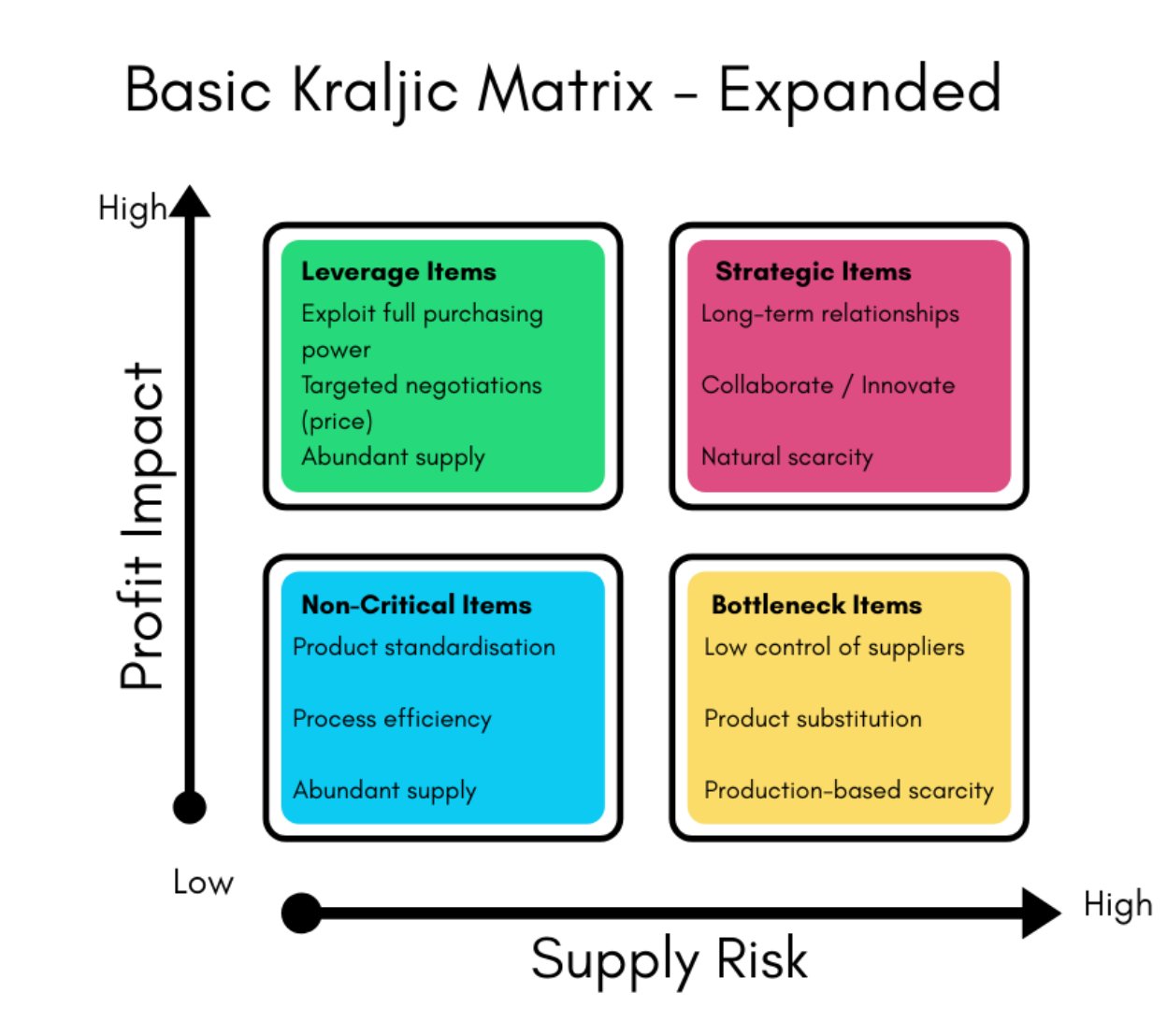 The Kraljic Matrix, with the buyer’s typical approach in each box.
Non-critical items
Low profit impact, low supply risk. These are everyday purchases such as stationery and standard services, where supply is plentiful and one supplier looks much like another. The buyer’s strategy is ruthless efficiency: standard processes, automated ordering, as little attention as possible. The relationship is transactional at best and non-existent at worst.
Leverage items
High profit impact, low supply risk. These purchases move the bottom line, but there are plenty of suppliers to choose from. Think standard raw materials or IT hardware. The buyer’s approach is aggressive negotiation, suppliers played off against each other, and an annual tender. The message is clear: you are replaceable, and we will remind you at every turn.
Bottleneck items
Low profit impact, high supply risk. These do not cost much, but if they are not there the operation stops. Specialised maintenance services and niche components live here. The buyer concentrates on securing supply, reducing risk and perhaps developing alternatives. The relationship is cautious, with a contingency plan always in the buyer’s back pocket.
Strategic items
High profit impact, high supply risk. These are critical purchases from a small number of sources: custom machinery, specialised consulting, core raw materials. Here the buyer’s approach is partnership, collaboration, joint planning and a horizon of several years. This is where every supplier wants to be, because this is where relationships go beyond transactions.
Why buyers keep the strategic box small
Here is the uncomfortable truth. Buyers want as few suppliers as possible in that strategic box. Strategic relationships need investment, compromise and mutual dependence. They carry risk, they reduce flexibility and they eat resources.
It is far easier to treat most suppliers as leverage or non-critical, keep the upper hand, keep options open, and drive costs down through competition. The Kraljic Matrix gives procurement both the intellectual framework and the internal justification to do exactly that.
A buyer’s ideal world is a vast ocean of easily replaceable suppliers with a tiny island of genuinely strategic partners in the middle of it. Their careers often depend on making the ocean bigger and the island smaller.
Buyers classify categories, not companies
This is the part of Kraljic that suppliers most often misunderstand. We imagine the buyer puts our whole company in a box, and we celebrate: “We’re a strategic supplier. We made it!”
That is not how it works. Buyers position categories of purchase, not suppliers. You might have two product lines classified as strategic and the other 20 spread across the remaining three boxes. Even the Wikipedia entry on the Kraljic matrix points out that it was designed to map purchases, and that applying it to whole suppliers produces a misleading picture.
So before you ask whether you are a strategic supplier, ask a harder question. Which of your lines does this customer see as strategic, which does it see as leverage, and do you know the answer from the buyer’s side of the table or only from your own?
Because your profitability, your growth and perhaps your survival may depend on getting more of your business onto that island.
How to become a strategic supplier: three routes
If buyers categorise you (they do), and their categories shape your business (they do), then the central question is how you move from one box to another. More specifically, how do you get from the ocean to the island?
It takes understanding, strategy and patience, and the route depends on where you start.
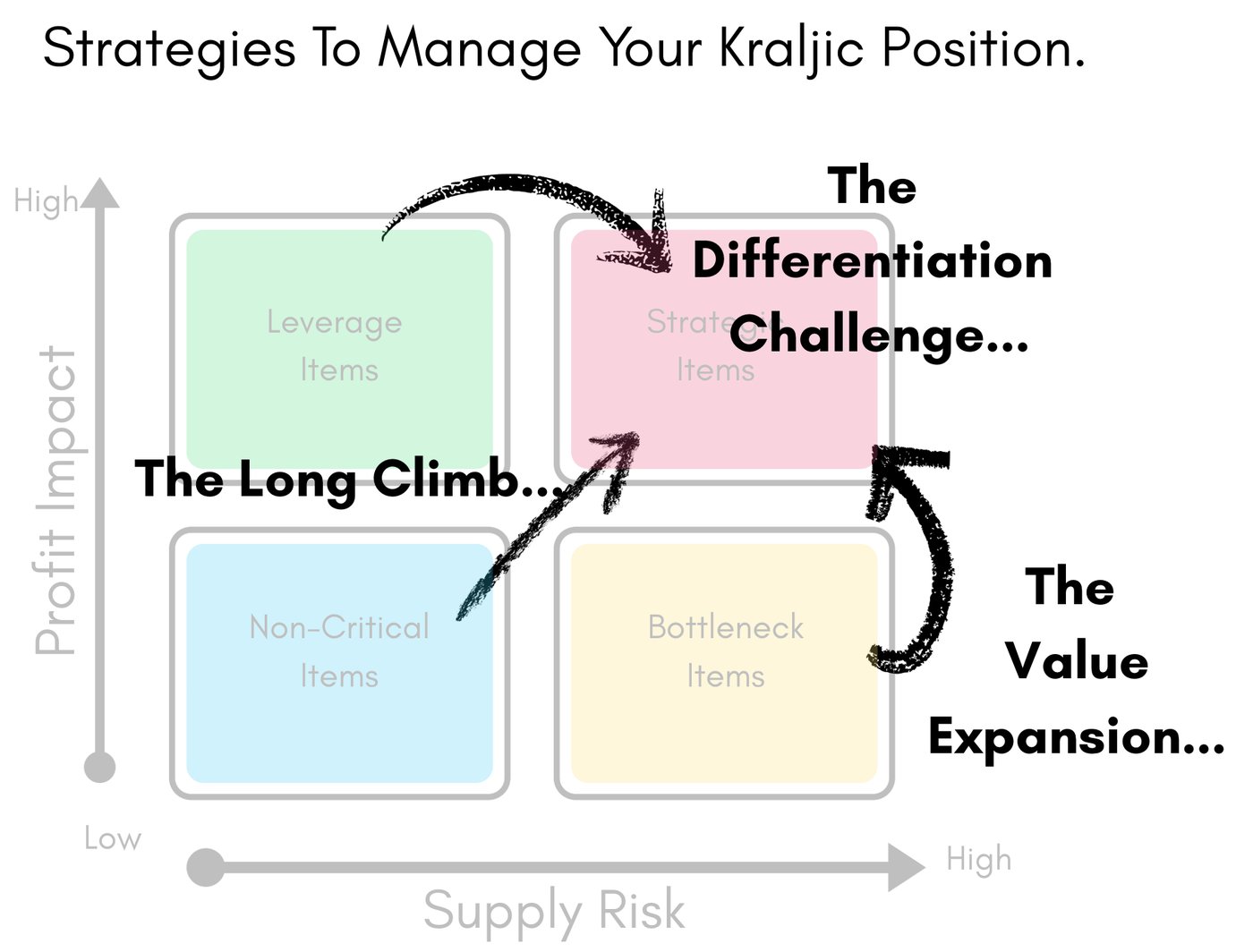
From non-critical to strategic: the long climb
If you are in the non-critical box you have the steepest climb, because you must raise both the buyer’s sense of your profit impact and their sense of supply risk.
Start by understanding the customer’s real business. Non-critical suppliers rarely see beyond their immediate contact, so break the pattern. Study the customer’s business model, their challenges and their strategic initiatives until you understand what drives their profit, not just the part your product touches today.
Then look for the hidden connection between that understanding and your expertise, which is often bigger than your current product. Perhaps a mundane component, modified, could improve the performance of their end product. Perhaps your service, extended, could remove a significant cost. This is where value in use and total cost of ownership earn their keep.
Next, make the uniqueness real. This needs a light touch. You are not manufacturing false scarcity; you are making sure the buyer understands what is genuinely different about your method, process or technology, and why it cannot easily be copied.
Finally, prove it. Propose a small pilot aimed at one significant profit driver, fund it yourself if you have to, record the results carefully, and turn them into a case the customer’s own people can repeat.
Be realistic about time. This climb is measured in years, not months, and it needs investment, persistence and a real repositioning of your offer.
From leverage to strategic: the differentiation challenge
In the leverage box you already have profit impact. Your task is to raise the buyer’s sense of supply risk so you become harder to replace.
Leverage suppliers compete inside tightly written specifications, so step outside them. Talk to people beyond procurement, in the wider decision-making unit, and find out why the specification says what it says. Then look for better ways to meet the underlying need.
Integrate rather than just deliver. Can you connect to their systems, take over inventory management, provide forecasting? The more embedded you become, the higher the cost of switching.
Lead with insight. Use your knowledge of the industry to give the customer something they cannot get elsewhere, perhaps patterns you see across many customers, or early warning of regulatory change. Be the supplier who makes them smarter, not the one who fills orders.
And build legitimate scarcity: capabilities that fit this customer’s needs precisely and that a competitor cannot copy quickly, such as a dedicated team with customer-specific expertise, customised equipment or tailored analytics. The harder it is for an outsider to see exactly how you create the value, the harder you are to replace, which is the idea behind causal ambiguity.
This move often happens faster than the long climb, but it takes political skill. You are asking a buyer to admit to more dependence, which runs against everything procurement is paid to do.
From bottleneck to strategic: the value expansion
The bottleneck box is an unusual starting point. The buyer already sees high supply risk but not much profit impact, so your task is to show far more value from the specialist position you already hold.
Start with the cost of disruption. Bottleneck items often matter far more than their price suggests; a small component can stop a whole production line. Document and quantify those wider effects so the buyer sees the real connection to profit.
Then widen your footprint. The customer already trusts your capability in one area, so find the neighbouring problems where the same knowledge gives them an advantage.
Turn risk into opportunity. Bottleneck suppliers are usually seen as a risk to be managed. Change that by showing how your specialist capability could give the customer something competitors cannot copy, a product feature or a route into a new market.
And become the category expert: the recognised authority in your niche, the one who publishes, helps shape industry standards and teaches the market how your category should be judged.
This route needs you to change the story from managing risk to creating value. You are asking the buyer to see possibilities where they used to see only a dependence they would rather not have.
Already in the strategic box? Defend your position
If you have reached strategic status, congratulations. Now stay alert. Procurement’s natural instinct is to reduce dependence and increase competition, so your place is never guaranteed.
Keep innovating, with new capabilities that reinforce what makes you different. Build connections at many levels and across many functions in the customer’s business, because every extra relationship makes you harder to remove. Measure and communicate the value you deliver, consistently, so your contribution cannot be argued with; our Value Edge Diagnostic is one way to find the gaps. And look ahead for the threats (a new competitor, a technology shift, a change in what the customer needs) and deal with them before procurement turns them into bargaining chips.
Strategic status also rests on something no matrix measures, which is whether the customer trusts you. I come back to that in do your strategic customers trust you?
Know which box you are in
The Kraljic Matrix is not just a procurement tool. It is the lens through which your business is being judged, often by people you have never met. Knowing where you sit, and patiently working to move, is not just good account management. It is commercial survival.
Somewhere in your customer’s building there is a spreadsheet with your company’s name on it, and a category next to each line you sell. Would you recognise yourself in it?
References
Kraljic, P. (1983) ‘Purchasing must become supply management’, Harvard Business Review, 61(5), pp. 109 to 117.
If this is your problem too, score your account with the Value Edge Diagnostic, or talk to us.
The newsletter this came from
Every fortnight: one idea from the method, worked through properly. Read it where you already are, on LinkedIn, or by email below.
Keep reading
What is this customer actually worth to you?
Revenue tells you what a customer paid you. It says nothing about what they spent. The gap between the two is your share of wallet, and most account teams cannot state it within twenty points.
Problem Framing: Define the Problem Before the Solution
Most lost proposals were lost before they were written, because nobody defined the customer's problem. Problem framing fixes that, and here is how to do it.