What Is a Key Customer, Anyway?
Ask five senior leaders to name your top 10 customers and you will get five lists. Here is how to decide what makes a key customer, and why it matters.

The next time you are in a room with senior leaders from different parts of your business, ask them two questions. Who are our top 10 customers? And how did we decide they should be in the top 10?
What you are really asking is: who are our key customers, and why?
You might have this nailed. If every function in your business would give the same list, for the same reasons, well done. But I have worked with hundreds of organisations across many sectors, and those two questions usually produce a pause, then some answers that do not quite match.
Here are a few I have collected. From a head of R&D: “Why do I need to know who our customers are? That’s a job for sales. I’m in R&D!” From a senior leader, with total confidence: “Oh yes, these are the top 10 customers.” Then from another senior leader in the same company, with exactly the same confidence, a completely different list.
And my favourite: “We identified our top 10 customers five years ago. It was a strategic project we did with a major consultancy. We didn’t release the findings because it might have upset the customers that weren’t regarded as key. I’ve got the file somewhere. Give me 10 minutes to find it.”
None of these people are foolish. What the answers show is a lack of focus, and a failure to see how much competitive edge a properly run key account management programme can give you. It all starts with knowing what a key customer is.
Why customer clarity matters so much
You might wonder whether it really matters that everyone agrees on the definition. It does, absolutely. How can your business focus on its customers’ needs if it cannot agree which customers it is focusing on?
If different departments cannot agree which customers deserve special attention, you have no chance of delivering exceptional, coordinated value to them. Every claim to be customer-centric falls apart at that point.
Customer management is a textbook case of the Pareto principle, the observation that roughly 80% of results come from 20% of causes. For most suppliers a small share of customers produces most of the sales and most of the profit, and the split is often steeper than 80:20. I have seen businesses where 90% of the profit came from just two customers. I would not recommend it as a strategy. Imagine losing one of them.
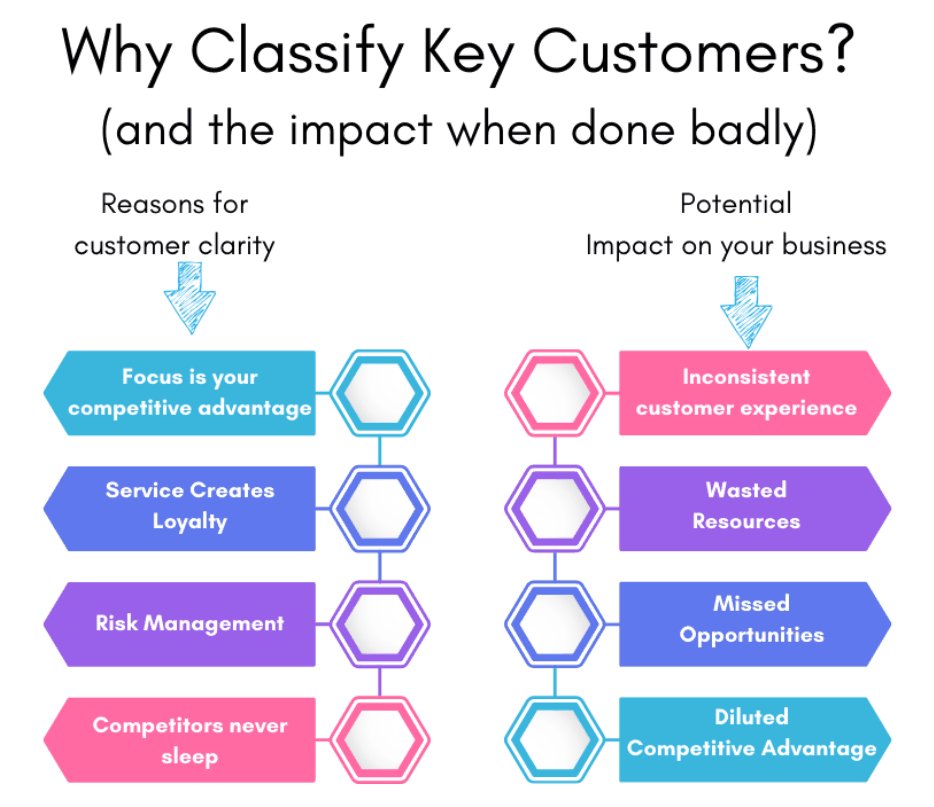
Four reasons to be clear about what makes a customer key
Focus is your competitive advantage
Your time, money and attention are limited. When you define your key customers clearly, you can put those resources where they will count. Spread them evenly across the whole customer base and everybody gets a mediocre service.
Superior service creates loyalty
Once you know who matters most, you can give them the service they deserve. That earns loyalty, and loyalty from your most significant customers is what sustains growth year after year.
Risk management
Losing a key customer hurts your revenue now and for years afterwards. I have watched one lost account do serious damage to a supplier’s commercial and reputational standing. If you know which accounts are critical, you can put specific plans in place to protect them.
Competitors never sleep
If a customer is valuable to you, it is valuable to your competitors too, and they are watching. Keep adding value and keep your best people close to that customer. Assuming the business is secure is how you lose it.
The cost of getting it wrong: why alignment matters
The most overlooked part of key account management is cross-functional alignment. When different leaders name different top 10 lists it is funny for about a minute. Then it is alarming.
When R&D, operations, finance and sales each prioritise different customers, the customer gets a disjointed experience, money goes on initiatives for customers who are not priorities, and your most important relationships never see the full capability of the business. Every function, from product development to delivery logistics, needs to know which customers are strategic priorities and why they were chosen.
So go back to those two questions. Who are your key accounts, and how did you make that decision?
Customer segmentation: from principle to practice
You do not need special glasses to see that identifying key customers is critical. The harder question is how to do it.
Whenever I advise a business on customer management, sales strategy or KAM, I start with customer segmentation, sometimes called portfolio classification. In short, I want you to divide your customer portfolio into buckets, or types of customer, each of which gets a different kind of attention.
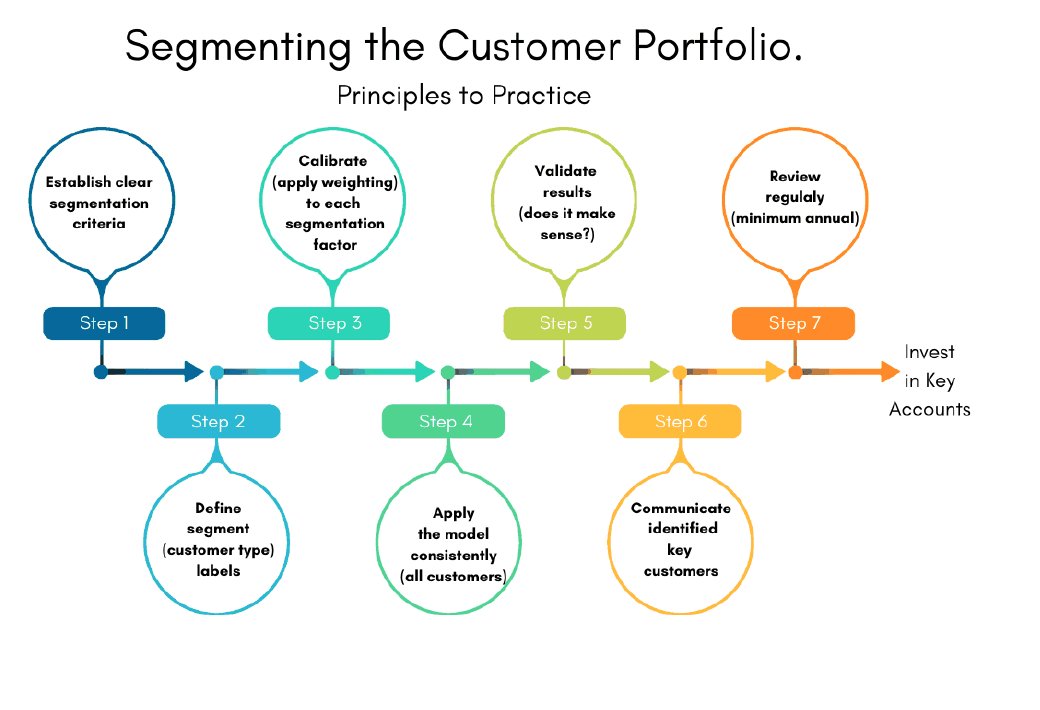 Seven steps from principle to practice.
Set criteria that go beyond revenue
This is where many businesses stumble. They sort by last year’s revenue and call it segmentation. Good criteria look at several dimensions: financial measures such as revenue, profit contribution and growth rate; strategic value such as market influence or the chance to innovate together; the strength of the relationship at executive level; future potential; and the cost to serve.
Name the segments carefully
Give each segment a clear, meaningful label. Beyond “key accounts” you might use “strategic growth partners”, “foundation customers”, “emerging opportunities” or “transactional accounts”. The words matter. They shape how your people think about and treat each group.
Weight the factors
Not every criterion matters equally. Work across functions to agree the relative weight of each one, so that customers who score well on what matters most rise to the top.
Apply the model to every customer
Run your whole portfolio through the model and apply the criteria consistently. This nearly always surprises people. Customers you assumed were key may not qualify, and some you had overlooked show real potential.
Validate, communicate and review
Ask leaders from across the business to review the first results. That improves the accuracy and builds buy-in at the same time. Then communicate the outcome clearly, so people understand not only which customers sit in which segment but why. Finally, review it regularly, at least once a year, because customers change and so does your strategy.
Be warned: this gets emotional. Key account managers become very attached to their customers. Then the business decides that a customer is no longer key but “foundation”, which means it no longer gets a key account manager. That is exactly why you need objective criteria and a systematic review. They protect the decision from attachment and bias, including your own.
Segmenting the customer’s customer
In some industries good segmentation looks one step further down the chain. Consumer goods companies such as Procter & Gamble and Unilever segment not only their retail customers but the shoppers who buy from those retailers.
That creates powerful alignment. When a major retailer shapes its offer around the shoppers the manufacturer is targeting, both sell more. Help your key customers serve their own customers better and you stop being just another supplier. You become hard to replace.
The four principles of key customer selection
Before any of the steps above, I introduce four principles that move a leadership team from confusion to clarity. They have become the anchor point for many KAM programmes I have worked on. Think of them as two plus two.
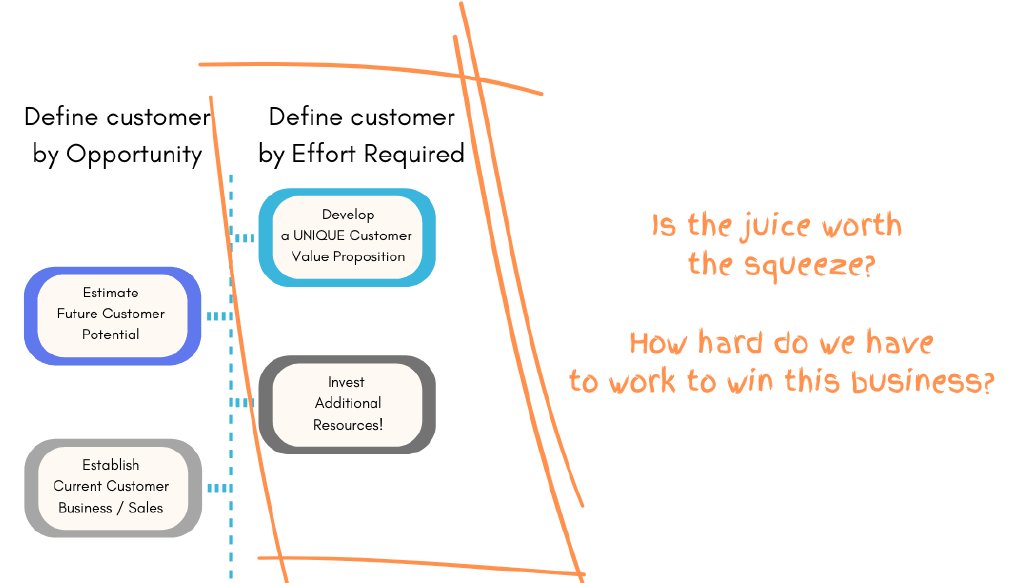
Define the customer by opportunity
The first principle is future potential. Usually that means financial opportunity, but not always. You might select a customer because working with them teaches you about a new sector or technology.
The second principle is the business you already have with them. Ask many businesses how they segment and this is the only factor they use: they pick customers off a spreadsheet of last year’s sales. That is clumsy and dangerous. What if those 10 customers are all in a shrinking market? Without the first principle you simply sink with them. You can see what a customer is really worth, and what share of their spend you could win, with our Whole Wallet calculator and in what is this customer worth?.
Look both ways, too. Is there an opportunity for the customer as well as for you? Do they see you as a supplier that could add value?
Define the customer by effort required
Principles three and four describe what you must do for a customer once you select them.
The third is a unique value proposition. If a customer passes the first two tests, you need to do something focused and specific for them that you will not do for the others. You must build an offer that adds value to their business. This is the shift that makes KAM value-based rather than a sales label, and it is what a customer value proposition is for.
The fourth is resource allocation. Key account management does not happen because you highlighted a name on a spreadsheet. You have to raise your game: hire the right people to manage key customers, align resources behind them, spend more time with them, perhaps develop specific products and services, or expand into new geographies to follow them.
An expression I have used for years, and which always lands with the teams I work with, sums it up: a key customer is a market segment of one. You put the same effort into each selected customer that you would put into an entire market segment or industry.
What happens when you get it right
A speciality chemicals business I worked with had 3,000 customers, and 850 of them were labelled “key”. That is not focus. That is a mailing list. Using a proper selection model they reassessed the whole portfolio and cut the key group to 65 accounts. Then they moved support and investment to where the data said it mattered. Within eight months revenue was up 32% and profit up 25%.
The lesson is not that fewer is always better. It is that 850 customers were each getting a thin slice of attention, while 65 of them had been quietly underserved for years.
What selection commits you to
Choosing your key customers is the start, not the finish. Each key account needs an executive sponsor who can clear internal barriers, or KAM slides back into sales as usual with fancier job titles. It needs a key account manager with skills well beyond selling (I set them out in the eight competences of key account managers), and those people are rare enough to deserve proper pay and a real career path. And it needs a plan that is used rather than filed. If you have ever found last year’s plan in a drawer, the plan in the filing cabinet is for you.
Is the juice worth the squeeze?
Put the first two principles against the last two and you have one question to ask of every candidate: is the juice worth the squeeze? How hard will you have to work to win and keep this business, and is the prize big enough to justify it?
If the answer is no, perhaps they are not a key customer. That is fine. Step back, serve them well in another segment, and put your effort into the customers who have the opportunity and warrant a unique offer. Both of you will be better off.
The businesses that do well in B2B markets have learned that focus is their friend. And it all starts with the question that stumped that room full of senior leaders. Somewhere in your building there may still be a file from five years ago. It is worth 10 minutes to find it, and a good deal longer to decide whether it is still true.
References
Davies, M. (2016) Infinite Value: Accelerating Profitable Growth Through Value-Based Selling. London: Bloomsbury. Available at: Google Books.
If this is your problem too, see the Strategic Customer Planning Tool on the ladder, or talk to us.
The newsletter this came from
Every fortnight: one idea from the method, worked through properly. Read it where you already are, on LinkedIn, or by email below.
Keep reading
The Plan in the Filing Cabinet
Somewhere in your organisation there is a key account plan that nobody has opened since the day it was approved. It does not die from lack of discipline. It dies because no team ever had the hours to keep it alive. Now, finally, something has the time.
Customer Segmentation: The Kingpin of Customer Management
Most companies segment customers on last year's sales, and pay for it. Here is a five-stage method for customer segmentation that looks at future value instead.