Do Your Strategic Customers Trust You?
Trust holds every key account together, yet it rarely makes the account plan. How to measure trust with strategic customers, and how to build it on purpose.

Ask a key account manager to walk you through their account plan and you will hear about market share, product launches, pricing and the customer’s strategy. You will rarely hear the word trust. And yet trust is the glue that holds every key account together.
It should be discussed far more than it is.
It is easy to get absorbed in strategic frameworks, spreadsheets of results and launch plans. But one thing never changes. People buy from people, and buyers deal with suppliers when they have people they trust, from companies that want to be trusted.
So let me ask you directly. Do your strategic customers trust you? How would you know?
What is trust, anyway?
Defining trust is a good place to start, especially in business.
When a customer chooses to work with a supplier, it is trusting that supplier to carry out tasks it has decided not to do itself. The reasons vary. Usually the supplier has capabilities focused on that area and can do the work better, cheaper, faster, to a higher standard, or some combination of all four. Whatever the reason, the customer has to trust that supply will be set up and maintained as expected.
Contracts, service-level agreements and pricing agreements formalise all of that. But trust is the human element that seals the deal.
The executive coach Charles Feltman gives one of the most useful definitions I know. In The Thin Book of Trust he describes trust as choosing to risk making something you value vulnerable to another person’s actions. That fits business precisely. Your customer is putting something it values (its production line, its product launch, its reputation with its own customers) in your hands.
When trust is fractured
Like any relationship, broken trust has consequences. In personal life it can end a partnership or a marriage. In a strategic business partnership the damage is quieter but just as real.
Decisions on your new proposals slow to a crawl. Business drifts to competitors. Business that once felt secure is suddenly put out to tender. Access to strategic information dries up. And you find yourself moved from the customer’s inner circle to the outer one, often without anyone telling you. If you want to know how buyers make that call, read are you a strategic supplier?
Trust also works both ways. If a customer behaves in a way that strains the relationship with its key suppliers, why should it keep receiving premium service or first sight of new products? A relationship where only one side is expected to be trustworthy is not a partnership.
A quick and dirty way to measure trust
Because trust lives between people, it is hard to measure. Fortunately others have done some of the work. In The Trusted Advisor, David Maister, Charles Green and Robert Galford set out the trust equation.
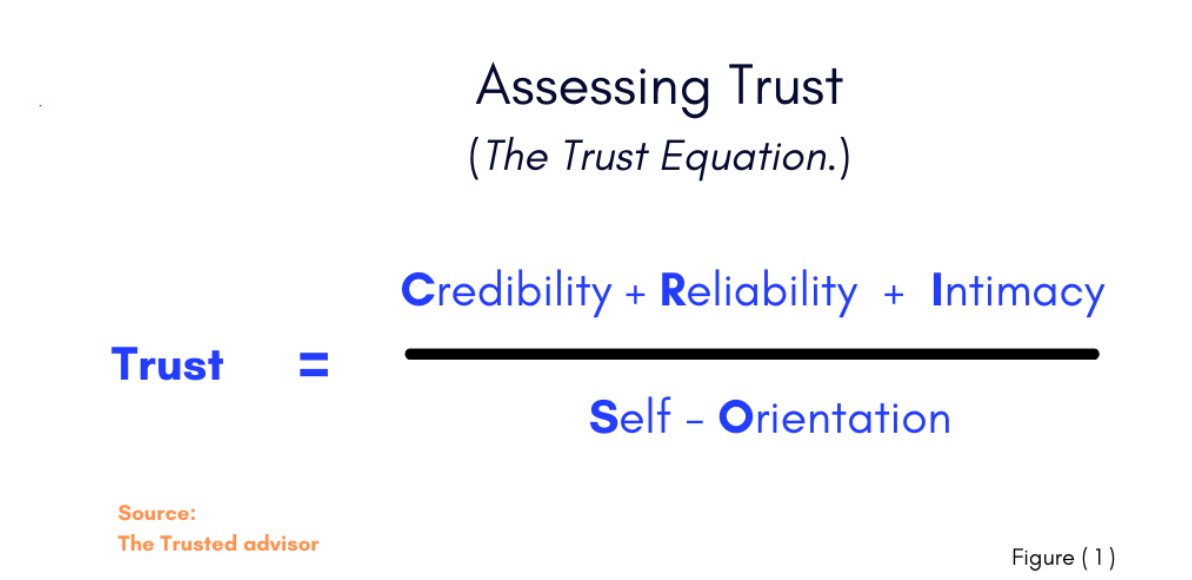 The trust equation, from Maister, Green and Galford’s The Trusted Advisor.
Look at it from your key customer’s side of the table. They want the top of the equation to be high. Are you credible, capable and skilled? Are you reliable, doing what you promise? And do you have intimacy, meaning you have worked hard to understand the parts of their business that really matter?
At the bottom sits self-orientation, and they want that low. If the relationship is all about you, your company and your numbers, trust shrinks, however good the top line looks. That is exactly what happens in sales-led businesses chasing monthly or quarterly targets.
The equation works in the other direction too. If a customer shows no interest in its suppliers beyond demanding lower prices, trust is strained just as badly from their side. Trust and relationships are two-way streets.
Why trust is more complicated in B2B
Relationships are hard enough when it is one person dealing with another. B2B involves many people.
You deal with a main contact, usually the buyer, but there are plenty of other relationships in the account, and some of them matter more than the one with the buyer. The customer’s decision-making unit includes buyers, deciders, specifiers, gatekeepers, users and influencers. Working out who plays which role is not always easy (some people wear several hats), but it is critical. If trust is broken anywhere in the decision-making unit, getting any deal agreed becomes very difficult.
And that is only the customer side. The key account manager sits at the centre of four sets of relationships, and must keep trust in all of them.
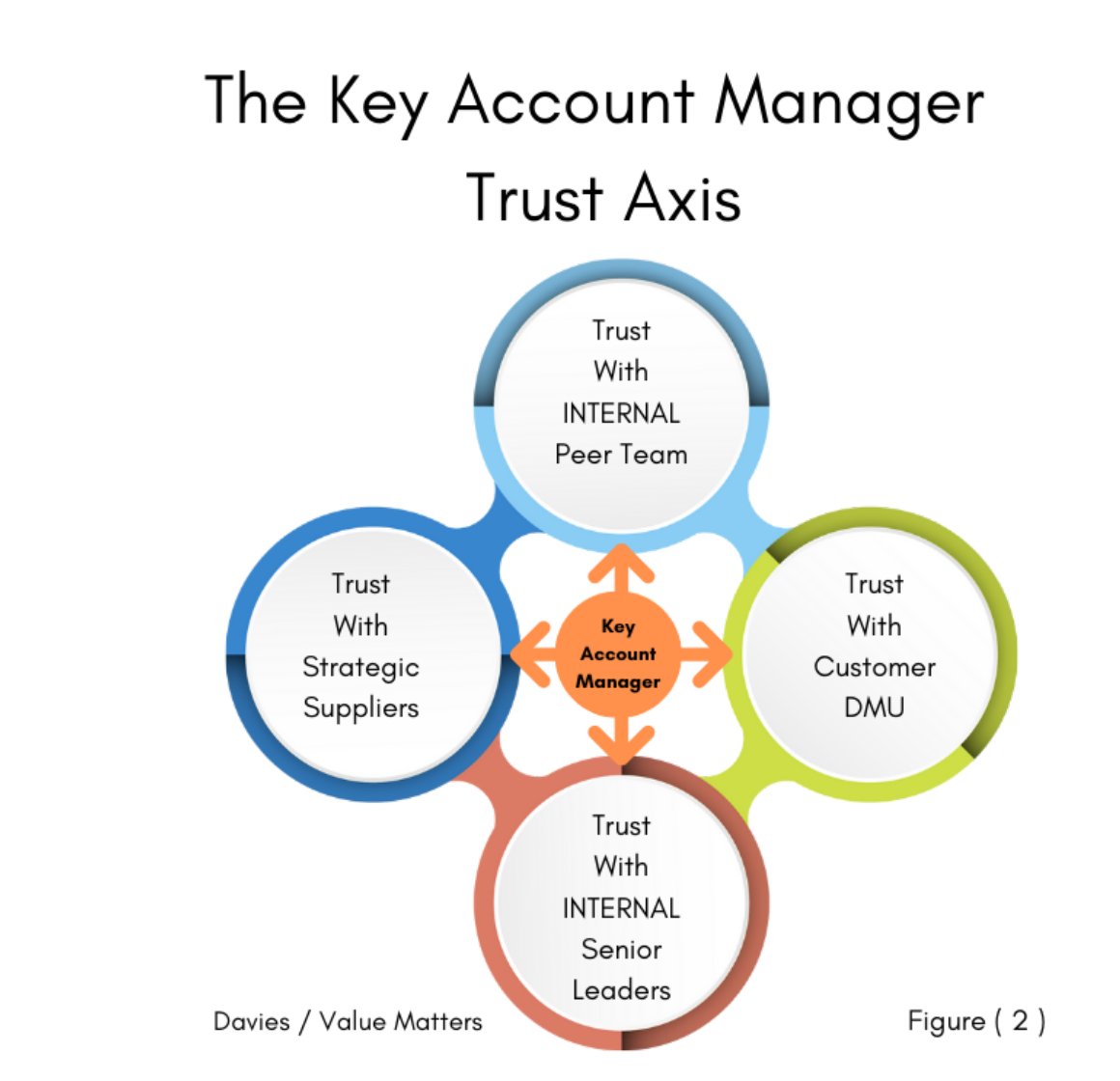 The key account manager trust axis.
There is the customer’s decision-making unit. There are your internal colleagues in other functions, whose help you need to deliver anything. There is your own senior leadership team. And there are your critical suppliers, whose performance becomes your performance in the customer’s eyes.
Think about what that means. A single key account can represent a large share of a supplier’s revenue and profit. Your leadership team and your investors are relying on you to look after that asset. Do you think it is easy being a key account manager? Think again. If you have ever felt that the whole account rests on you, the three constant KAM challenges will sound familiar.
How to build trust like a ninja
Two things have to be true before trust can grow.
First, you need strong relationships with the critical stakeholders, inside and outside your business.
Second, your business has to keep its promises. I often hear key account managers say that the customer trusts them personally and the relationship is strong, but their company keeps letting the customer down: goods arrive late, quality slips, and the admin systems are horrendous. Frankly, if your business cannot deliver, that is a bigger problem than anything I can help you with here. Your job is to be the customer’s voice inside your own business and to push those issues until they are fixed. Some of this needs wider teams to change. The rest of this section is about the trust you can build personally.
For that, the best foundation I know is Stephen M.R. Covey’s The Speed of Trust. Covey argues that trust is not a soft social virtue but a hard economic driver. High trust speeds things up and lowers costs. Low trust slows everything down and makes it more expensive. He calls these the trust dividend and the trust tax, and anyone who has waited three months for a low-trust customer to approve a proposal has paid the tax.
Covey describes five waves of trust, spreading outward from the self to relationships, organisations, markets and society. The first wave, self-trust, rests on credibility, which he builds from four cores: integrity, intent, capabilities and results. Put simply: are you honest, are your motives good, can you do the job, and have you done it before?
The second wave, relationship trust, is where a key account manager lives. Covey sets out 13 behaviours that build trust with other people.
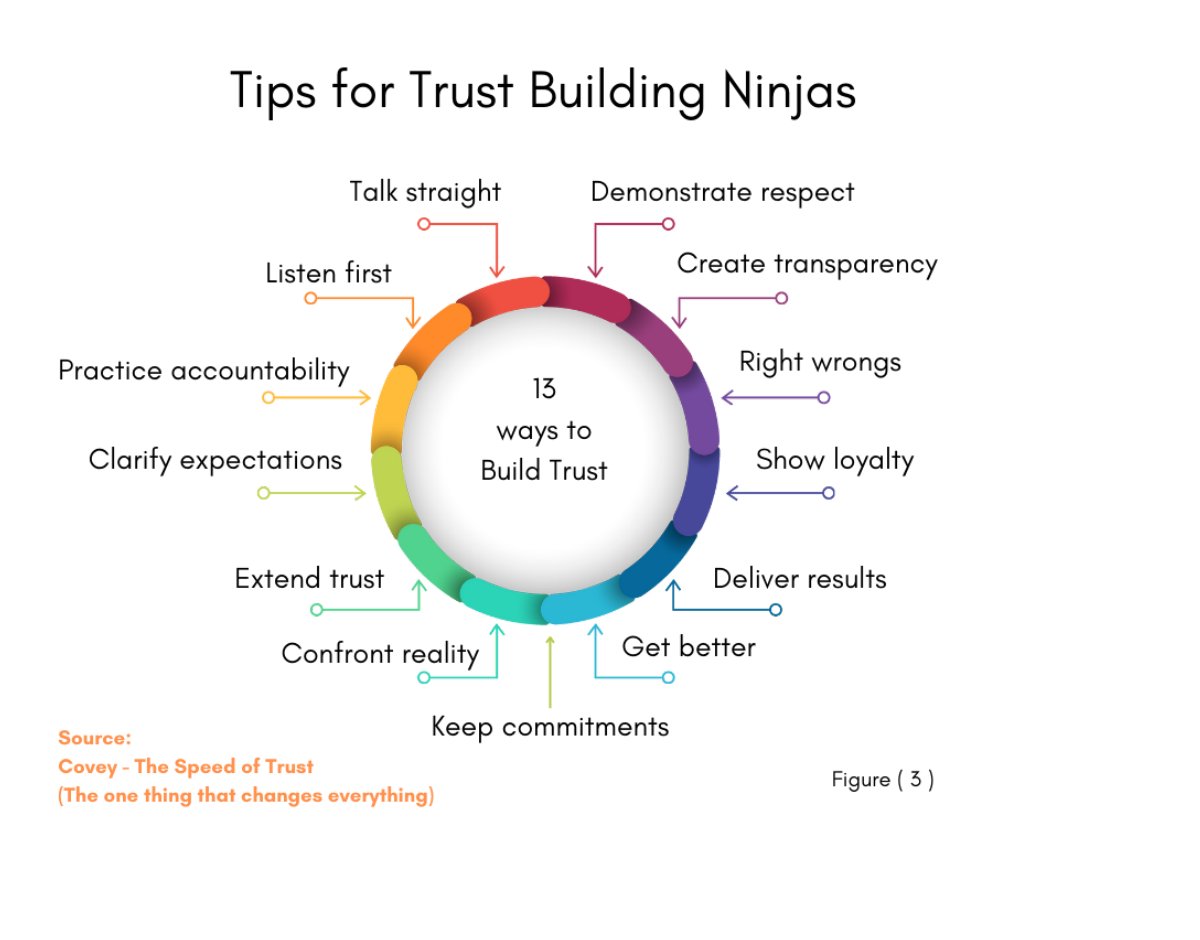 Covey’s 13 behaviours, a checklist for trust-building ninjas.
They are: talk straight, demonstrate respect, create transparency, right wrongs, show loyalty, deliver results, get better, confront reality, clarify expectations, practise accountability, listen first, keep commitments and extend trust. Use them as a checklist. Take your most important customer, go down the list, and be honest about which ones you do well and which ones you skip when the quarter is tight.
The later waves matter to your business as a whole. Organisational trust depends on systems and structures that reward trustworthy behaviour rather than undermine it. Market trust is your reputation with customers at large. Societal trust is the widest ring of all. You cannot fix those alone, but you can make sure your own account is not the place where they break.
What next? Questions to ask yourself
Since I started applying these ideas I have found that having a framework changes what you notice. Here are the questions I have been asking myself, about customers, suppliers and partners alike:
- Do I trust this organisation?
- Do I trust the people I am dealing with?
- Do they trust me?
- Have I done anything to strain or break that trust?
- What did the other party do to strain or break it?
- What could I do to restore it, if it needs restoring?
You have to be brutally honest to answer them. You also have to decide whether you want to put in the effort to repair and build trust, because it is so much easier to carry on with a fractured relationship and hope it sorts itself out. (It never does.)
There was a seventh question: should I build these principles into the KAM training and coaching I do? That one was easy. Yes. Trust now runs through our KAM development programme, because a key account manager’s skills are wasted if the customer does not believe them. You can test your own starting point with the KAM Tri-Skills self-assessment.
Of all the models, Covey’s 13 behaviours are the one I have adopted most. They work for me. Pick the customer you worry about most, and the one behaviour you know you have been skipping with them. Start there, next week, and see what changes in the room.
References
Covey, S.M.R. (2006) The Speed of Trust: The One Thing That Changes Everything. New York: Free Press.
Feltman, C. (2011) The Thin Book of Trust: An Essential Primer for Building Trust at Work. Thin Book Publishing.
Maister, D.H., Green, C.H. and Galford, R.M. (2000) The Trusted Advisor. New York: Free Press.
If this is your problem too, score your account with the Value Edge Diagnostic, or talk to us.
The newsletter this came from
Every fortnight: one idea from the method, worked through properly. Read it where you already are, on LinkedIn, or by email below.
Keep reading
What is this customer actually worth to you?
Revenue tells you what a customer paid you. It says nothing about what they spent. The gap between the two is your share of wallet, and most account teams cannot state it within twenty points.
Problem Framing: Define the Problem Before the Solution
Most lost proposals were lost before they were written, because nobody defined the customer's problem. Problem framing fixes that, and here is how to do it.