The Three Constant KAM Challenges, and How Value Fixes Them
Fifteen years of listening to key account managers produced the same three KAM challenges every time. All three have one root cause, and one way out.

For 15 years I organised and hosted the Key Account Management Best Practice Club at Cranfield School of Management. Over that time I sat in rooms with hundreds of key account managers and KAM leaders from dozens of industries around the world. Their markets, products and services could hardly have been more different.
And yet, meeting after meeting, the same three KAM challenges came up. Not occasionally. Constantly.
The first was buyers fixated on lower prices. The second was knowing that each key customer needed an innovative offer, and not knowing how to build one. The third was a feeling of being alone: a key account manager should have the full support of the business behind them, and getting that support from the “non-customer” functions was essential and incredibly hard.
My consulting and training work since then has only confirmed it. If you manage key accounts, I would be surprised if at least one of those did not describe your week.
Why these challenges matter to both sides
These are not small irritations. Each one damages the supplier’s key account management programme, and each one hurts the customer too, because anything that weakens KAM weakens your ability to build solutions that improve the customer’s business.
Here is the uncomfortable part. The cause of all three sits mainly with the supplier, and fixing them means changing how the supplier works.
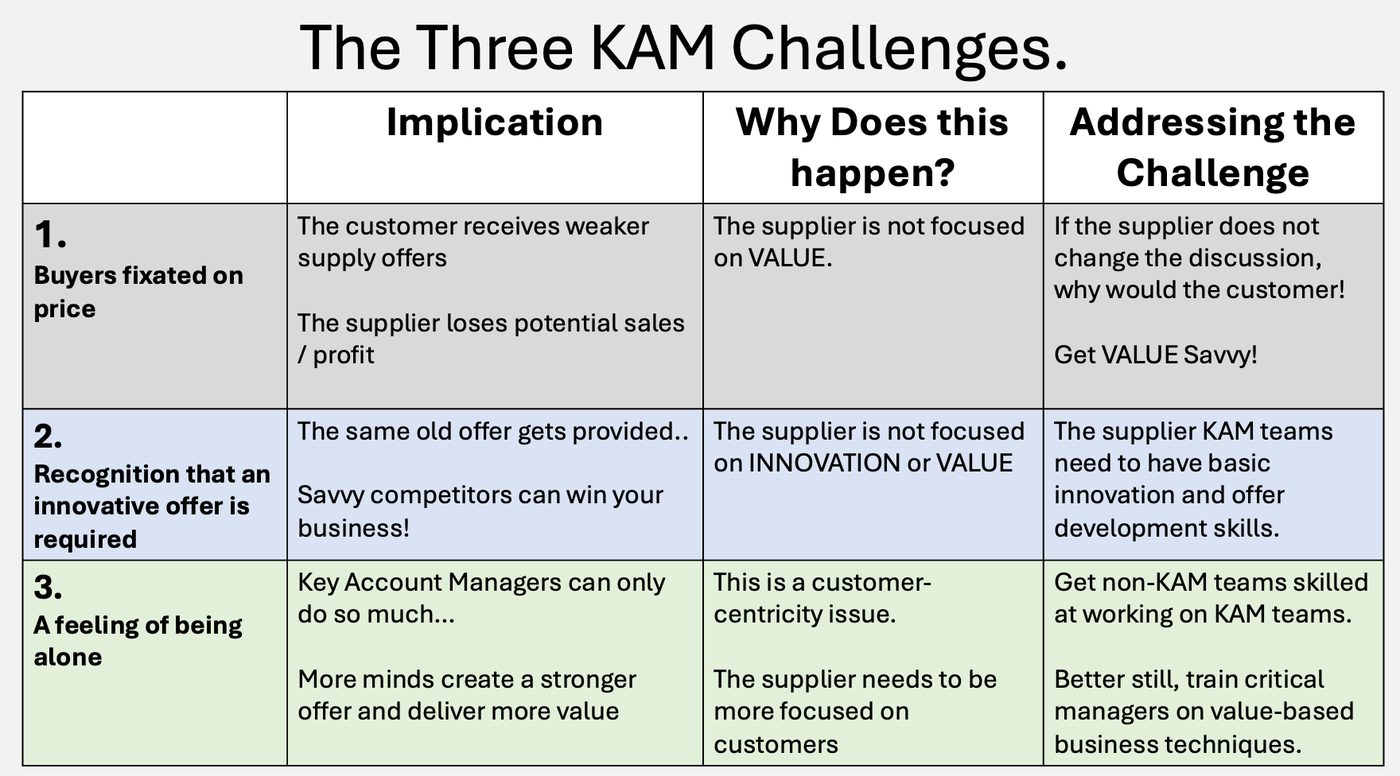 The three KAM challenges: implication, cause and remedy.
1. Buyers fixated on price
When the whole conversation is about price, the customer receives weaker offers and you lose sales and profit you could have had. Why does it happen? Because you have not made the conversation about value.
Seth Godin put it better than anyone, in a blog post that is just two lines long: “Maybe the reason it seems that price is all your customers care about is… that you haven’t given them anything else to care about” (Godin, 2007).
Read that twice if you are a key account manager. If you do not change the discussion, why would the customer? Squeezing a supplier on price gives a buyer a quick hit of satisfaction. But does it give their business a real strategic advantage? Almost never. Customers do better when their suppliers care about their business and do useful things to help them reach their goals. If they are honest, most buyers know that. You have to give them something else to talk about.
2. Knowing you need an innovative offer, and not knowing how
The second challenge follows from the first. The same old offer gets presented year after year, and a sharper competitor eventually wins the business with something new. The cause is a supplier focused on its products rather than on innovation or value.
Most key account managers I met understood this perfectly well. What they lacked was the method. Nobody had taught them how to build an offer around one customer’s strategy, which is a skill in its own right. We call it offer development and innovation, and it can be learned. The Offer Wheel is one way to start.
3. The feeling of being alone
The third challenge is the one people spoke about most quietly. A key account manager can only do so much alone. More minds create a stronger offer and deliver more value, but finance, supply chain, R&D and marketing all have their own priorities, and the key customer is rarely one of them.
This is a customer-centricity problem, and it belongs to the whole business, not just the KAM team. The remedy is to give people outside sales the skills to work on key account teams, and better still, to train your critical managers in value-based business techniques so they understand why the customer matters to them too.
Value leakage: how the three challenges destroy value
A customer is selected as key because there is significant business today and real potential for growth tomorrow. That potential shrinks fast when every discussion is about price and price reduction. This was the thinking behind my book Infinite Value, and the model below comes from it.
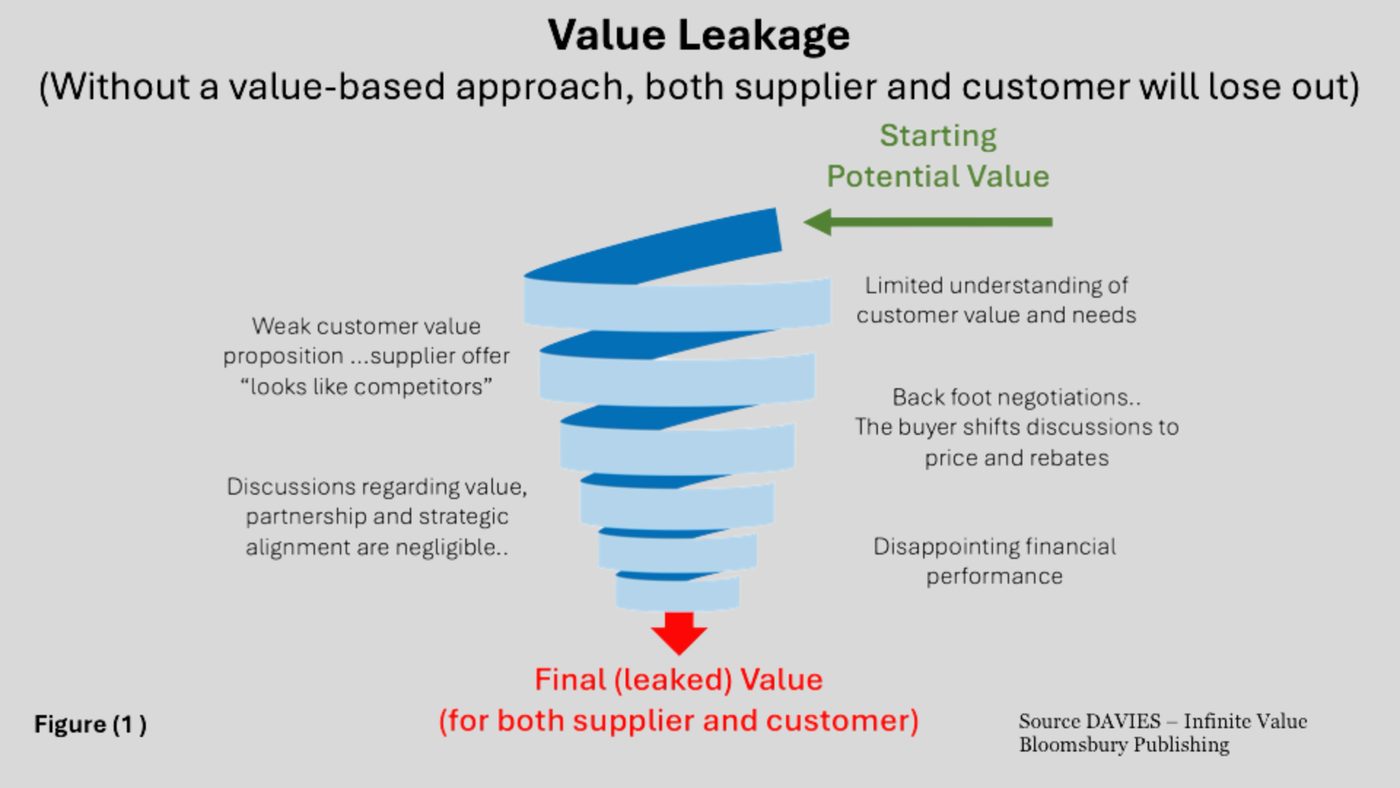 Value leakage: without a value-based approach, both supplier and customer lose out.
Every value-based business model starts with a strong, deep understanding of the customer’s business. Suppose you know the customer’s strategy, the threats and opportunities in their market, their strengths and weaknesses, and the five or six major initiatives they are pursuing to reach their goals. Then you can shape your offer to make those things happen, faster and more efficiently than they could alone.
If you do not know those things, you are outside everything that really matters to them. You are where most suppliers are, fighting competitors with a “me too” offer on the lowest common denominator. Price. (Back to Mr Godin again.)
That is when value leaks away, one turn of the spiral at a time. Your offer is weak and looks like your competitors’. Your negotiations are weak because you have nothing new to bring to the table, so the buyer moves the talk to price and rebates. Conversations about value, partnership and strategic alignment shrink to almost nothing. The financial results disappoint. A large opportunity has turned into a small one, and it is a loss for the customer as much as for you. This is the commodity trap, and you walk into it one reasonable concession at a time.
Value-based KAM: the intersection of strategy, sales and innovation
Something has to change. What many businesses do at this point is give up on KAM and go back to a plain sales approach. That is a mistake. Building a KAM business model, and working with customers in a more strategic and innovative way, is essential. But the approach has to evolve.
I start with the definition. KAM should be redefined so that it says plainly that it is about value:
Value-based KAM is the intersection of strategy, sales and innovation.
That pushes at the boundaries of what KAM is for. It should be strategic, not transactional. It should be about sales, but selling value. And it should be innovative, bringing new ideas to the customer rather than simply selling more of your existing products and brands.
In the programmes I have delivered and coached over many years, value and value proposition development have taken up more and more of the time. It is a natural fit. Any decent KAM plan starts with serious work to capture the customer’s strategy, and a customer value proposition is simply what you do with that knowledge. I set out the full model in the value-based KAM framework.
Redefining KAM on its own changes nothing, of course. It needs investment and a shift in thinking. But you do not have to wait for your whole business to change before you start.
Where to start: one customer, one small team
Pick one key customer
Start small. Choose one key customer and build a strategic plan for that customer alone. Do not worry about the rest of your portfolio yet. Pick one and develop a unique, valuable customer value proposition for them. You cannot boil the ocean by trying to run value-based KAM across many customers at once, so do not try. Just do one.
Build a small team around it
Bring in managers from marketing, supply chain, R&D, finance and HR. A few hours a week for a few months is enough. Now you have a team, and the third challenge has already started to shrink. They will help you find the new value-adding ideas and offers that answer the second challenge. And when you walk into the next negotiation with something the customer has never seen before, you may find the first challenge takes care of itself. If you want to do that with us beside you, it is exactly what a key customer deep dive is for.
I think often about the key account managers in those Cranfield rooms, describing the same three problems in a dozen accents. Nearly all of them already knew what their customers needed. What they wanted was permission to stop selling on price, and a few colleagues willing to help them do it.
References
Davies, M. (2016) Infinite Value: Accelerating Profitable Growth Through Value-Based Selling. London: Bloomsbury.
Godin, S. (2007) ‘Price’, Seth’s Blog, 29 May. Available at: seths.blog/2007/05/price.
If this is your problem too, score your account with the Value Edge Diagnostic, or talk to us.
The newsletter this came from
Every fortnight: one idea from the method, worked through properly. Read it where you already are, on LinkedIn, or by email below.
Keep reading
What is this customer actually worth to you?
Revenue tells you what a customer paid you. It says nothing about what they spent. The gap between the two is your share of wallet, and most account teams cannot state it within twenty points.
Problem Framing: Define the Problem Before the Solution
Most lost proposals were lost before they were written, because nobody defined the customer's problem. Problem framing fixes that, and here is how to do it.