Customer Segmentation: The Kingpin of Customer Management
Most companies segment customers on last year's sales, and pay for it. Here is a five-stage method for customer segmentation that looks at future value instead.

Why do some customer relationships flourish while others quietly drain resources and give back less every year?
More often than not, the answer is a single mistake made long before anyone wrote an account plan. Most companies segment their customer portfolio on one number: last year’s sales. It seems logical. It feels objective. And it is dangerously incomplete.
Segment on historical revenue alone and you end up over-serving customers who do not justify the effort and under-serving the ones with real strategic importance and growth potential. Your best people get allocated to accounts that look impressive on a spreadsheet but offer little future value. Meanwhile, tomorrow’s most important relationships get yesterday’s approach.
This is not a minor operational issue. Customer segmentation is the kingpin of any serious customer management strategy. Get it wrong and everything downstream suffers: resource allocation, account planning, your value propositions and, eventually, your competitive position.
There is a better way. I have used the method below with companies in professional services, pharmaceuticals, technology and industrial manufacturing. It takes more thought than sorting a column by revenue. The clarity it gives you is worth it.
What customer segmentation actually is
At its simplest, customer segmentation means dividing your portfolio into groups that need different approaches, different levels of investment and different commercial strategies. Marketers have done it to consumer markets for decades; industrial market segmentation applies the same thinking to business customers. Think of it as a map. Without one, every customer looks roughly the same. With one, you see where to invest heavily, where to provide efficient service, and where the hidden opportunities are.
Your customers want different things from you. Here is the part people forget: you also want different things from each of them. Some have years of trading history; others show potential nobody has tapped yet. Some fit your strategic direction perfectly. Others, frankly, do not.
A good segmentation model answers three questions. Which customers deserve your greatest attention and investment? Which should get efficient, standardised service? And which could become strategically important, even if they are nowhere near it today? Without clear answers, resource allocation becomes political rather than strategic. Account managers fight for support on the strength of their relationships rather than the size of the opportunity, and the business lurches from quarter to quarter without a coherent view of where value will come from.
What poor segmentation costs you
Your most experienced account managers spend their time with customers who will never grow much, delivering exceptional service to accounts that would be perfectly happy with less. Every hour spent there is an hour not spent on a real opportunity.
Meanwhile, the high-potential customers get generic treatment. They never see your best thinking or your strongest propositions. And one day you discover they have chosen a competitor who paid attention.
Your propositions drift out of alignment too. Key accounts need bespoke solutions built around their specific challenges. Smaller accounts need efficient, reliable service without unnecessary complexity. Confuse the two and you either overwhelm small customers with sophistication they did not ask for, or underwhelm strategic ones with a generic offer, which is a quick route into the commodity trap.
And planning becomes reactive: a pile of individual account plans with no framework holding them together, and no way to see where growth will come from.
Get segmentation right and the picture changes. You know where to compete. Your best people work on your most important accounts, and everyone understands why resources flow where they do. You spot high-potential customers before they become high-revenue customers, and prove your value early, before competitors notice. And leadership can have an informed conversation about customer strategy instead of a debate driven by opinion and politics.
A consulting practice that looked again
One professional services client of ours ran a primary segmentation of its portfolio and found a striking pattern.
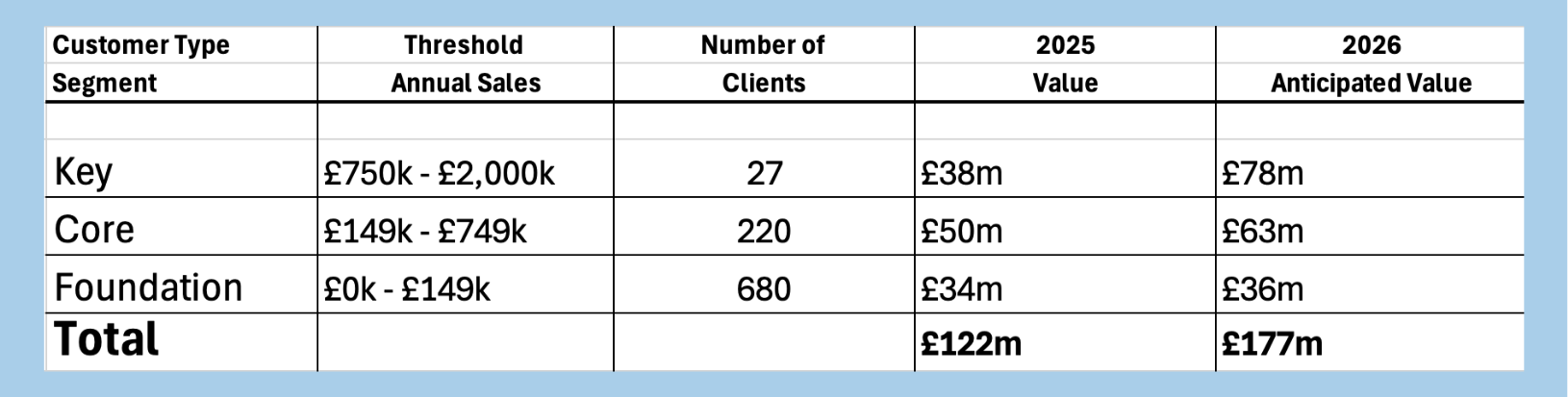
Primary segmentation for a consulting practice, current value against anticipated value.
Look at those numbers carefully. The 27 key clients were worth £38 million and were projected to deliver £78 million the following year. That is a doubling of value from about 3% of the client base. The 680 foundation clients, by contrast, were projected to grow from £34 million to £36 million. (The projected growth in key and core clients assumed the accelerated performance that followed our value-based KAM training and coaching.)
The analysis changed how they allocated resources. Their future growth depended heavily on a small number of relationships, and without the exercise they would have gone on spreading effort evenly across the portfolio. If you want to put numbers on your own biggest accounts, the Whole Wallet calculator is a good place to begin, and I have written about what a customer is really worth elsewhere.
Five stages to segment a customer portfolio
The method balances rigour with practicality, and it puts the right people in the room for the right decisions.
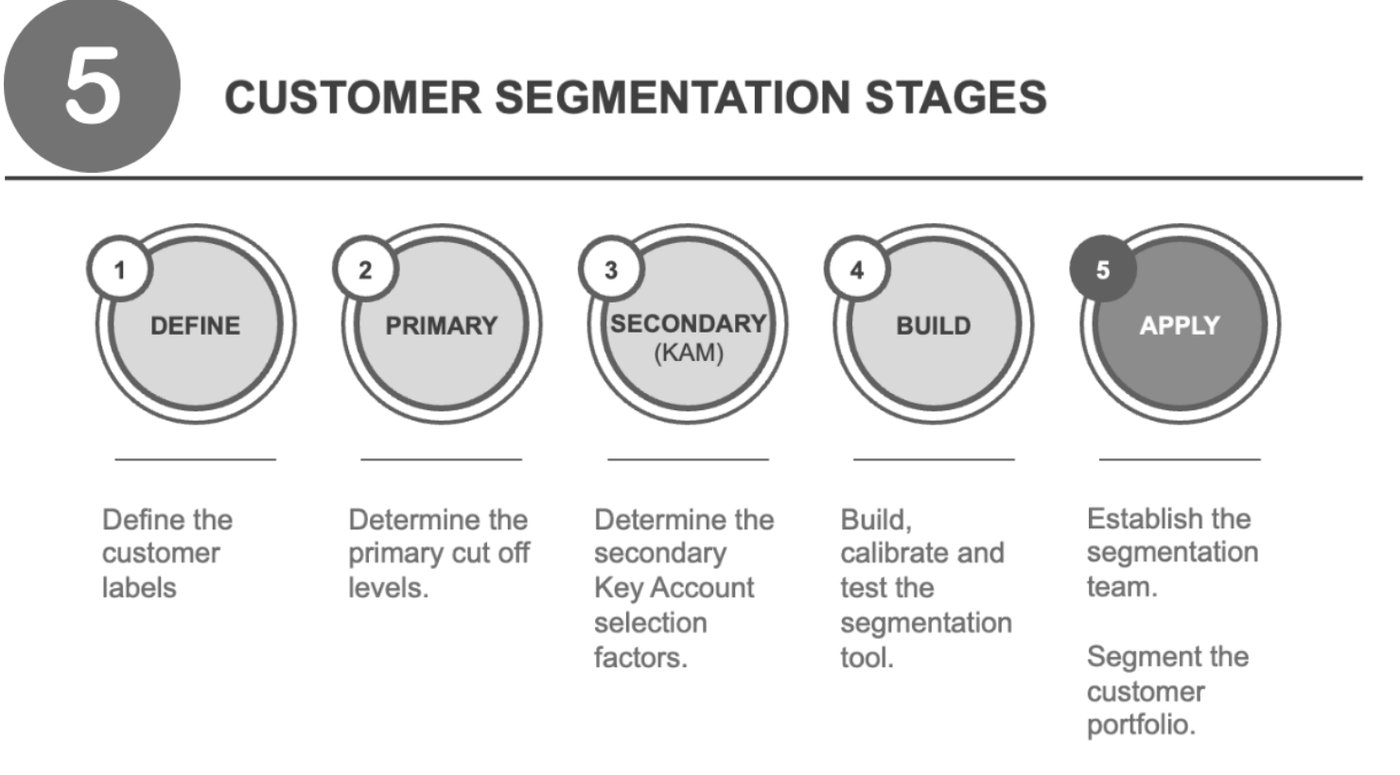
Stage 1: Define your segments
Before you segment anyone, decide what your segments are called and what they mean. It sounds obvious. Plenty of companies skip it and live with the confusion for years.
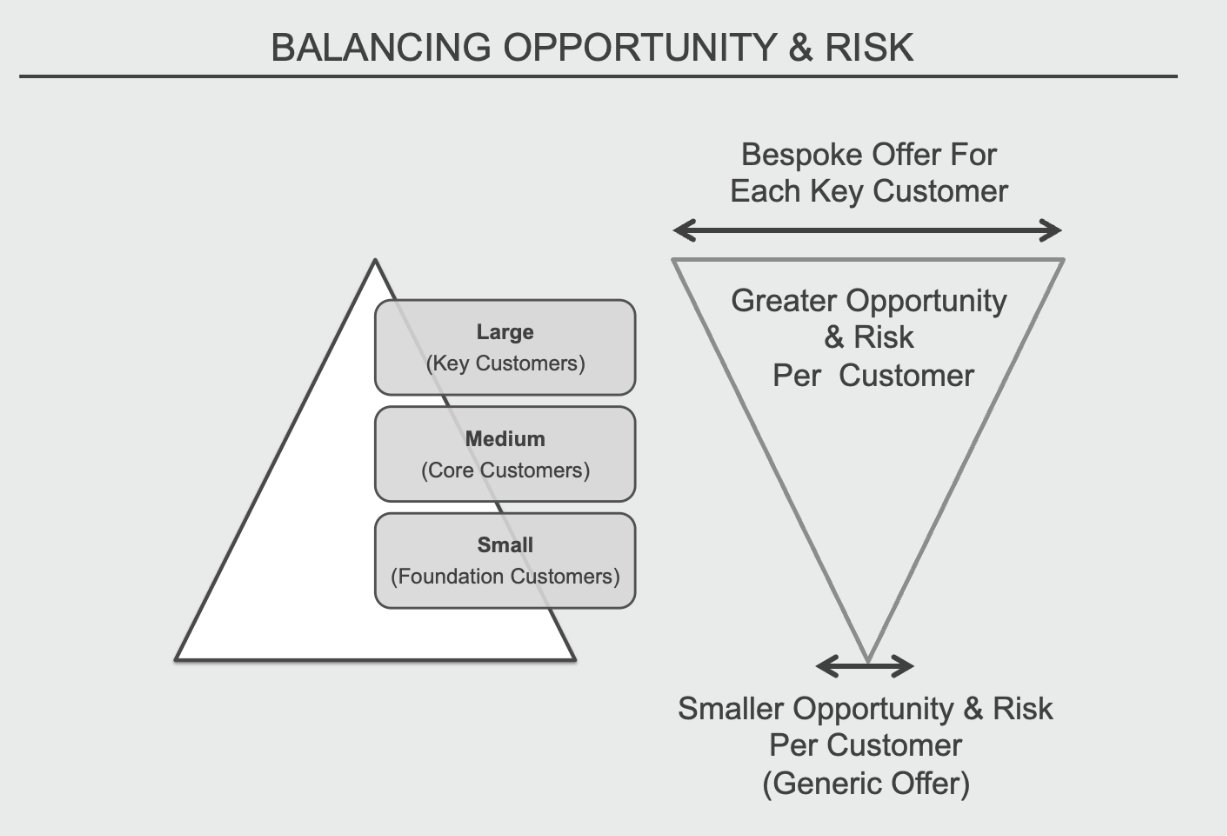
I recommend three tiers: foundation, core and key. Foundation customers tend to be smaller and have limited scope for growth; there are many of them, and they need efficient, standardised service rather than customisation. Core customers are larger and need a more focused approach from the account team; there are fewer of them, but each offers more opportunity. Key customers are a small group of very high value. They are more complex to manage and the rewards are significant, and losing one can do real damage to the whole business. (If you are still debating what counts as key, start with what is a key customer, anyway?)
As you move up the pyramid, both opportunity and risk rise per customer. Key customers need offers built for them. Foundation customers can be served well with a more generic approach.
Stage 2: Primary segmentation
The first cut is usually financial, typically annual sales. It gives you an initial filter and a rough position for every customer in the portfolio.
But, and this is the crucial bit, you must also find the high-potential customers currently sitting in foundation or core. A customer buying little or nothing from you today may be key tomorrow. Build a simple way to tag these “HiPo” customers so they get the attention their potential deserves, whatever their current revenue.
Stage 3: Secondary (KAM) segmentation
This is where the method gets more sophisticated. “Key” is a wide label, and it covers customers with very different opportunities and very different management challenges. We use a portfolio classification with four types.
A key local customer operates in one area or country. A key regional customer operates across several countries in a region, and expectations shift from country to country, which changes how you manage them. A key global customer needs service across two or more regions at once, say Europe, North America and Asia. And a key strategic customer buys from several of your business divisions; coordinating across your own silos takes real effort, but the payoff from joining up business across units can be large.
You may not need all four. If you only trade in one country, regional and global do not apply. The point is to accept that not all key customers are the same, and to manage each class accordingly.
Then look at the relationship itself. Ask two questions of every key customer: how important are they to you, and how important are you to them? The answers give you four relationship types.
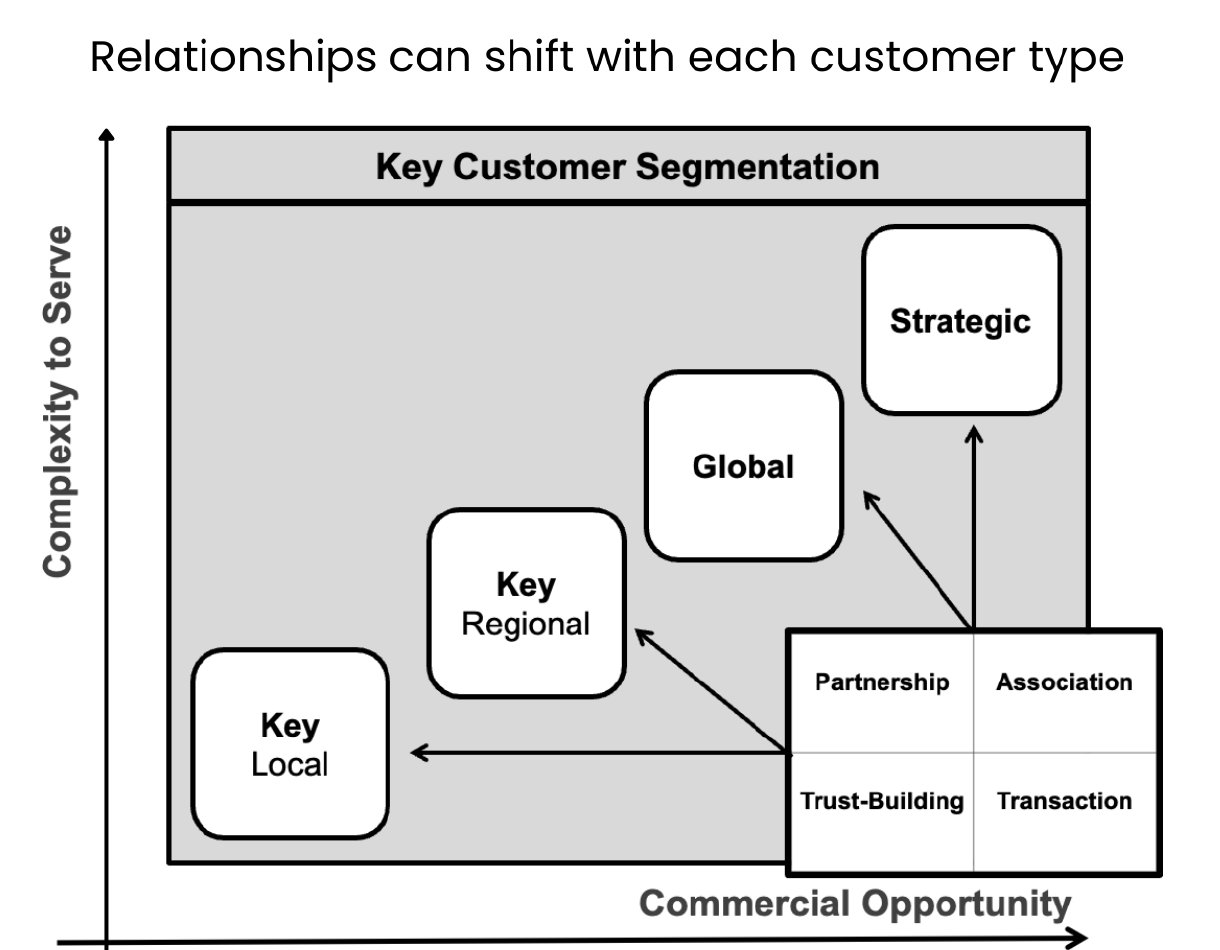
In a partnership, you matter to each other. The relationship is balanced and both sides think it worth investing time and effort, so expect open, candid conversations about working together. In a transaction relationship, neither of you matters much to the other; the business is necessary but revolves around price and meeting specification, and your investment should be just enough to get the job done.
Association is the tricky one. The customer is less important to you, but you matter a lot to them. They like what you offer, but if they lack growth potential they can quietly consume resources, so manage these carefully, because circumstances change. Trust-building is the reverse: the customer matters to you, but they see you as a small player, perhaps because of limited trading history, your scale or location, or simply because they do not yet appreciate what you could do. If the potential is real, you need to build the relationship and earn their trust. It takes commitment, and these are often the partnerships of the future.
Stage 4: Build the model
Once your attractiveness factors are agreed, build the segmentation model. It is usually a spreadsheet that holds all the data and all the decisions. Weight the factors to reflect what matters most to your business; for example, growth opportunity at 60%, with relationship history and number of operations at 20% each.
Calibrate it on a small group of customers you know well. Do they land where you would expect? Adjust until they do.
Then, and this matters more than the spreadsheet, form a KAM selection panel. Bring together people from commercial, technical, supply chain and business leadership to consider each customer on its merits. Their job is to bring informed, unbiased knowledge of each customer, and a realistic view of the potential and the effort involved.
Stage 5: Apply it
Primary segmentation is straightforward once the thresholds are set; the spreadsheet will sort customers into bands for you. The secondary panel should meet over several sessions to assess customers for KAM status. Do not overwhelm it. Somewhere between 30 and 70 customers is typically the right number to review and score against the secondary criteria.
One final point deserves emphasis. A segmentation model gives you a framework for better-informed decisions about how to manage and resource customers. The spreadsheet, with its weightings and descriptions, is essential. But it is part of a process, not a substitute for one. It is the leaders of the business who decide how to manage customers, not a spreadsheet.
The idea that key accounts should be selected on attractiveness and future potential rather than size alone owes a great deal to Malcolm McDonald and Beth Rogers, whose work on key account management is still the best grounding in the subject.
How effective is your segmentation?
Score each statement from 1 (strongly disagree) to 5 (strongly agree).
- We have clearly defined customer segments, with documented criteria for each tier.
- Our segmentation considers future potential, not just historical revenue.
- We have a formal way to find high-potential customers in lower segments.
- Our key accounts are further classified by type: local, regional, global or strategic.
- We assess how important each key customer is to us, and how important we are to them.
- Our segmentation actually drives resource allocation.
- A cross-functional panel reviews and validates customer classifications.
- We review and update the model at least once a year.
- Account managers understand and accept the criteria.
- Leadership uses segmentation when making strategic decisions.
A score of 40 or more means your practice is mature, and the work is about refinement and consistency. Between 25 and 39, the foundations are there but there are gaps, so start with your lowest scores. Below 25, segmentation is the biggest opportunity in your customer strategy, and it is where we usually start when we run a KAM development programme.
The account on page three
Every company I have worked with has one. Somewhere on page three of the sales report, well below the line where anyone looks, there is a customer buying very little from you today who could be your biggest account in five years. Nobody is calling them. Nobody has asked what they are trying to achieve.
Last year’s sales will never find that customer for you. Somebody has to go looking.
If this is your problem too, see the Strategic Customer Planning Tool on the ladder, or talk to us.
The newsletter this came from
Every fortnight: one idea from the method, worked through properly. Read it where you already are, on LinkedIn, or by email below.
Keep reading
The Plan in the Filing Cabinet
Somewhere in your organisation there is a key account plan that nobody has opened since the day it was approved. It does not die from lack of discipline. It dies because no team ever had the hours to keep it alive. Now, finally, something has the time.
Three Techniques to Understand Your Customer
You cannot solve a problem you do not understand. Three techniques to understand your customer: ten background questions, their outside world, and their inside.