Think Smarter: Critical Thinking for Key Account Managers
Most key account managers are winging it. Ten ways critical thinking, sharpened by AI, turns instinct into better decisions and strategic sales growth.

Count the decisions you make before your second coffee. Which customer problem gets your attention first? Is this request strategic or just operational? Do you tailor this proposal or send the standard one? Each of those choices ripples out into the relationship, the forecast and your position against the competition.
Here is what nobody admits: most key account managers are winging it. You rely on instinct, on experience, and on whatever framework you remember from the last training day. When product advantages evaporate in months and customer needs shift every quarter, that is not good enough.
Critical thinking is not an academic luxury. It is the thing that separates key account management from glorified order-taking. And AI, far from replacing it, can make it a great deal sharper. The question is not whether AI will change how you think. It is whether you will use it well before your competitors do.
What critical thinking actually means
The phrase gets thrown around carelessly, so it is worth pinning down. In 1990 the American Philosophical Association convened a panel of 46 experts to agree a definition, and the result, known as the Delphi Report, described critical thinking as “purposeful, self-regulatory judgment which results in interpretation, analysis, evaluation, and inference” (Facione, 1990).
That is comprehensive but dense. Richard Paul and Linda Elder put it more simply: critical thinking is self-directed, self-disciplined, self-monitored and self-corrective thinking, which “presupposes assent to rigorous standards of excellence and mindful command of their use” (Foundation for Critical Thinking).
In practice it comes down to five skills: interpretation, analysis, evaluation, inference and explanation. Paul and Elder add that all reasoning is built from the same elements (purpose, questions, information, concepts, inferences, assumptions, implications and point of view) and that good thinking holds each of them to standards such as clarity, accuracy, relevance and depth.
None of this is about being clever or contrarian. It is about better reasoning, which leads to better decisions.
Why key account managers need it more than most
Key account management asks you to think on three levels at once, each needing a different kind of skill. We call this the KAM Skills Tri-Stack: three domains, four sub-skills each, twelve in all.
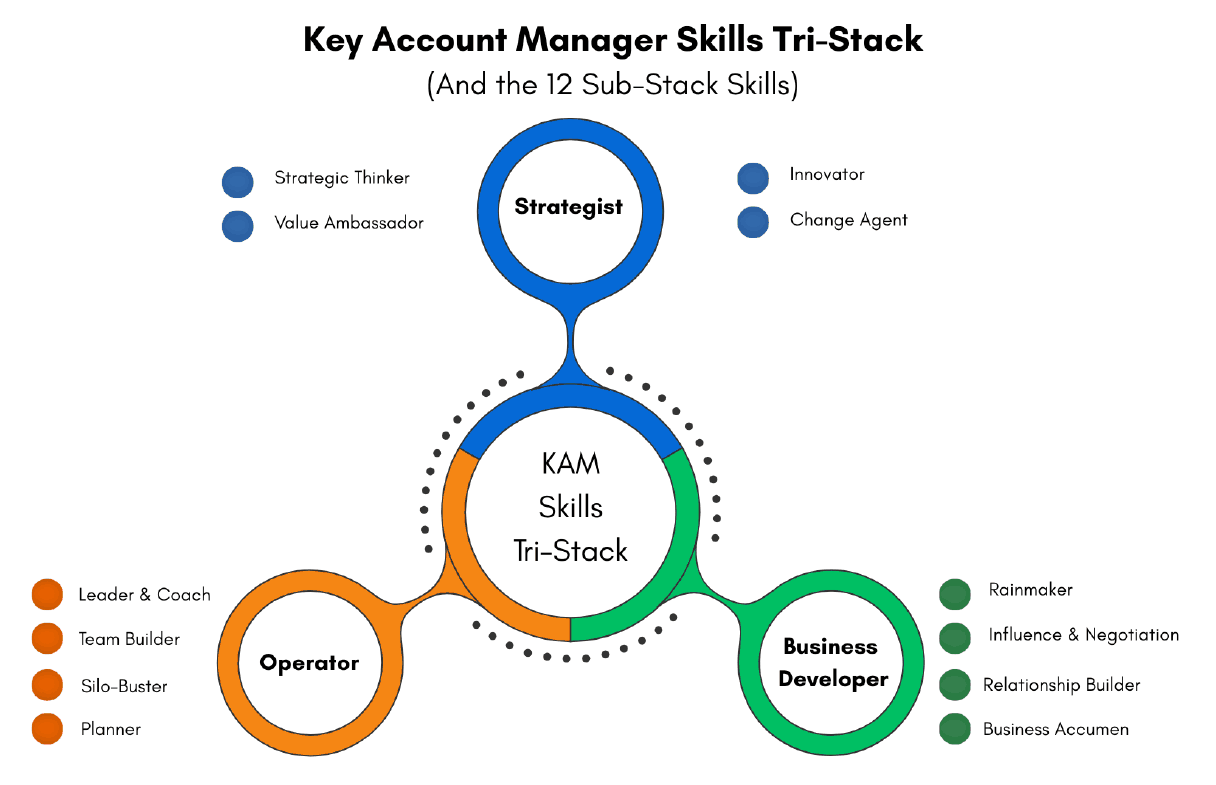 The Key Account Manager Skills Tri-Stack and its twelve sub-skills.
The Strategist connects scattered information into a plan and designs solutions competitors cannot copy. The Business Developer turns opportunity into profitable revenue without any formal authority over the customer. The Operator gets it all delivered across functions that do not report to them.
The model makes one point hard to escape. Key account managers are not salespeople with bigger territories. They work where strategy, innovation and sales execution meet, and they have to switch between them several times a day. If you want to see where your own profile sits, the KAM Tri-Skills self-assessment will show you which of the twelve you lean on.
Those stacks map onto three modes of work: creating a new proposition for one customer, selling it, and delivering it while proving the value arrived. The hard part is moving between the three without losing the thread. You cannot think like a strategist when a shipment needs sorting today, and you cannot stay buried in operations when a strategic opening appears.
What happens without it
Without disciplined thinking, you chase the loudest request rather than the most valuable one, and measure activity rather than outcomes. Take a pharmaceutical key account manager who gets an urgent call from a hospital to expedite a delivery. The easy response is to promise faster delivery, lean on logistics and hope. The thinking response starts with questions. What is really driving this (interpretation)? Is it speed, or is it inventory, budget cycles or disruption on the ward (analysis)? How urgent is it really, set against everything else (evaluation)? What happens if we optimise for speed instead of reliability or cost (inference)? Which answer meets the real need and gives us an advantage we can defend?
That line of questioning might reveal that the “delivery problem” is a forecasting problem. The answer is not faster lorries. It is a shared planning process that reduces uncertainty and lets the hospital hold less stock. That is the kind of insight that turns a transactional relationship into a partnership.
Ten ways to apply critical thinking across the Value-Based KAM Framework
The Value-Based KAM Framework runs in three phases: Offer Development and Innovation, Value Sell and Value Capture. Here is where critical thinking earns its keep in each.
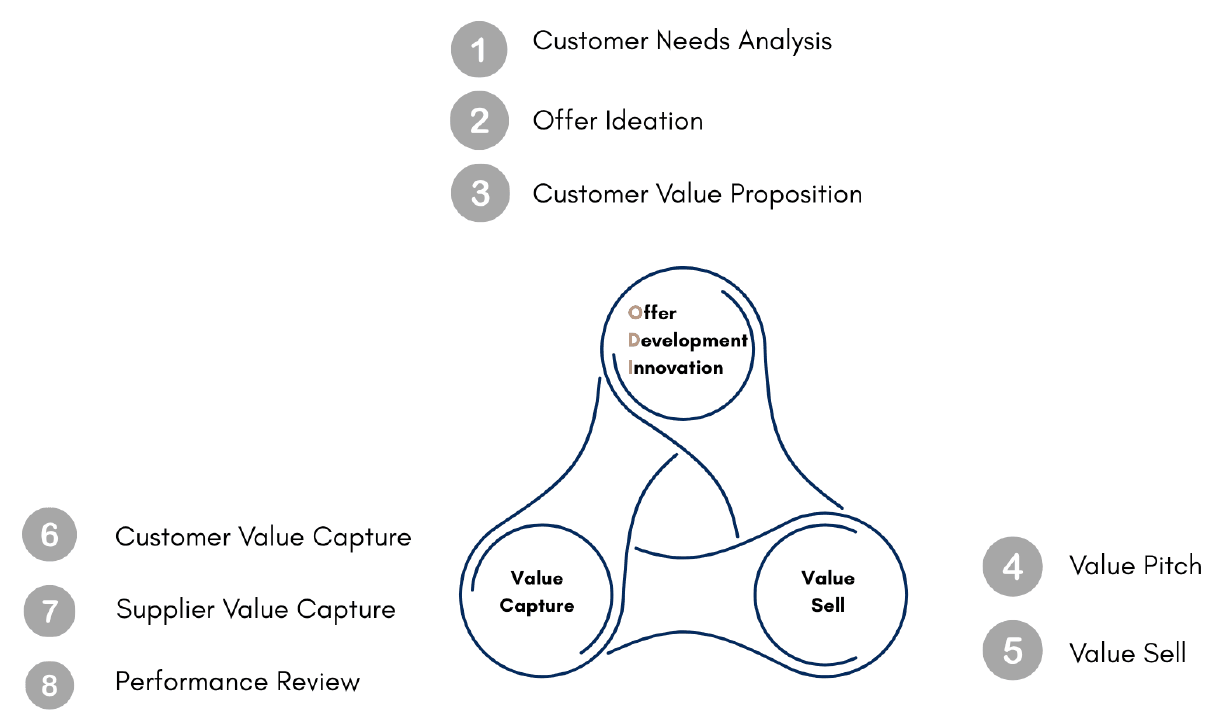 The three phases of the Value-Based KAM Framework.
Phase 1: Offer Development and Innovation
1. Frame the problem before you solve it. Most of us jump to solutions before we understand the problem. Use Paul and Elder’s elements deliberately. What is the customer ultimately trying to achieve, as opposed to what they asked for? What assumptions are you making about their situation? Whose point of view are you taking: procurement’s, the operations team’s, or the chief executive’s? Framing decides whether you end up with a commodity or a defensible advantage. There is more on this in problem framing.
2. Separate symptoms from root causes. Customers describe symptoms: better prices, faster delivery, more support. When a key customer of one of my clients, a global medical device manufacturer, reports “budget pressure”, the reflex is to cut price. Critical analysis asks whether the real issue is a genuine budget limit, how procurement is being measured, an upcoming formulary decision, or worries about the product pipeline. Each needs a different response, and only one of them needs a discount.
3. Challenge the accepted solution. Every industry builds up standard answers to standard problems. Ask what a company in another sector would do, or what you would offer if your usual solution were off the table. A medical device key account manager who does this might realise that hospitals do not want better surgical instruments. They want better surgical outcomes, shorter procedures and fewer complications, which points towards training, outcome analytics and protocol support rather than another hardware upgrade.
4. Combine what you already have. Innovation is rarely invention from scratch. It is usually existing capabilities put together in a new way. In animal health, the strongest account teams combine veterinary medicines with data, training and advice to offer whole-herd health management. None of the pieces is unique. The combination is.
Phase 2: Value Sell
5. Adapt the argument to each stakeholder’s logic. In a complex sale the finance director weighs return and risk, the operations director weighs disruption, and the innovation lead weighs differentiation. Same solution, three different conversations. Ask what evidence each person finds credible and what success looks like to them, then build the case they will actually hear.
6. Test internal feasibility before you commit externally. Before you propose something bespoke, ask whether your own organisation can deliver it. What cross-functional dependencies does it create? What would make it fail internally, and which departments will resist it? A great many account failures come from overselling something the business was never set up to deliver. Better to say “not yet” and keep your credibility.
7. Read the politics as well as the process. Who has formal authority, and who has real influence? What agendas are sitting under the table? Someone selling into a law firm might find that the formal route runs through procurement, while the real decision is made at a partners’ meeting three weeks before procurement is involved. Knowing that changes your whole plan of engagement.
Phase 3: Value Capture
8. Distinguish activity from value. It is easy to count what is easy to count. “We ran twelve training sessions” is activity. “We cut onboarding time and gave back thousands of staff hours” is value. Ask whether a number would matter to the customer’s board and whether it could move without anything real changing. Then report the numbers that pass the test.
9. Tell causal stories, not just data points. People reason through narratives, not spreadsheets. When an energy infrastructure company reports cost savings to a manufacturing customer, the account manager who can explain which system changes, behaviours and operational adjustments produced which savings makes the value undeniable, and sets up the next round of innovation. Ask what would have happened without you, and how you know the result was not caused by something else.
10. Know when to pivot and when to persist. Not everything works first time. Decide in advance what evidence would tell you something is failing. A packaging key account manager might see a sustainability initiative stall, not because the idea is wrong but because it is in front of the wrong people. The right move is to take it to the environmental compliance team, not to abandon it.
How AI sharpens the thinking
AI does not replace any of this. What it does is take on the tedious and overwhelming parts of the work so that your attention goes to the judgement.
Tools such as Claude, ChatGPT and Gemini make good sparring partners. Explain your reasoning about a customer and ask the model to attack it: what assumptions are you making, what have you missed, what are the alternatives? It is like having a colleague who has read every strategy book and never tires of asking “but have you considered…?” Our KAM prompt guide has worked examples.
It is also good at the things critical thinking needs but people find hard. It can find patterns in procurement data across dozens of hospital trusts, break a customer problem down using Paul and Elder’s elements, and play out how a proposition might land with each stakeholder. Give it your last few proposals and it will point out your habits: that you reach for technology when a process change would do, or that your assumptions about procurement have gone untested for months. Ask it how the finance director, the operations director and the innovation lead would each judge your proposal. The answer is a starting point, not a verdict.
Who does what
The best way to work is structured collaboration. You define the problem and what matters, because AI cannot decide what is strategically important. It breaks the problem down and generates options. You judge those options and choose a route using what you know about the customer. It stress-tests your choice for gaps. You make the final call.
The machine brings speed, pattern recognition and synthesis. You bring judgement, relationship intuition and context. The key account managers who do well over the next decade will not be the ones who refuse AI, nor the ones who trust it blindly. They will be the ones who think clearly enough to direct it. It is the same argument we made in what the technology cannot do.
Where the advantage really sits
A framework is a map. It does not build the capability, and neither does reading about it. Critical thinking develops the way any skill does, through practice, feedback and coaching on real accounts, which is why we build it into our KAM development programme rather than teaching it as a separate module.
Your advantage is probably not hiding in your product or your price list. It is sitting in the heads of the people who manage your most important customers, in the quality of the questions they ask before they reach for an answer. Next time a customer calls with something urgent, notice the first solution that comes into your head. Then ask one more question before you say it out loud.
References
Facione, P. A. (1990) Critical Thinking: A Statement of Expert Consensus for Purposes of Educational Assessment and Instruction (The Delphi Report). Newark, DE: American Philosophical Association.
Paul, R. and Elder, L. (2002) Critical Thinking: Tools for Taking Charge of Your Professional and Personal Life. Upper Saddle River, NJ: Financial Times Prentice Hall.
Paul, R. and Elder, L. (2006) The Miniature Guide to Critical Thinking: Concepts and Tools. Foundation for Critical Thinking.
If this is your problem too, see how we build the capability properly, or talk to us.
The newsletter this came from
Every fortnight: one idea from the method, worked through properly. Read it where you already are, on LinkedIn, or by email below.
Keep reading
Why you keep rebuilding your KAM programme
Four out of five sales organisations rebuild their key account programme every few years. The rebuild is treated as a failure of effort. It is almost always a failure of capability.
Five Steps to a High-Impact KAM Training Programme
Most key account management training fails because it treats KAM as a sales technique. Five steps to a KAM training programme that changes how people work.