Is Your KAM Programme Good Enough? 20 Questions
Talented people, smart templates, plenty of training, and key accounts still not growing? Score your KAM programme against 20 questions and find the gap.

They hire talented people. They build smart planning templates. They invest in training. And still the results disappoint. Key accounts grow more slowly than the plan said they would, relationships feel transactional, and competitors chip away at share.
If that sounds like your business, the problem is probably not effort. It is your key account management (KAM) capability, and it can be diagnosed. The 20 questions at the end of this piece will show you where the gaps are. First, what most companies get wrong.
The three things that make KAM work
In my experience, KAM programmes fail at one, or all, of three things. Together they make up the organisational capability of KAM.
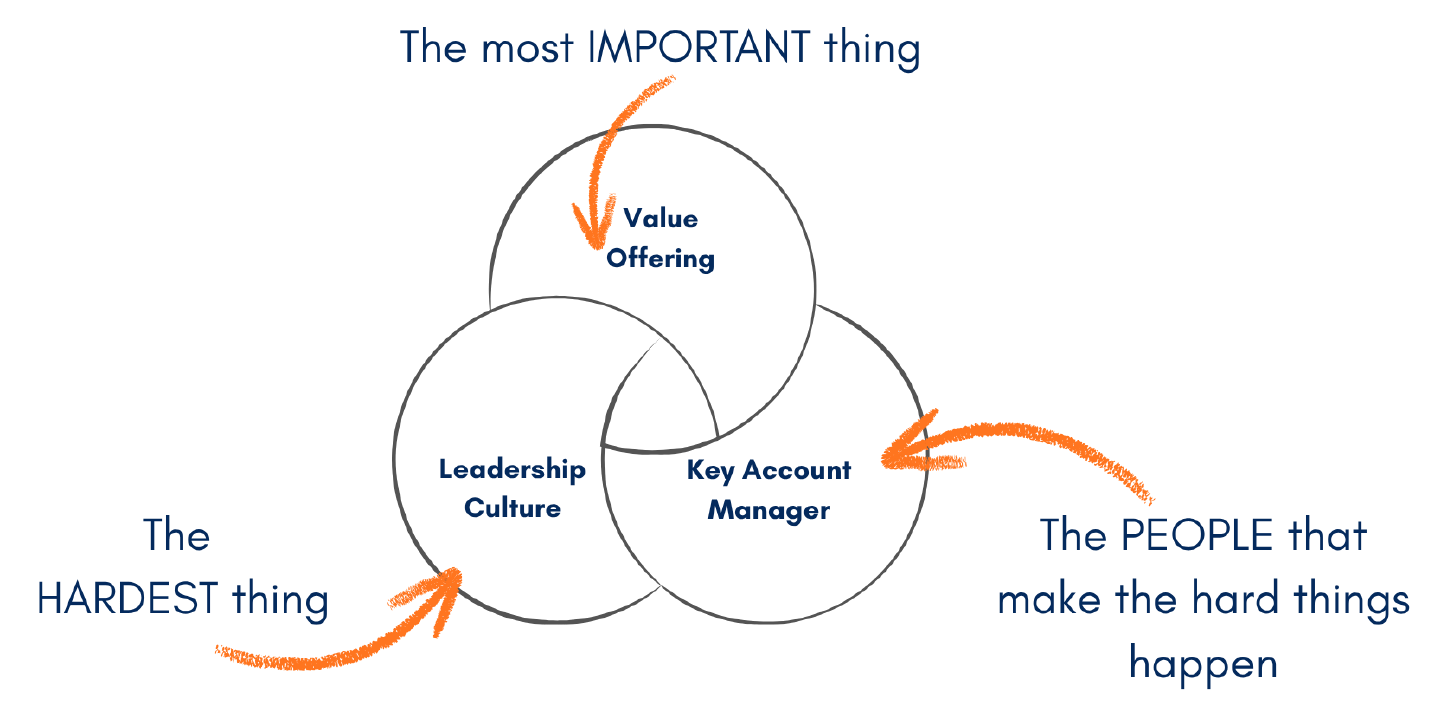 The three things: the most important, the people, and the hardest.
Miss any one of them and your programme becomes an expensive exercise in relationship management that does not move the needle. Get all three right and you have an advantage that is very hard to copy.
1. The customer value offering: the most important thing
Most companies that think they are doing key account management are really doing account management with better CRM software.
Value-based KAM starts with a different question. Not “how do we sell more to this customer?” but “how do we create unique value that moves this customer from where they are now to a better future state?” It starts with real curiosity about the customer’s strategy, pressures and internal battles, turns them into problem statements that matter to the people who hold the budgets, and then builds an offer that shows exactly how you will get them from here to there. Not your product portfolio in the customer’s language. An actual offer that creates measurable value.
We call this stage offer development and innovation, and it is where most companies stumble, because it takes strategic thinking and the courage to say “our standard solution will not work here; we need to build something different.” The final step is to crystallise the work into a customer value proposition. If you cannot explain your unique value in two sentences, you do not understand it well enough to sell it to a room full of stakeholders.
Get this right and everything else gets easier. Rush it and you end up with a beautifully crafted account plan for selling products the customer does not really want, at prices they do not want to pay, against alternatives that look just like yours.
2. The key account manager: the people who make hard things happen
Be honest about what we ask key account managers to do. Think like strategists, sell like rainmakers, innovate like entrepreneurs and manage like general managers. Build relationships across organisational boundaries, influence without authority, and deliver results that matter to people they have never met. Then we act surprised when a good traditional salesperson struggles in the role.
Key account managers are not salespeople with bigger territories. They need eight competences. Four are strategic: the strategist, who thinks at the level of the whole system; the value ambassador, who creates value across many stakeholders; the innovator, who develops new answers to unique problems; and the change agent, who leads change inside both organisations. Four are operational: the rainmaker, who turns opportunity into profitable revenue; the silo-buster, who works across departmental walls; the team builder, who leads without formal authority; and the planner, who manages complexity over long sales cycles. I cover them in depth in the eight competences of key account managers.
These are general management skills, not sales skills. A key account manager is running a business within a business, which is why you cannot simply promote your best transactional salesperson and expect success. Start with your strongest relationship builders and business developers, then deliberately develop their strategic thinking, innovation and change skills. It is easier to teach a great salesperson to think strategically than to teach a strategist to build customer relationships. The Tri-Skills self-assessment is a quick way to see where each of your people stands.
But even the most talented key account manager will fail in the wrong culture.
3. Leadership and culture: the hardest thing
KAM programmes fail because of leadership far more often than because of execution.
I have seen brilliant KAM strategies sabotaged by leaders who said they wanted customer focus and then rewarded product push. I have watched talented key account managers burn out trying to work in a new way inside an old-thinking organisation. Edgar Schein, who spent his career at MIT studying organisational culture, showed how much of a culture is set by what leaders pay attention to and what they reward. KAM is a live demonstration.
Value-based KAM asks for real shifts, and they take courage from leadership. The courage to turn down profitable business that does not fit your key customer strategy. The courage to invest in bespoke work that does not scale. The courage to measure success differently.
That leadership works at two levels. Senior executives set the vision and define “the way we do things around here”. Line managers coach day to day, remove obstacles and keep the focus. Between them they need a clear customer management strategy, standards that turn principles into how decisions and resources are actually handled, and every function (marketing, operations, finance, service) treating key accounts differently.
Most programmes fail not because the method is wrong but because leaders underestimate the cultural change it needs. They want the benefits of strategic relationships without changing how the company works, and they settle for KAM-lite. That is the paradox: the difficulty is exactly what makes it an advantage. I have written about what happens when companies skip this part in why you keep rebuilding your KAM programme.
The 20 questions
Now the real test. Score each question honestly, on what you do consistently, not on what you intend to do. Use this scale for every question:
- 0 to 3: not happening, or rarely
- 4 to 6: inconsistent or partly in place
- 7 to 9: consistent, with room to improve
- 10 (or the maximum shown): best in class
Questions 1 to 15 are worth 10 points each. The last five carry the weights shown. Each of the five sections is worth 50 points, 250 in all. The first three sections test the three things; the last two test your position in the market.
Section 1: the customer value offer (50)
- Do you have a strategic understanding of each key customer? Best in class: a documented profile of each customer’s business model, competitive position, priorities, internal challenges and decision-making, kept current through senior conversations, so your KAMs know not just what the customer buys but why.
- Do you create a unique offer for each key customer? Best in class: a bespoke proposition built for their situation, often with innovation or customisation not available to ordinary customers, through a formal offer development process.
- Do your offers clearly describe the value the customer will receive? Best in class: measurable outcomes, tangible and intangible, explained in two sentences in language a board will care about, not just procurement.
- Can you avoid winning business by dropping your price? Best in class: you rarely need to discount to win or keep key account business, and you can turn a price request into a value conversation.
- Do customers regard your offer as the best in its category? Best in class: key customers call you market-leading without prompting, and use you as the benchmark when they look at alternatives. A strong Net Promoter Score among key accounts is one way to evidence it.
Section 2: the key account manager (50)
- Do you select key account managers against a defined set of competences? Best in class: every appointment is assessed against the eight competences, not handed to the top salesperson.
- Do you have a structured value-based KAM training programme? Best in class: development well beyond sales training (planning, proposition design, financial analysis, change, executive communication), with structured onboarding, ongoing coaching and clear progression.
- Do line managers coach every key account manager? Best in class: regular coaching on account strategy, not pipeline reviews, from managers trained to coach, who join critical customer meetings.
- Are the KAM team members from every function trained too? Best in class: operations, finance, marketing and technical people who support key accounts understand value-based principles and why these customers are different.
- Do your KAMs talk regularly and confidently to senior leaders on both sides? Best in class: at least quarterly conversations with executives in the customer and in your own business, as trusted advisers, not product experts.
Section 3: leadership and culture (50)
- Has leadership put in place a clear customer selection model? Best in class: key accounts chosen on strategic value and potential, not just revenue, reviewed annually, with the discipline to de-select.
- Is there a clear strategy for how each type of customer is managed? Best in class: defined service levels and resources for each tier, and a value-based KAM model that is an operational reality, not a slide.
- Has leadership set standards for how key accounts are managed? Best in class: documented standards for planning cadence, executive engagement, value capture, reporting and escalation, monitored and enforced.
- Does leadership regularly hear each account team present its growth strategy? Best in class: protected quarterly strategy reviews where leaders give guidance, remove obstacles and commit resources.
- Is a value-based, customer-centric culture established across the company? Best in class: every function knows its part in creating customer value, rewards recognise value creation, and there is a clear route for exceptions when a key account’s needs clash with standard procedure.
Section 4: competitor ability (50)
- Do you work to understand how competitors manage key customers? (15) Best in class: systematic intelligence on who runs formal KAM, how, and with what propositions, shared with your teams.
- Are you better than your main competitors at KAM? (20) Best in class: objective evidence from customers and win/loss analysis that you are ahead, and a habit of learning from every loss.
- Do you ask customers how you compare with competitors? (15) Best in class: formal research at least annually, including the uncomfortable answers, tracked over time and acted on.
Section 5: market needs (50)
- Have you tested whether key customers in your category want strategic suppliers? (25) Best in class: you know which customers value strategic relationships and which prefer arm’s-length buying, and you do not force strategy on customers who do not want it.
- Do you gather key customers’ feedback on you as a trusted supplier? (25) Best in class: structured feedback on trust, relationship health and value realised, gathered at operational and executive level, and visible to leadership.
Reading your score
A total of 200 to 250 is a world-class programme; your job is to keep it that way as the market moves. 150 to 199 is a strong foundation with real room to grow, so go after your lowest section first. 100 to 149 means the programme exists but is not yet delivering; you probably have a gap in one of the three things, and systemic fixes will do more than tactical ones. 50 to 99 is early stage or struggling, and the honest question is whether you have genuine leadership commitment or are running KAM-lite. Below 50, you may not really have a KAM programme at all, and the first step is deciding whether and how to build one.
Then look at the shape. Plotting the five section scores on a simple radar chart makes the gaps obvious. If the value offer is lowest, work on offer development, customer understanding and proposition design. If it is the key account manager, look at selection, competence development and coaching. If leadership and culture is lowest, and it often is, fix that before you expect better execution; it is usually the root cause. A low competitor score calls for sharper intelligence and differentiation. A low market needs score asks the most basic question of all: do your customers actually want strategic KAM from you?
If you want a structured, independent view of how your value looks from the customer’s side of the table, the Value Edge Diagnostic is a good companion to this exercise.
Do not simply fix the lowest number. The three things only work together. And if you found yourself hesitating before writing down a score, that hesitation is probably the most useful result on the page.
If this is your problem too, see how we build the capability properly, or talk to us.
The newsletter this came from
Every fortnight: one idea from the method, worked through properly. Read it where you already are, on LinkedIn, or by email below.
Keep reading
Why you keep rebuilding your KAM programme
Four out of five sales organisations rebuild their key account programme every few years. The rebuild is treated as a failure of effort. It is almost always a failure of capability.
Five Steps to a High-Impact KAM Training Programme
Most key account management training fails because it treats KAM as a sales technique. Five steps to a KAM training programme that changes how people work.