Managing Key Customers Directly: Five Principles for KAM
Is the juice worth the squeeze? Once you have chosen the key customers you will manage directly, five principles decide whether key account management pays off.

There is an old question that haunts every revenue leader: is the juice worth the squeeze?
It arrives the moment you have identified your most promising customers, the ones that could change the shape of your business. Now you have to decide how much energy, money and senior attention to put into winning and growing them. Say yes to too many and you spread yourself thin. Say yes to too few and a competitor will happily take the rest.
The customers you choose to manage directly usually fall into three groups. Large existing customers you must protect, because losing them would hurt. Large existing customers you want to protect and grow, because the upside is big. And customers with little or no business today whose future potential you can already see. If you have decided these are the juice, the next question is far more practical. How exactly do you squeeze a bit harder?
Not all key customers are created equal
This is where most companies stumble. They treat every key customer the same way, with a one-size-fits-all approach about as effective as using a chainsaw to burst a pimple.
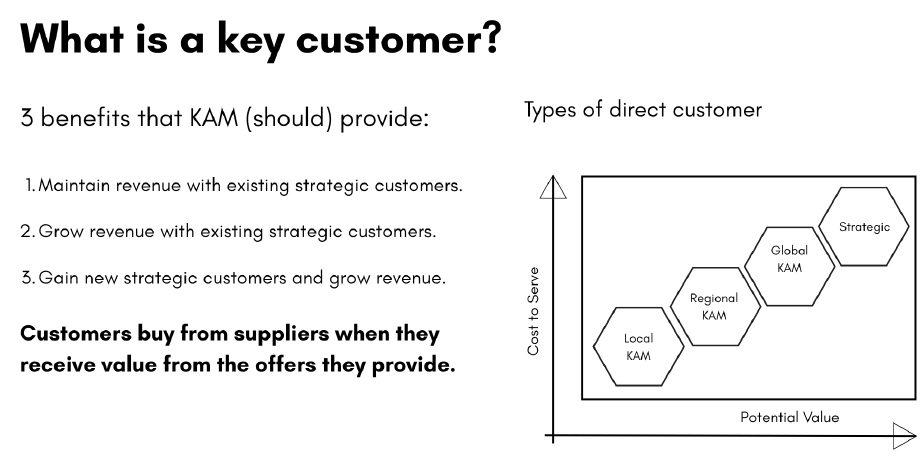 Types of direct customer, by potential value and cost to serve.
Your key customers sit on a spectrum: local, regional, global and strategic. Each needs a different approach, different resources and a different relationship model. What works for a local key customer operating in one country will fail badly with a global customer spread across several continents. The cost to serve rises as you move up the scale, so the potential value had better rise with it. (If you are still deciding who belongs on the list at all, start with what a key customer actually is.)
There is a harder truth underneath. Most companies that fail at key account management fail because the basics are not in place. They do not know how to sell value. Worse, they do not really understand what value is. If you are introducing KAM for the first time, or trying to get traction after a couple of false starts, begin with a solid value-based selling programme. Walk before you run. Learn to create and articulate value before you take on the strategic complexity of KAM.
Why buying behaviour makes this urgent
Customers have changed how they buy. They do not want to spend time meeting suppliers unless those suppliers bring significant, demonstrable value to their operations. Everything else is increasingly bought through distributors and digital channels, which is why so many suppliers now serve a large share of their business through third parties (I look at what that means for you in the power of channels).
That squeeze puts four questions in front of every supplier. How do you add real value? How do you organise to deliver it? What structure and people do you need? And what, exactly, counts as value in the first place?
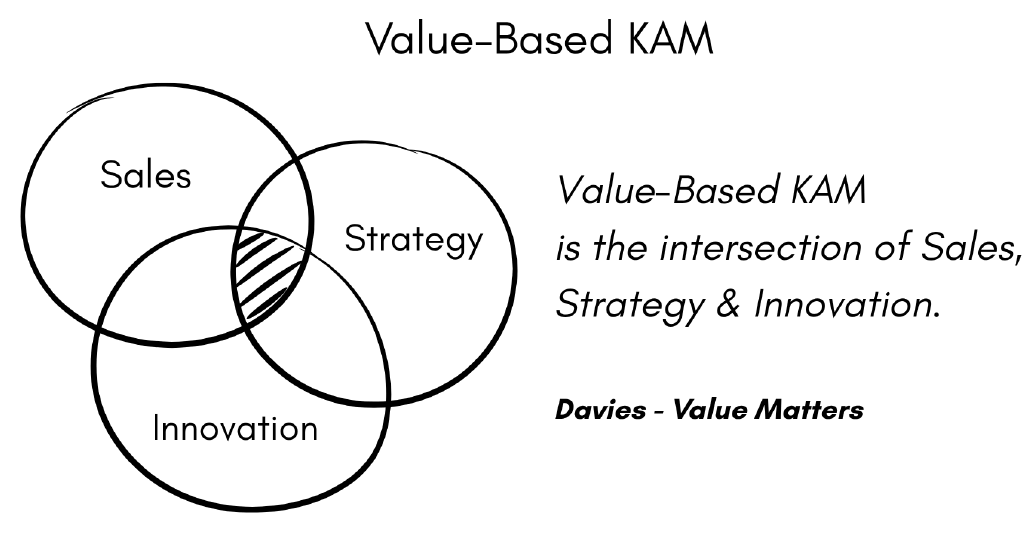 Value-based KAM sits where sales, strategy and innovation overlap.
The mindset shift is this: KAM is strategy, customer by customer. It is not about administering accounts. It is about crafting a specific strategy for each individual customer that creates value for both of you. Value-based KAM sits where three disciplines meet: sales, the engine that drives revenue; strategy, the thinking that creates lasting advantage; and innovation, the capability that delivers something different. Supplying value to a strategic customer is a different business from selling products, and it asks you to create, deliver and capture value on both sides of the relationship.
Why most KAM programmes disappoint
Gartner found that 79 per cent of sales organisations had rebuilt their key account programmes at least once in seven years to fix underperformance. That is not comforting if you are about to invest heavily in one. I have written about why that cycle of rebuilding happens. But failure is not inevitable. The companies that get KAM right, and become the most influential suppliers in their industries, tend to follow five principles.
1. Build your own house first
Work out who your key accounts are, and take real care over it. Then accept that you have different types of key customer, each needing its own management approach. A global customer with potential across many markets needs a different strategy from a local key customer in one country.
Stop buying the Big Book of KAM and applying it to every key customer in the same way. That is like running a corner shop on enterprise software. Start designing a model that fits your business, your customers and your industry. Can you say clearly why each key account deserves the title? And are your tools and processes sized to each relationship, or is everyone on the same template?
2. Focus on the most important thing
Customers do not buy KAM. They buy the value you provide.
Your key account manager may be the person who makes things happen, but what the customer is buying is a distinctive offer that creates distinctive value. That is a KAM fundamental: you spot high potential in a customer, designate it as key, and then provide something for it that you do not provide for everyone else.
The difference does not have to be complicated or expensive. One client started giving a key customer a named packaging designer instead of simply supplying bespoke packaging. That person became the go-to expert for every packaging question the customer had. Over time the customer began asking for advice on categories outside the supplier’s core range, and in effect started buying consultancy. That one change drove significant sales growth in the category.
So what do your key accounts get that other customers do not? And could you describe it in words the customer would recognise and value?
3. Win hearts and minds, and the rest will follow
KAM is a different way of working, and it needs your own company behind it. One of the hardest parts of the job is aligning resources internally. It is surprisingly difficult to get people to focus their time, thinking and energy on specific customers.
The answer lies in key account managers who can network and engage their own organisation. They build personal connections across teams, functions and levels of leadership, and use them to create, develop and deliver customer value propositions. This is a real skill: influence without authority, relationships across silos, and selling a customer strategy internally before you sell it outside. Can your KAMs mobilise people from other functions for a customer initiative? Are your internal stakeholders genuinely committed to the strategy, or just polite about it?
4. Develop people who make things happen
KAM succeeds or fails on having the right people with the right skills, and the role has moved a long way beyond traditional selling.
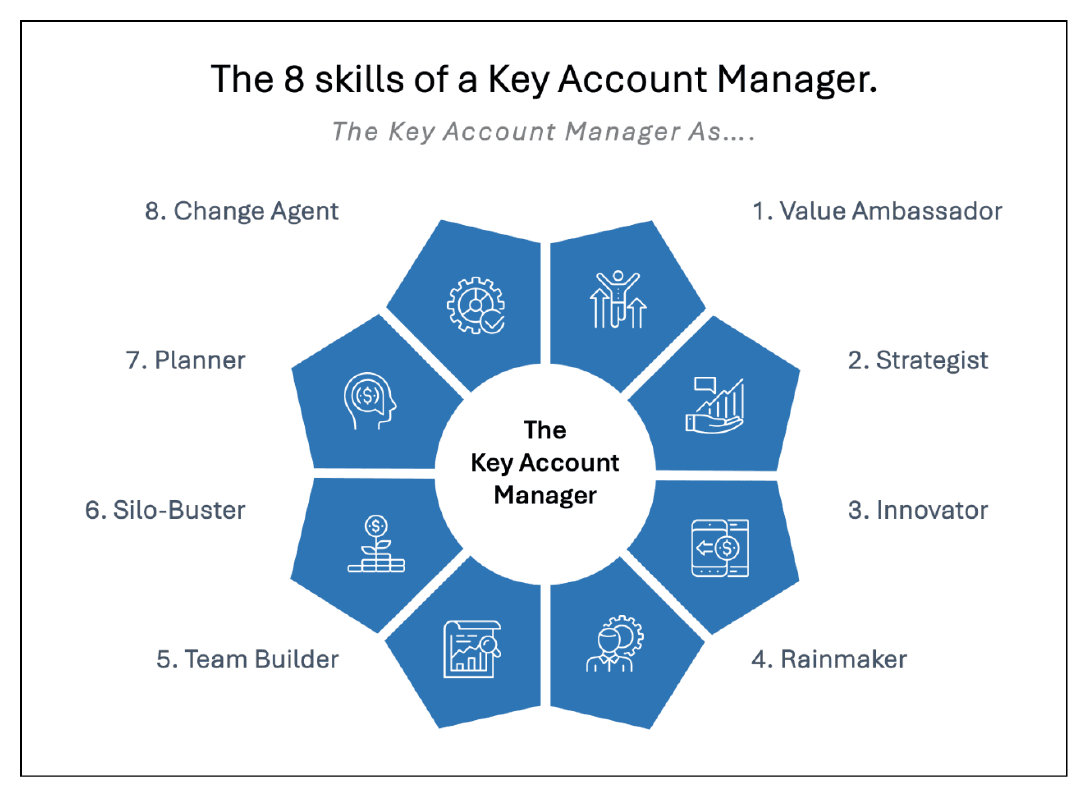 The eight skills of a key account manager.
I describe eight competences. A key account manager is a value ambassador who understands what the customer truly values and acts as the focal point of contact; a strategist who builds customer-specific plans for lasting value, often involving real investment; an innovator who keeps regenerating the offer so the customer keeps seeing you as essential; and still a rainmaker, who can sell, take rejection and close. They are also a team builder, leading cross-functional and often cross-border teams with no direct authority; a silo-buster working across business units that are focused on their own operations rather than the customer; a planner who turns strategy into action; and a change agent who sells new ideas internally. I explore each one in the eight competences of key account managers, and you can test yourself against the core skills with the KAM Tri-Skills self-assessment.
In my experience, most of a key account manager’s time goes on internal work rather than in front of the customer, with account planning getting the smallest slice. That is not a distraction from the job. It is the job.
5. Adjust your sails when the wind changes
Your business world will shift, and your KAM approach has to be flexible enough to move with it. Economic and political change (think trade tariffs), accelerating technology (AI and robotics) and social shifts all reach into your customer relationships and the work of your key account managers.
The companies that do this well watch the outside world, anticipate change and adjust their approach while protecting the core value they deliver. Your KAM model should be sturdy enough to take a shock and flexible enough to evolve. How do you currently spot the external changes that could hit a key customer relationship, and what happens when you do?
Building the capability
Three practical decisions shape whether the principles turn into results.
The first is recruitment. Look for potential key account managers across the whole business, not just in sales. People from other functions often understand what the company can really deliver and are less likely to overpromise. Consider mixing commercial and technical profiles so that KAMs with different strengths can support each other. And beware the high-performer trap. Do not automatically promote your best salesperson into a KAM role, because hunting new business and building long-term relationships call for very different strengths.
The second is development. Build the eight competences through mentoring and coaching, key account planning workshops, cross-functional leadership development and deliberate work on internal networking. Our KAM Development Programme is built around exactly that mix, and bodies such as the Association for Key Account Management offer recognised qualifications if you want to go further.
The third is team design. Your KAM teams should include people from operations, R&D, finance, marketing, logistics and technical functions. For complex customers you may need a team spanning local KAMs, regional managers, technical sales and customer service. Teams like these work when there is strong leadership from the KAM, a shared account plan, clear roles and goals, agreed ways of communicating, trust, and recognition when the team succeeds.
Customer by customer
My view is that sales will keep moving towards a key account management model, and quickly. The companies that make that shift will become the most influential suppliers in their industries. The ones that do not will find themselves more and more commoditised, competing on price through distributors and digital channels.
You can carry on managing accounts, or you can start crafting strategies, customer by customer. The juice is worth the squeeze. The only question is whether you are ready to squeeze with both hands.
If this is your problem too, see how we build the capability properly, or talk to us.
The newsletter this came from
Every fortnight: one idea from the method, worked through properly. Read it where you already are, on LinkedIn, or by email below.
Keep reading
Why you keep rebuilding your KAM programme
Four out of five sales organisations rebuild their key account programme every few years. The rebuild is treated as a failure of effort. It is almost always a failure of capability.
Five Steps to a High-Impact KAM Training Programme
Most key account management training fails because it treats KAM as a sales technique. Five steps to a KAM training programme that changes how people work.