
Building a Competitive Advantage with Channel Partners
Most suppliers treat channel partners as distribution points. Ten steps to manage them as customers and turn your supply chain into a competitive advantage.

“Very unusual. In fact it seldom happens.”
That was the verdict of a senior sales director at a building energy management company, when I told him how I had behaved as a customer fifteen years earlier. I had fought my way through three layers of contractors to influence which control system went into a £20 million pharmaceutical facility, because the system was critical to our FDA validation and nobody in the supply chain was talking to me about what failure would cost. He was not surprised that his channel had failed to reach me. He was surprised that I had bothered to reach them.
I tell the full story, and why channels destroy value so reliably, in the power of channels. This piece is about what you do about it. If a fifth to three-fifths of your business flows through third parties, and for many suppliers it does, then how you manage those partners is not an operational detail. It is one of the few sources of competitive advantage your rivals cannot copy by next quarter.
The supplier’s dilemma
The BEMS maker in my story was trapped. It developed long-life, high-quality systems designed to run a building for 25 years. But its supply chain was built for short-term construction contracts, and every link was optimised to take cost out for the customer immediately above it. The panel builders wanted cheaper products from the manufacturer. The mechanical and electrical contractors wanted cheaper panels. The design-and-build contractor wanted cheaper everything from everyone.
Worse, end users were increasingly outsourcing building operations to facilities management companies. So the link between supplier and end user was cut twice: once at specification and again across the operating life of the building, which is exactly where the real value would have shown up.
Warren Buffett, quoting his teacher Ben Graham, put it neatly: “Price is what you pay; value is what you get” (Buffett, 2009). The supplier’s channel talked almost entirely about the first half of that sentence. A £100,000 system that could prevent millions in losses was sold on price because nobody between the factory and me understood, or communicated, what it was worth.
Channel management is part of customer management
Most suppliers put a lot of thought into their direct key accounts and very little into their channels. That is backwards when the channel carries half the revenue.
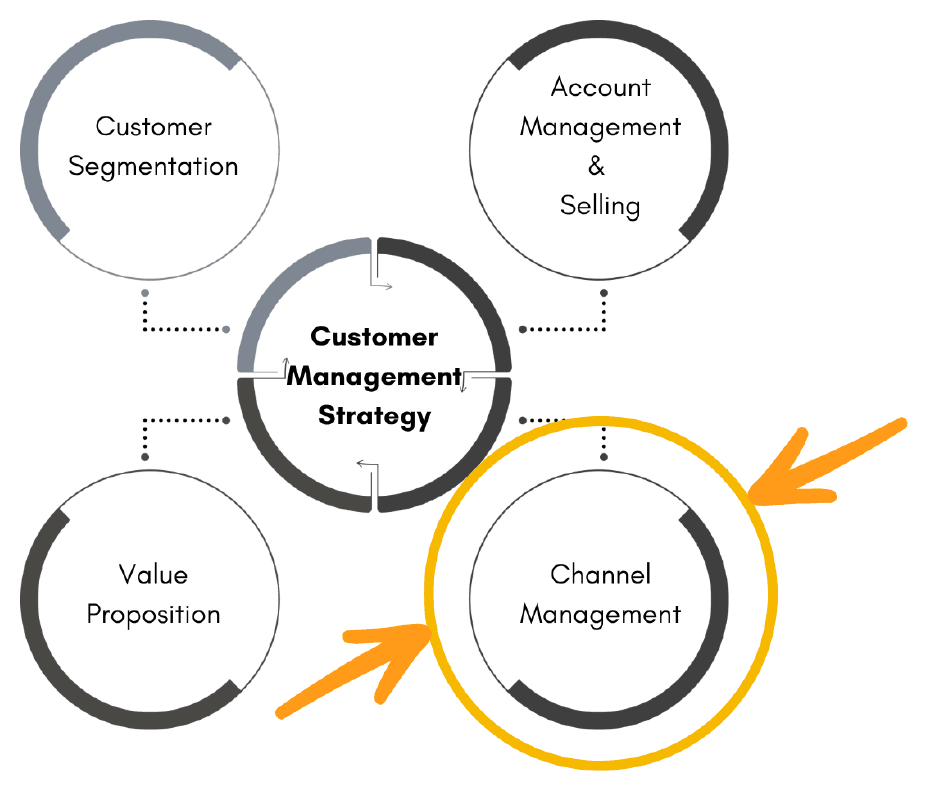 Channel management is one of the four pillars of a customer management strategy.
Channel management sits alongside segmentation, managing key customers directly and the value proposition as one of the building blocks of a customer management strategy, the kind you can write on one page. The shift it asks of you is simple to say and hard to do. Treat your channel partners as customers, not as distribution points.
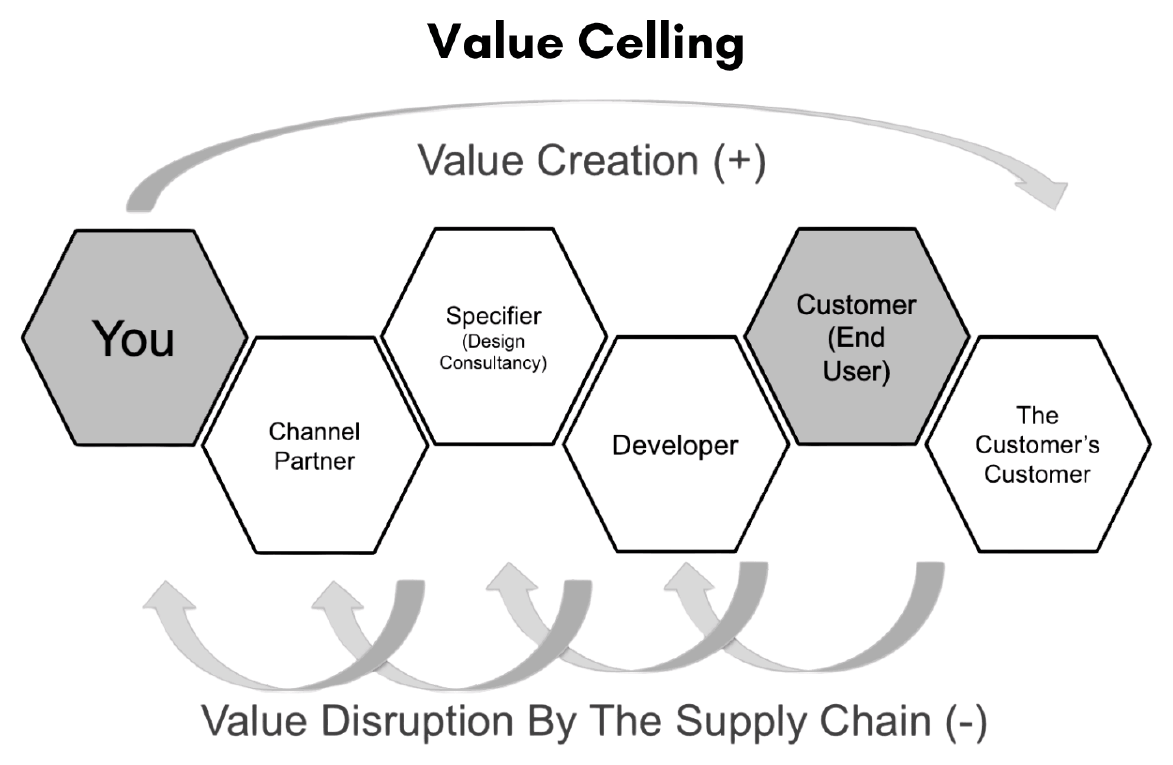 Value celling: look at each organisation in the chain and what it needs to win.
I call this value celling. Take a helicopter view of the whole chain and look at each cell, each company in it, and ask what motivates it to run its business the way it does. No company sets out to destroy value. Each one wants to prosper and win the game it is playing. If you understand the game, you can change what winning looks like.
Ten steps to build channel capability
This is the structured approach I use with clients. It runs in three phases, strategy, develop and operate, and it is a cycle, not a project.
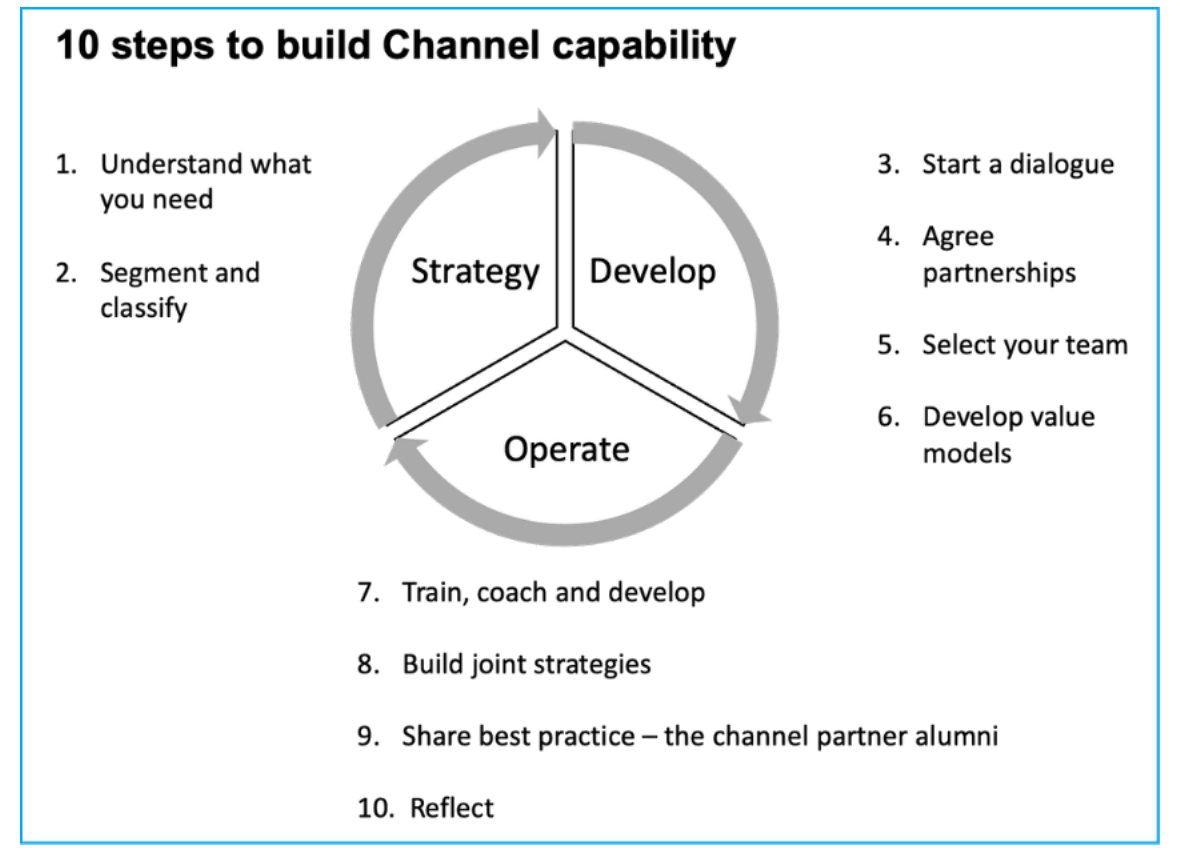 Ten steps in three phases.
Strategy: know what you need and who matters
Step 1, understand what you need. Start with the hard questions. Which end customers must you reach, and where are they? Do you have the commercial, technical, operational and logistical reach to serve them yourself? What behaviour do you need from channel partners, and are you getting it today? (This is where the question of when to use a channel at all gets settled.)
Step 2, segment and classify. Not all partners are equal, so do not manage them as if they were. Classify them on two things: their impact on reaching the customers you care about, and their intent to work with you in partnership. It is the same logic as portfolio classification for direct customers, and it tells you where to invest.
Develop: build the relationship and the tools
Step 3, start a dialogue. The keyword is partnership, and partnership needs real, open conversations about common strategy. You choose partners because they fit your needs, but the value has to be mutual. If a partner sees no value in working more closely with you, think again about whether it should be a strategic partner at all.
Step 4, agree the partnership. Formalise it with service-level agreements and, where needed, contracts. But lean towards partnership rather than paperwork. A contract tells you what happens when things go wrong. It does not make them go right.
Step 5, select your team. Channel management needs specific skills, and your organisation should be built around the types of partner you have. Strategic partners need dedicated focus. As a rule of thumb, one full-time person can manage around two strategic partners or ten associate partners.
Step 6, develop value models. Build the tools, standards and commercial conversations that let a partner move from a price-led model to a value-led one. The best question to ask yourself here is, “If I were running this partner’s business, what would I need in order to work differently?”
Operate: keep it alive
Step 7, train, coach and develop. Put value-based principles to work through training, online learning, planning tools, facilitated workshops and leadership coaching. If you do not share what you know about value-based business, how else will your partners learn it?
Step 8, build joint strategies. Work with your partners to understand the customers they serve, especially your key target accounts. Joint planning across the commercial, technical, operational and supply chain sides produces better results for everyone, and it is the channel equivalent of a living account plan.
Step 9, share best practice. Create a channel partner alumni: a club where partners come to conferences, join webinars and share success stories. Done well, membership becomes something partners prize, and that is a powerful motivator.
Step 10, reflect. Markets change and first thinking is rarely perfect. Review your strategy, segmentation, partner selection and results regularly, and be ready to go round the cycle again. Supply chain cultures drift back to price the moment you stop paying attention.
Habits that turn partners into value-cells
The ten steps give you a structure. What makes it work day to day is a handful of habits.
Map your supply chain, all of it, including your partners’ suppliers and your competitors. It will look complicated. That is the point: you need to see the ground you are fighting on, and where value is being created or destroyed at each stage. Then put yourself in each partner’s shoes. Talk to managers in each company about why they make the commercial decisions they do. You will be surprised what you learn.
Describe the value proposition between each pair of parties. What does each company offer its direct customer? Does it talk about value, or does it offer a cheaper alternative? That one exercise usually explains why the chain behaves as it does.
Ask your partners what they think of you. Are you a good supplier? Do they get useful technical, commercial and market advice? What could you do to help them earn more? Then preach value, constantly. Many partners are smaller entrepreneurial businesses that have never had anyone talk to them about value, and they appreciate it more than you might expect. Run value seminars where partners present their own examples, and take advice on competition law before you bring competing partners into one room (the Competition and Markets Authority’s guidance is a sensible starting point for UK businesses).
Change who you talk to. Big value opportunities need senior conversations, so aim for 10 to 20 senior executives across your supply chain. It takes brave, open, two-way conversations, and what you learn is extraordinarily useful. And look backwards as well as forwards. Be value-centric, not just customer-centric, and treat your own suppliers the way you want your partners to treat you. It would be hypocritical to demand value-based treatment and not offer it.
Finally, co-create. Suppliers often go looking for new partners to innovate with while ignoring the willing, capable ones they already have. Your channel is the most obvious place to start.
A channel value health check
If you want a quick read on where you stand, score each statement from 1 (rarely true) to 5 (consistently true).
- We can say clearly what percentage of our revenue flows through third-party channels.
- We have a current, accurate map of our full supply chain, including all key intermediaries.
- Our channel partners can explain our value proposition to end users in their own words.
- We have segmented our partners by strategic impact and mutual intent.
- We invest in training our partners in value-based commercial skills.
- We have joint plans with our most strategically important partners.
- We regularly talk to partners about more than price, fees and delivery.
- We understand what our partners value in their relationship with us.
- We can name at least one specific time a partner created value for an end user, not just delivered product.
- We review and refresh our channel strategy at least once a year.
A score of 40 to 50 means your channels are working as value-cells and the question is how to sustain and scale that. Between 25 and 39, you have the right instincts but gaps in execution, and there are probably specific points in the chain where value is being diluted. Below 25, value is leaking and your supply chain is working as a distribution mechanism rather than a commercial asset. That is also where the biggest opportunity sits.
The advantage nobody else can copy
When a competitor matches your product, and eventually one will, a well-developed channel becomes the difference. Partners who understand, communicate and deliver your value at every touch point are much harder to copy than a feature.
My BEMS story ended well because one stubborn end user fought through the supply chain to get the value he needed. Think about how rare that is. Then imagine the version where he never had to, because every company between the factory and the plant room already knew what was at stake and was working together to deliver it.
References
Buffett, W. (2009) Letter to the Shareholders of Berkshire Hathaway Inc. (2008 Annual Report). Omaha, NE: Berkshire Hathaway.
If this is your problem too, see the Strategic Customer Planning Tool on the ladder, or talk to us.
The newsletter this came from
Every fortnight: one idea from the method, worked through properly. Read it where you already are, on LinkedIn, or by email below.
Keep reading
The Plan in the Filing Cabinet
Somewhere in your organisation there is a key account plan that nobody has opened since the day it was approved. It does not die from lack of discipline. It dies because no team ever had the hours to keep it alive. Now, finally, something has the time.
Customer Segmentation: The Kingpin of Customer Management
Most companies segment customers on last year's sales, and pay for it. Here is a five-stage method for customer segmentation that looks at future value instead.