Three Ways Key Account Management Powers B2B Innovation
Most B2B innovation dies after the lab, when someone has to sell it and make it work. Your key account managers are best placed to stop that happening.

Every boardroom I walk into has the same ghost in it. Somewhere on the agenda sits innovation, and somewhere in the room sits the memory of the last big initiative that was launched with a fanfare and quietly buried two years later. Nobody mentions it. Everybody remembers it.
The numbers explain the silence. Bain’s Darrell Rigby and his colleagues put the failure rate of innovations at somewhere between 70 and 90 per cent, and they see no evidence that the figure is improving, despite incubators, new structures and even AI (Rigby, First and Boyd, 2023). That is not a rounding error. That is most of the money.
My argument in this piece is simple, and a little unfashionable. The people who can change those odds in B2B are already on your payroll. They are your key account managers, and in most companies they are kept well away from the innovation process.
VUCA on steroids: why B2B innovation is getting harder
Volatility, uncertainty, complexity and ambiguity have always made innovation difficult. VUCA is not new. What is new is the speed. AI has pushed every one of those four dimensions harder at once. McKinsey’s 2025 survey found that 88 per cent of respondents now report regular AI use in at least one business function, up from 78 per cent a year earlier, yet only around a third say their companies have begun to scale it (McKinsey & Company, 2025). Your customers are in the middle of that shift. Their needs are moving while you are still writing the brief.
Pharmaceuticals shows it clearly. For decades, growth came from new chemical entities protected by patents. Those days are fading. A healthcare customer today has payers demanding proof of outcomes, providers trying to adopt AI-enabled diagnostics while holding down cost, and patients expecting care shaped by their own data. The innovation that matters is no longer only the molecule. It is the whole solution that deals with those layered, interconnected pressures at once.
And the product itself ages faster than ever. Economists who have tracked product sales over their lifetimes find they peak within a year or two and then fall away steeply, which means you have to keep launching simply to stand still. I call this the innovation-obsolescence cycle, and it is why innovation cannot be treated as an occasional project.
So how do most companies respond? With more bureaucracy. Innovation committees. A Chief Innovation Officer. Ideation platforms and internal accelerators. None of these is wrong, but they miss the point. You are rarely short of ideas. You are short of a connection between those ideas and the market as your customers actually experience it.
That connection already exists. It sits in the job description of your key account managers. Here are three reasons they belong at the heart of your innovation strategy.
1. Effective innovation starts with real customer needs
For half a century the evidence has pointed the same way. Products fail when they do not meet genuine customer needs. It should not be a surprise, and yet companies keep building solutions before they properly understand the problem.
AI makes this worse. Customer needs are no longer a fixed target you can capture in an annual survey. They change as your customer deploys new technology, restructures, and reacts to its own competitors. Traditional market research simply cannot keep up.
Your key account managers live in the customer’s world. They do not visit once a year with a questionnaire. They are inside the operational reality of your most important customers, and that gives them something no survey can: they see what customers do, not just what they say. They see where processes break. They see the workarounds that nobody puts in a slide deck. They understand the politics that shape a buying decision, and they know which problems senior people care about enough to fund. Right now they are also watching, first hand, where a customer’s AI projects succeed, where automation creates new pain, and which human skills still matter.
Think about the last time a customer told you what they wanted. Was it the same as what you saw them struggling with?
The first stage of our method, Offer Development and Innovation, turns that advantage into a discipline. It begins with a structured customer needs analysis: the problems underneath the problems, and the people who feel them. When key account managers drive that discovery, innovation stops being a leap in the dark. It becomes a considered response to documented, validated customer problems. The pipeline fills with ideas that have already passed the market test, because they are grounded in the customer’s economics rather than your own enthusiasm.
2. Innovation has to beat the competitor’s offer
A brilliant idea still loses if it cannot win a real deal. Yet most innovation teams work at arm’s length from competitive intelligence. They know their own capabilities and their own technology inside out. What they rarely see is what competitors are doing at account level, where deals are actually won and lost.
Your key account managers see it every week. They know which competitors are winning and why. They see competitor proposals. They hear the pitch. They know the pricing structure, the service commitments, and the history of the relationship that shapes a customer’s preferences.
As AI capability becomes table stakes across industries, that ground-level knowledge matters even more. The difference a customer will pay for often lies not in the technology itself but in how it fits their workflow, how implementation is supported, and how the value keeps being shown after go-live.
This is strategic gold. It tells you where competitors are exposed. It tells you the threshold requirements any new offer must meet just to be considered. And it tells you what distinctive value would actually shift the customer’s preference. Without it, your innovation team risks building something interesting that is not compelling when the buying decision comes.
Go back to pharma. A new therapy may have superior clinical data. But if a competitor has secured its place on the formulary, built patient support programmes, earned the trust of key opinion leaders and deployed tools that make prior authorisation easier, clinical superiority alone will not win. Innovation has to answer the whole competitive picture, not just the technical specification.
Key account managers can tell your innovation team what good looks like from the customer’s side of the table. They can stress-test a concept against the real alternatives and separate the features that matter from the nice-to-haves. That feedback loop between innovation and the competitive front line is not optional. It is how you build an edge that lasts longer than a product cycle.
3. Innovation only counts when it is sold and delivered
This is where most innovation dies. Not in the lab, and not at the concept stage, but at the moment someone has to turn technical possibility into customer value, make the sale, and then make it work in the messy reality of a customer’s operation.
Scott Kirsner, writing in Harvard Business Review, found that the most dangerous moment for an innovation project comes when it has to be handed from the innovation team to the business units for a large-scale launch (Kirsner, 2017). The idea is sound. The research is promising. Then the transition stumbles, because nobody owns the difficult work of making it real for customers.
Key account managers are the bridge. They own the commercial relationship and they carry the accountability for implementation. They understand how the customer buys and who has to approve. They can work through the internal politics of a large purchase, and they can explain the value in terms an economic buyer cares about, not just a technical user.
Here is what separates them from every other role in the innovation chain. Key account managers are judged by their customer and by their own company on whether the innovation delivers in practice. That dual accountability is a forcing function nobody else faces. When the new offer underperforms, it is the key account manager who gets the call. When implementation stalls, they have to diagnose it and get it moving. When the promised benefits fail to appear, it is their credibility that suffers. This is not theoretical responsibility. It is career-defining.
Because of that, good key account managers do not hand the innovation over and move on. They run the change. They work with the customer’s people to overcome resistance, spot the training gaps, fix the integration problems, track adoption and quantify the value delivered, and they adjust when the first approach falls short. With AI redefining roles and processes as well as tools, the human side of implementation now decides success more often than the technology does.
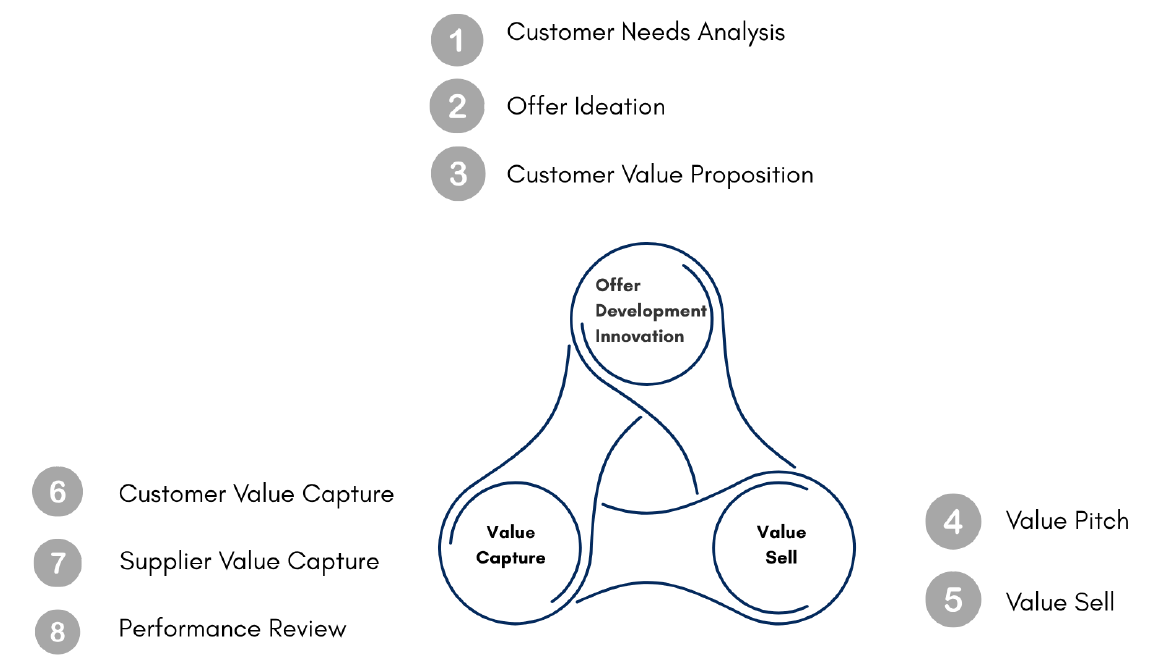 The Strategic Customer Planning Cycle (Davies, Value Matters, 2025).
The framework we use makes this explicit. The Strategic Customer Planning Cycle runs from Offer Development and Innovation, through value selling, to value capture, with eight phases underneath. It is not enough to design a compelling offer. You have to sell it inside your own business, sell it to the customer, and then capture measurable value for both sides, finishing with an honest performance review. That takes commercial discipline, account planning, relationship management and a relentless focus on execution. I set out the whole model in the value-based KAM framework.
Who does all that? The key account manager. And they do it knowing they will be judged on actual results, not projected potential.
Innovation without commercialisation and implementation is research. It might even be important. It does not drive growth. Key account managers take the new product, the new service or the new business model, sell it to the customers who matter, make it work, prove the value, and then expand it.
Stop treating KAM as a relationship exercise
Most companies still measure key account management by satisfaction scores and retention. Those matter, but they miss the larger opportunity. Bring key account management into your innovation strategy and it stops being a cost centre focused on keeping customers and becomes the place where profitable innovation is shaped, sold and proved. If your programme has drifted into the first description, ask whether it is good enough for the second.
The long pattern of innovation failure can be broken, but it needs an honest admission first. The problem is not a lack of creativity or money. It is the gap between innovation effort and market reality, and your key account managers are the people standing in that gap every day.
So the next time the innovation committee meets, look around the table. Is there anyone in the room who will get the phone call when it goes wrong?
If this is your problem too, see how we build the capability properly, or talk to us.
The newsletter this came from
Every fortnight: one idea from the method, worked through properly. Read it where you already are, on LinkedIn, or by email below.
Keep reading
Why you keep rebuilding your KAM programme
Four out of five sales organisations rebuild their key account programme every few years. The rebuild is treated as a failure of effort. It is almost always a failure of capability.
Five Steps to a High-Impact KAM Training Programme
Most key account management training fails because it treats KAM as a sales technique. Five steps to a KAM training programme that changes how people work.