How to Write a Compelling Strategy on One Page
Most executives cannot say what their strategy is. A six-step method for writing a compelling strategy on one page, and the habits that make it stick.

Sooner or later it happens in every boardroom. Someone asks the deceptively simple question, “So, what exactly is our strategy?”, and the room goes quiet. Not because nobody cares. Because nobody can say it clearly, despite all the planning documents, the slide decks and the away days.
Have you been in that room? I have, more times than I can count.
The question matters more than it looks. Strategy sits at the centre of any serious approach to customer management. Without a clear strategy, even the cleverest customer segmentation and the most brilliant value propositions become academic exercises. So this piece is about the one thing that holds the rest together: a strategy you can write on a single page and explain to anyone.
Most executives cannot say what their strategy is
David Collis and Michael Rukstad called it a dirty little secret in their Harvard Business Review article Can You Say What Your Strategy Is?: most executives cannot state the objective, scope and advantage of their business in a simple statement. And if they cannot, nobody else in the business can either.
Why? Partly because strategy is rarely communicated well. But mostly because forming a strategy is a skill, and it is badly under-developed in most leadership teams. The good news is that it can be learned. Over the past two decades I have watched hundreds of people, from key account managers to chief executives, adopt the one-page approach I describe below. They have used it for customer strategy, and also to size up competitors, assess suppliers, think through acquisitions and, in one or two cases, sort out their own lives. Once you have the discipline, it becomes a lens you look at every problem through.
What is strategy, anyway?
I once asked a very capable chief executive, who had built a £50 million business, to describe his strategy. He talked for twenty minutes about operational excellence, customer service and market positioning. All good things. When he finished, I asked, “So what’s the strategy?” He paused, smiled ruefully, and said, “I think I just proved your point.”
Rick Page put it well in the title of his book on complex selling: hope is not a strategy. Yet how many strategy documents are full of aspiration and wishful thinking?
A strategy is not a vision statement, though vision matters. It is not a list of goals, though goals are important. It is not a budget, though resources are crucial. Strategy is the coherent set of choices about where to play and how to win that creates lasting competitive advantage. Think of it as your theory of success: a clear hypothesis about what you will do differently from your competitors to create more value for customers, and to capture a fair share of that value yourself.
What strategy is not matters just as much. It is not trying to be everything to everyone. It is not a collection of best practices copied from successful companies. It is not a plan to be slightly better at what everyone else is doing. Real strategy takes the courage to say no to good opportunities so that you can say yes to great ones.
Why strategy is so hard
Four things get in the way, and you will recognise all of them.
Strategy gets confused with planning. I have sat through countless “strategic planning” sessions that were really operational planning with a fancy name. Planning asks how. Strategy asks what and where. Planning assumes the current approach is right and focuses on execution; strategy questions everything and demands choices.
The vision is blurry. Ask most leaders about their vision and you get something inspiring and vague: “We want to be the market leader in exceptional customer value.” Lovely. But which market? Exceptional how? Compared with whom? Strategy demands specifics.
Today kicks tomorrow in the teeth. This is the most insidious of the four. Urgent operational problems always feel more important than strategic thinking. The call from an unhappy customer feels more real than a market shift five years away. As someone once told me, the urgent is seldom important, and the important is seldom urgent.
Change is painful. Strategy means change, and change makes people uncomfortable. Products get discontinued, segments get deprioritised, cherished ways of working have to go. The resistance often kills a strategy before it starts. I learned this early in my career, advising a technology company with a brilliant plan to move from low-margin manufacturing to high-margin services. Analytically it was perfect, financially it was compelling, strategically it was essential. The manufacturing team saw it as a threat to their expertise and status, and without dealing with that human side, the strategy became one more unused document.
Six steps to a one-page strategy
This is not theory. It is a step-by-step method that has been used by hundreds of people across industries and continents for more than twenty years, and it builds directly on Heinz Weihrich’s TOWS matrix, which matches your internal strengths and weaknesses against the external opportunities and threats and builds strategy from the pairings. What the six steps add is enough structure to make it usable by a customer management team on a Tuesday afternoon.
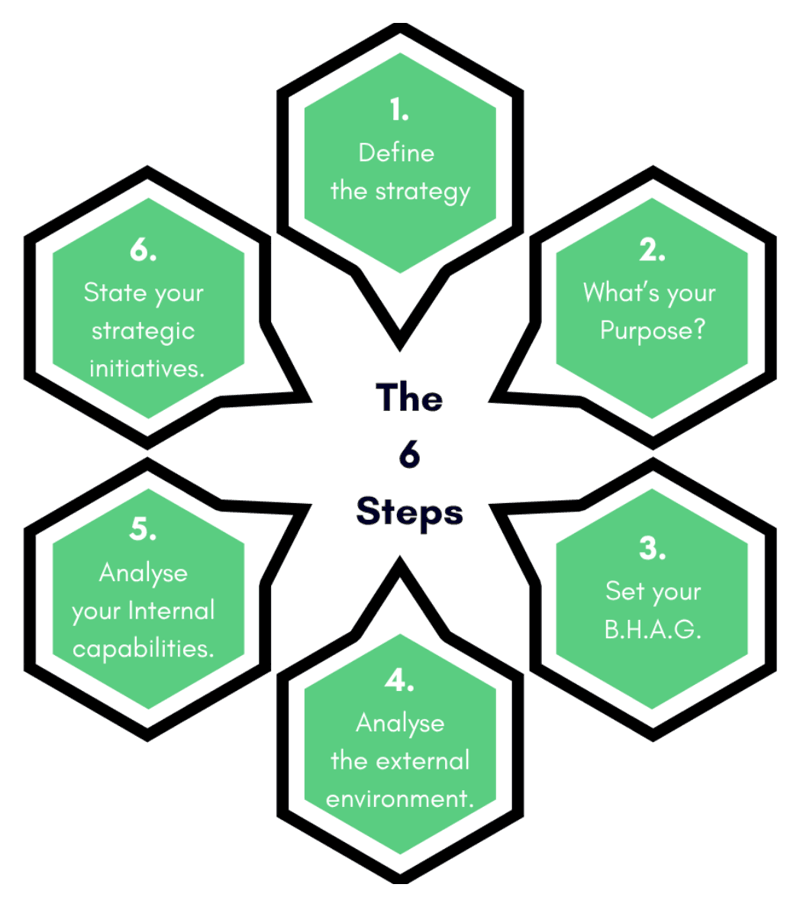 The six steps to a one-page strategy.
1. Define the strategy
Start by deciding exactly what the strategy is for. A business unit? A market? A single key customer? The scope sets everything else, and most muddled strategies are muddled here first.
2. What is your purpose?
Write down why you exist and what you are trying to achieve, in a sentence a customer would understand. Not a slogan. A plain statement of the business you are in and who it serves.
3. Set your BHAG
The Big Hairy Audacious Goal, a phrase from Jim Collins and Jerry Porras, is the stretching, specific target that gives the strategy its direction. Put numbers and a date on it. “Grow” is not a goal. “Grow revenue from $60m to $100m in the next 18 to 24 months” is.
4. Analyse the external environment
What is happening in the markets, among customers and competitors, and in regulation and technology that creates opportunities or threats for you? Be specific and be honest about the threats.
5. Analyse your internal capabilities
What are you genuinely good at, and where are you weak? Strengths and weaknesses only mean something relative to what customers value and how competitors perform, so hold each one up against those two tests.
6. State your strategic initiatives
This is where the TOWS thinking pays off. Match strengths to opportunities, find the weaknesses that threats will expose, and turn the result into a short list of concrete initiatives. Ten is plenty. Each one should be something a named person can start next month.
What it looks like on the page
Here is how it came together for a consulting firm I worked with. They were struggling with falling margins and rising competition. Working through the six steps, they discovered that their real advantage was not general consulting at all. It was their deep expertise in environmental compliance.
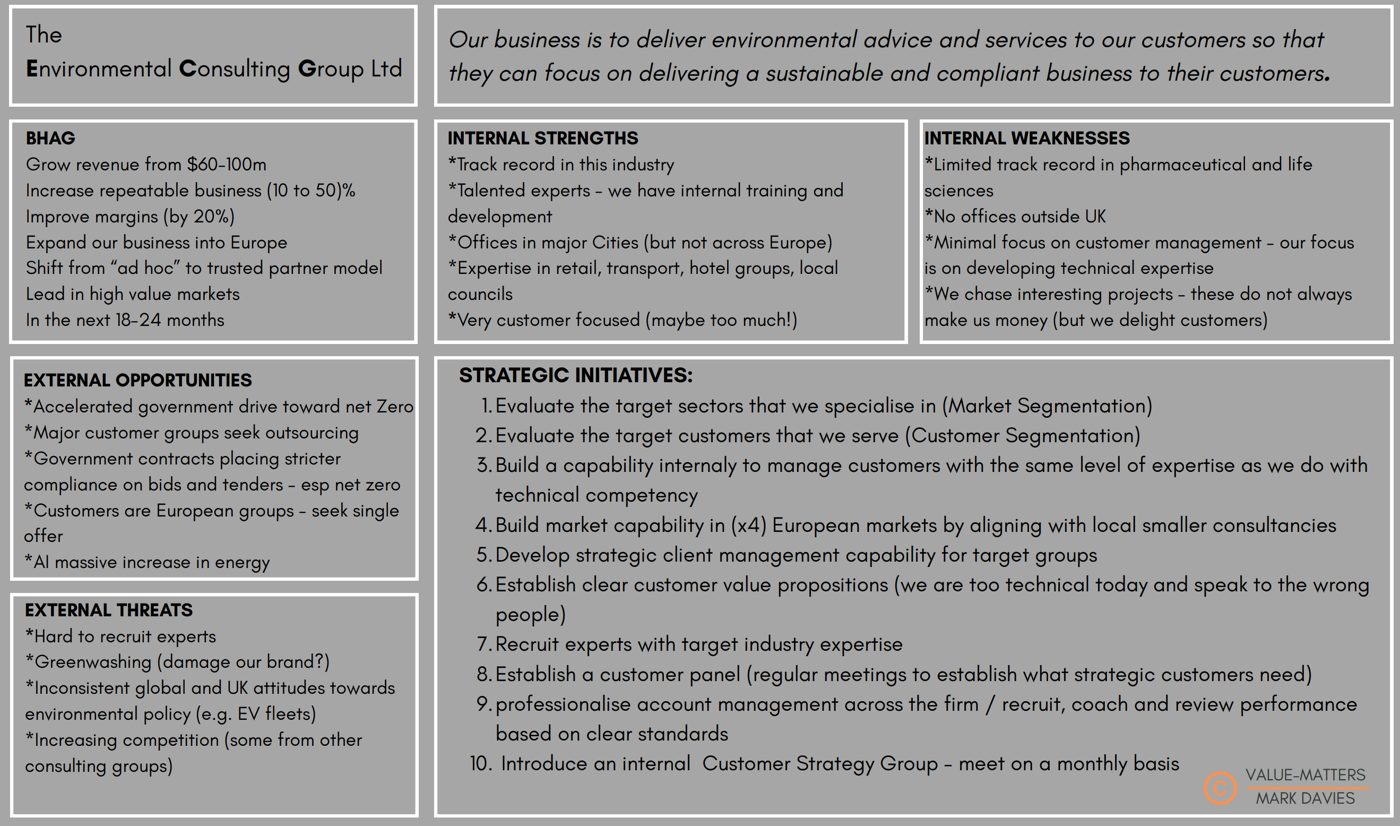 An example one-page strategy (illustrative, based on a real engagement).
The initiatives they chose were about customer management: segmenting their markets and customers, building Value-Based KAM capability, creating clear customer value propositions, and putting a regular customer panel and an internal customer strategy group in place. That repositioning, in their account, tripled their margins within 18 months.
Look at what sits on the page: a clear purpose, specific goals, an honest assessment of strengths and weaknesses, the external opportunities and threats, and ten concrete initiatives. Most importantly, it passes the real test. Anyone who reads it understands what the firm does, for whom, and how it plans to win.
The same discipline works at the level of a single account. Our One Page Proposition applies it to your most important customer, and the blank one-page template is free to download if you want to try it yourself first.
Tips for building a compelling strategy
After watching a great many strategy processes, I have seen the same patterns separate the ones that work from the ones that fail.
Create a burning platform. Change only happens when people see a real problem that demands action. If your organisation is comfortable with the status quo, strategy work becomes an academic exercise. Help people see that staying on the current path is the riskiest option of all.
Secure an executive sponsor. Strategy without senior support is expensive wishful thinking. Get a board member to sponsor the work, agree the scope and commit time, resources and political capital. I have seen brilliant strategies die because nobody senior defended them when implementation got hard. We call this person the sponsor for good reason.
Build a cross-functional team. You cannot develop a strategy alone. Sales knows customer pain points finance never sees. Operations understands cost drivers marketing might miss. Strategy comes from where those views meet.
Protect time to think. Strategic thinking needs space away from the day job. Some of the best insights I have seen came from off-site sessions where teams could think beyond the quarter.
Obsess about customers and competitors. Be ruthlessly specific about which customers you are trying to serve and which competitors you are trying to beat. Generic strategies produce generic results.
Be curious in your research. If your research only confirms what you already believe, you are not researching. You are validating. Go looking for the data that challenges your assumptions.
Look outside your industry. If you only study your own sector, you will only find your sector’s answers. Some of the most original strategies borrow ideas from completely different industries.
Make room for crazy ideas. Safe strategies rarely create lasting advantage. Give the odd, uncomfortable idea a proper hearing before you rule it out.
The skills behind a good strategist
Following a process is not the same as being good at strategy. The people who do it well combine strategic thinking with a working knowledge of models such as Porter’s Five Forces, a feel for offer development and innovation, the patience to manage change, an understanding of how their business model creates and captures value, and the measures to tell early whether it is working. Together that is what I would call strategic leadership: the ability not just to write a strategy, but to make it happen.
Before the next boardroom
A strategy is not a prediction of the future. It is a way of preparing for several possible futures and positioning yourself to do well whichever one arrives.
So try this before your next leadership meeting. Take a single sheet of paper and write your purpose at the top. If you cannot do it in a sentence, you have found where to start. And the next time someone asks “So, what exactly is our strategy?”, you might be the one who does not need to look at the floor.
References
Collis, D. J. and Rukstad, M. G. (2008) ‘Can you say what your strategy is?’, Harvard Business Review, 86(4), pp. 82 to 90.
Page, R. (2002) Hope Is Not a Strategy: The 6 Keys to Winning the Complex Sale. New York: McGraw-Hill.
Weihrich, H. (1982) ‘The TOWS matrix: a tool for situational analysis’, Long Range Planning, 15(2), pp. 54 to 66.
If this is your problem too, see the Strategic Customer Planning Tool on the ladder, or talk to us.
The newsletter this came from
Every fortnight: one idea from the method, worked through properly. Read it where you already are, on LinkedIn, or by email below.
Keep reading
The Plan in the Filing Cabinet
Somewhere in your organisation there is a key account plan that nobody has opened since the day it was approved. It does not die from lack of discipline. It dies because no team ever had the hours to keep it alive. Now, finally, something has the time.
Customer Segmentation: The Kingpin of Customer Management
Most companies segment customers on last year's sales, and pay for it. Here is a five-stage method for customer segmentation that looks at future value instead.