
The 5-Stage Model for Breakout B2B Sales Growth
Brilliant products, flat sales? This 5-stage customer management model brings the rigour you use in R&D to strategy, segmentation, selling, channels and value.

A precision engineering firm I worked with held patents on manufacturing processes nobody else could match. Their quality was unquestioned. Their technical team solved problems their competitors could not even understand. And their revenue had been flat for three years.
Around the same time I met a software company with genuinely innovative AI capabilities and world-class technology. They kept losing deals to competitors with weaker products, who simply knew how to sell and explain value better.
I have seen this pattern across B2B businesses for 25 years. It is never a shortage of good products or smart people. It is a failure to apply the rigour that created the products to the equally complex job of taking them to market.
Here is the uncomfortable truth: engineering excellence in your product means nothing if you have not engineered excellence into your customer management strategy.
Where the science goes missing
Technically driven businesses pour money and brainpower into research and development. They spend months perfecting a feature, years on a breakthrough, fortunes on patents. That is science, applied methodically and measured carefully.
Then the conversation turns to customers, and the same leaders who insist on rigorous test protocols become remarkably casual. They hire salespeople for personality rather than fit. They chase any prospect who shows interest, whether or not it suits their capabilities. They compete on price, because they have never built a systematic way to communicate value.
Kenichi Ohmae put it neatly: rowing harder does not help if the boat is heading in the wrong direction.
When the science is missing from customer management, the same problems turn up every time. Resources go to the wrong places, so your best people spend their days on your worst prospects while your highest-potential customers are neglected. The technical teams start to see sales as a necessary evil rather than the thing that multiplies the value of their work. Competitors who do think systematically about customers beat you, even with inferior products. And morale suffers, because nothing demoralises a team quite like watching a better product lose, again.
The art and the science of customer management
Sustainable B2B growth needs both art and science, and it is the science that technical businesses overlook. The art is intuition about what customers need and the knack of building relationships. Most technically minded leaders accept that it exists, then dismiss it as “soft skills” that cannot be systematised.
They are wrong. Each conversation with a customer takes artistry, yes. But the framework around those conversations can and must be designed with rigour: who you target, how you segment them, what value propositions you build, how you organise yourselves to deliver. That is what the five-stage model does. It does not replace relationship skills. It gives them a strategic foundation, so the skills you already have go much further.
Start with a strategic reality check
Before you fix anything, get an honest picture of where you are. Gather your leadership team and try this. Give the questions below to three different people in your business, separately, without discussing them first. Then compare the answers. If they differ significantly, you have found your first priority: basic strategic alignment.
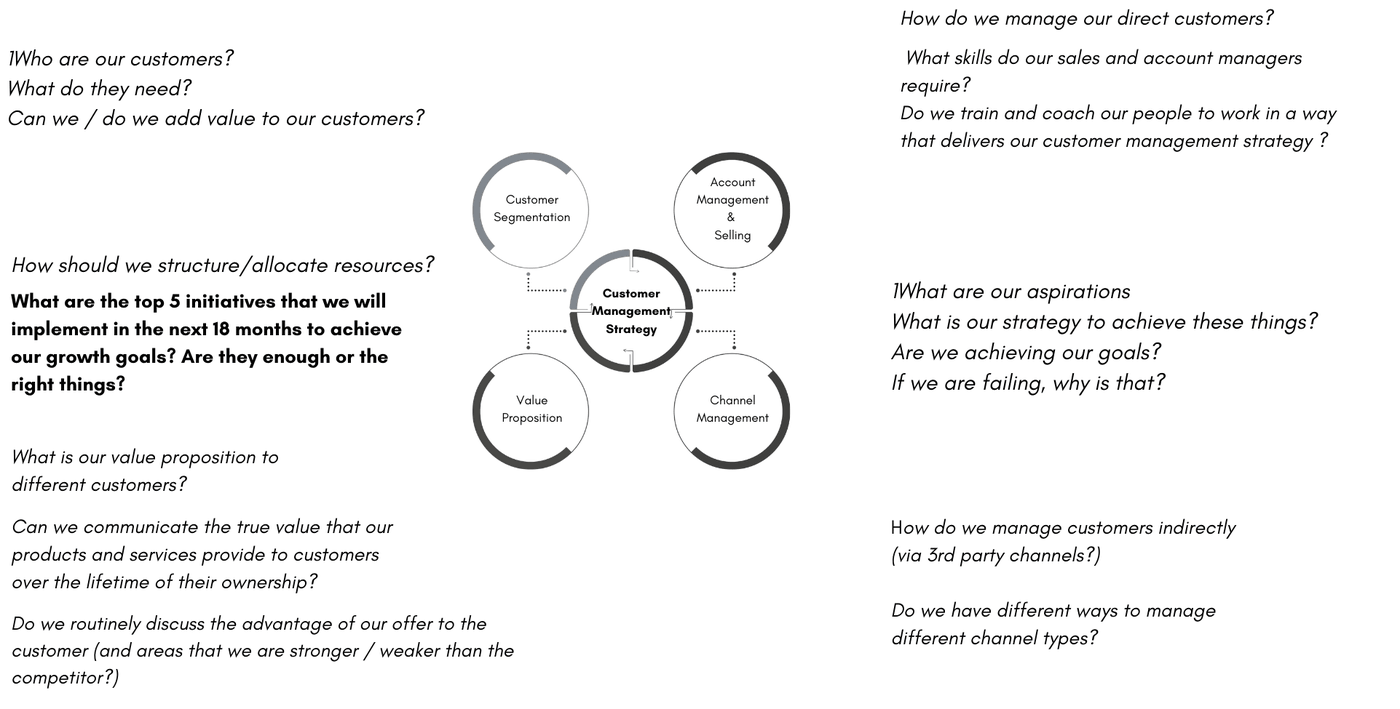
- What are our growth aspirations for the next 18 months, and what is our strategy to reach them?
- What are the top three reasons we lose deals to competitors?
- Who exactly is our target customer, by industry, size, geography and characteristics?
- How do we add measurable value to our customers’ businesses today?
- How do we decide which customers to serve directly and which through channel partners?
- What skills do our sales and account managers need, and do we train them systematically?
- Can we explain the value we give customers over the whole lifetime of what they buy?
- What are our top five growth initiatives for the next 18 months, and are they enough?
When an emergency power backup company did this, the VP of Sales thought the target market was research laboratories, the Marketing Director was chasing industrial manufacturers, and the CEO was pursuing government contracts. No wonder the messaging was confused. This is common in technical businesses, where everyone assumes the product speaks for itself.
The five stages of customer management
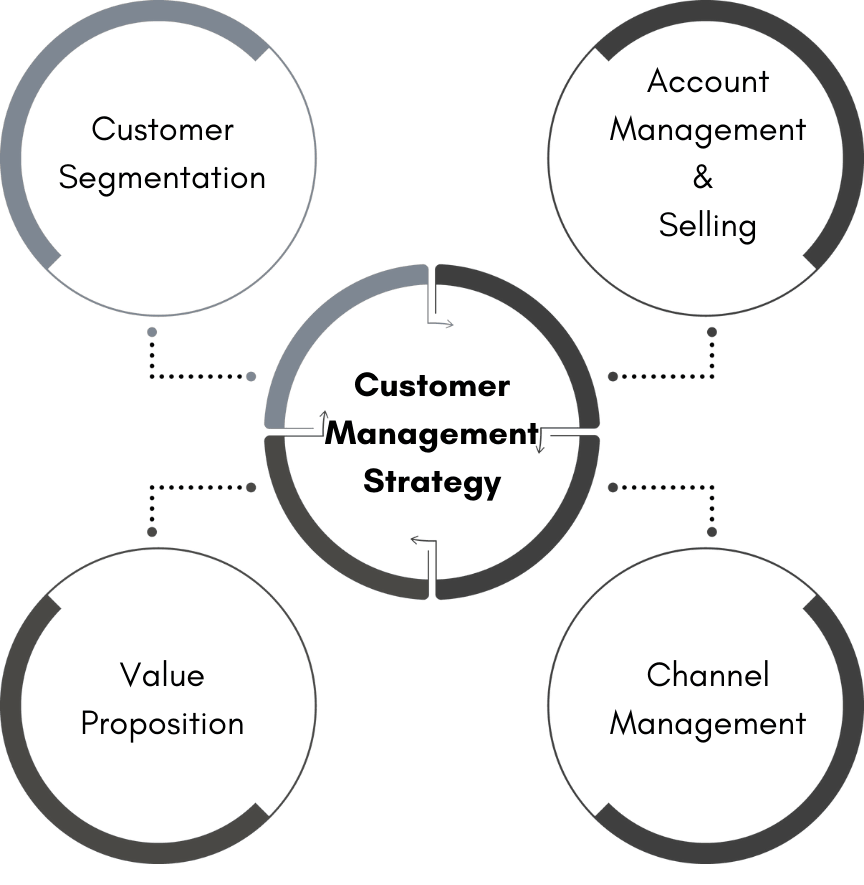
The model has five stages, with customer management strategy at the centre and the other four arranged around it. Each one informs the others.
Stage 1: Customer management strategy, your foundation
Think of this as your satnav. You would not set off on a complicated route without knowing where you are and where you are going, and you cannot build effective customer management without the same clarity.
It asks for honest analysis outside the business (market change, competitors, new entrants, regulation) and inside it (capabilities, culture, money, and how effective your selling really is).
The goal is not a long strategic plan that sits on a shelf. It is a clear strategy on one page that captures your BHAG (Jim Collins’s Big Hairy Audacious Goal) and the six to ten strategic actions needed to get there in 12 to 24 months.
A software company went through this analysis and realised they were trying to serve three different market segments with one approach. They chose to focus on manufacturing companies with 200 to 1,000 employees, built targeted messaging and specialist expertise around them, and tripled their close rate.
An environmental consultancy turning over about £60m a year had an average invoice of around £3,000. Every customer was treated the same, and every assignment was handled ad hoc. By choosing 20 key clients and building service packages around carefully worded value propositions, they grew overall sales by 30% and gained a steadier income from monthly service contracts. That came directly from taking a key account management approach with a few high-value customers.
Stage 2: Customer segmentation, the science of resource allocation
This is where technical businesses make their biggest mistakes. They treat all customers equally, with the same service and attention regardless of potential or strategic importance.
Good segmentation weighs opportunity against cost to serve. I recommend four categories. Foundation customers are lower value and easy to serve, ideal for efficient, scalable processes. Core customers are moderate value and need moderate investment: your bread and butter. Key customers are high value and justify serious investment and dedicated account management. Global customers carry the highest value and complexity, and need global account teams that work across borders. When you do move a customer into the top tiers, managing that customer directly is a different job. If you are unsure where the line falls, start with what a key customer actually is.
The critical decision is which customers you serve directly and which through channel partners. That decision drives resource allocation, skills, processes and technology.
An aerospace components manufacturer used this segmentation and discovered it was giving expensive direct service to dozens of small customers who should have been served through distributors, while underserving three major OEMs (original equipment manufacturers) who represented 60% of its potential market value.
Stage 3: Account management and selling, excellence with direct customers
For the customers you serve directly, you need account management that matches their strategic importance. Hiring “good salespeople” and hoping for the best is not a strategy. You need the right people for each segment, a structure that coordinates them, consistent processes, account planning that treats major customers as investments, and leadership that puts the customer at the centre of decisions.
Value selling should be the baseline for every direct customer conversation, moving the discussion from product features to customer outcomes. For your most strategic accounts it grows into full key account management, or global account management for customers spanning several regions.
An industrial equipment manufacturer trained its technical sales team to lead with customer business outcomes rather than product specifications. Instead of torque ratings and tolerances, they talked about production efficiency and quality improvements. Their average deal size rose 40% within six months.
If you want to understand industrial value selling in depth, read Value Merchants by James Anderson, Nirmalya Kumar and James Narus. It shows how suppliers in business markets estimate, document and get paid for the value they create at the customer’s own site.
Stage 4: Channel management, getting the most from indirect routes
Almost every B2B business sells through channel partners, and most treat channel management as an afterthought. Your partners find customers, design solutions, deliver service and handle logistics. Treat them as extensions of your own sales and service capability.
Your most strategic channel partners deserve the same key account management you give major direct customers: invest in them, build their capabilities, plan jointly, and treat the relationship as genuinely strategic. Approach them with a “privilege to work with us” attitude and they will give you minimal commitment in return. I have written more about building competitive advantage with channel partners.
An automated packaging systems company gave its top partners technical training, co-marketing support and dedicated channel account managers. Partner-generated revenue rose 35% in 18 months, and the partners became advocates rather than distributors.
Stage 5: Value proposition, how you communicate value
This stage runs through all the others, and it is often where the fastest gains are. Technical businesses talk about features and benefits when they should be talking about business value.
The line usually credited to Theodore Levitt, and traced by Quote Investigator back to a 1940s sales adage, says it best: people do not want a quarter-inch drill, they want a quarter-inch hole. Your customers do not buy your products. They buy better business outcomes, and being able to explain how you contribute to them is the difference between competing on price and earning a premium.
A strong customer value proposition answers specific questions about the customer’s business. How do you help them sell more? Where do you remove waste or cost? Which business risks do you reduce? How do you strengthen their operations? What edge do you give them in their own markets? The best B2B suppliers go one step further and understand how they help their customers serve their customers better.
Where to begin
You can start using this model straight away, before you have perfected any of the five stages. But be realistic about the work involved.
Customer management strategy sits at the centre because it both drives and depends on the other four. It pushes requirements out to stages 2 to 5 and takes insight back from them.
So begin by drafting your customer management strategy on a page. Just start, and accept that the first version will be wrong in places.
Next, sort your customers into a simple portfolio classification. It does not need to be complicated. Segmentation is a decision about where your resources go: up where the opportunity is highest, down to simpler, cheaper approaches where it is not.
Finally, work out how you will communicate value. Key and strategic customers get a proposition built just for them. Foundation and core customers, perhaps served through distributors or online, get a standard one, built properly but built once. Expect this to send you back to reclassify a few customers. That is the model working.
The same rigour, pointed outwards
Picture the precision engineers again, the ones with the patents and the flat revenue. They already know how to test an assumption, measure a result and iterate until something works. They have been doing it in the lab for years. The only change the five stages ask of them is to walk down the corridor and do the same thing with their customers.
If this is your problem too, see the Strategic Customer Planning Tool on the ladder, or talk to us.
The newsletter this came from
Every fortnight: one idea from the method, worked through properly. Read it where you already are, on LinkedIn, or by email below.
Keep reading
The Plan in the Filing Cabinet
Somewhere in your organisation there is a key account plan that nobody has opened since the day it was approved. It does not die from lack of discipline. It dies because no team ever had the hours to keep it alive. Now, finally, something has the time.
Customer Segmentation: The Kingpin of Customer Management
Most companies segment customers on last year's sales, and pay for it. Here is a five-stage method for customer segmentation that looks at future value instead.