Three Things That Kill KAM Performance
Most key account management programmes fail before they start. Three things kill KAM performance: a generic offer, timid leadership and the wrong people.

Key account management can be a supplier’s superpower. Somewhere along the way, a lot of businesses have dumbed it down into glorified selling.
It is not selling.
You already know which handful of customers matter most. They carry your current business and most of your future growth. They are more demanding than everyone else, and they are the customers your competitors most want to take from you. So you set up a KAM programme, appoint some key account managers, and wait for the growth. Then, two or three years later, you find yourself rebuilding it. Gartner found that 79% of sales organisations have rebuilt their key account programmes at least once in the past seven years to fix underperformance. That is not an indictment of the idea. It is a verdict on how the idea gets executed, and I have written before about why you keep rebuilding.
In my experience, three things kill KAM performance. One of them is the most important, one is the hardest, and the third is about the people who have to make the other two happen.
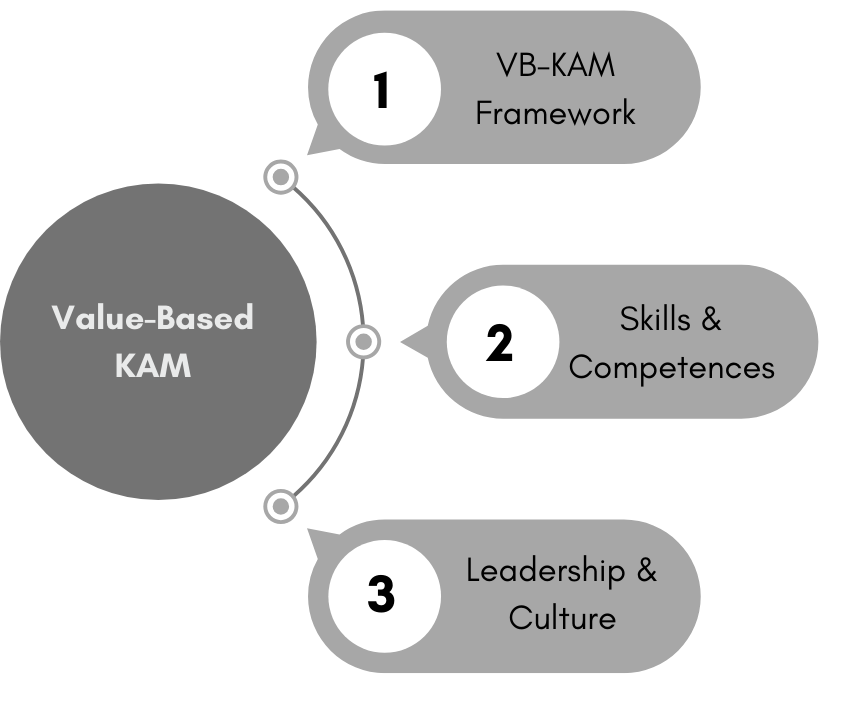 The three elements of Value-Based KAM. Get any one wrong and the other two cannot carry it.
1. The most important thing: offer development and innovation
All business comes down to understanding the customer and adding value. That should be the centre of any KAM programme. Which means key account management has to produce a value proposition honed for each key customer, rather than a standard offer built to promote your products and brands. Your products may well be a big part of the proposition. They are not the proposition.
Here is where most programmes go wrong. They walk into a key customer with a generic, product-focused offer. That is what you want to sell. It is not what the customer needs.
KAM starts the other way round. First you understand what this customer values, then you build an offer around it. That is the heart of offer development and innovation, and it is what separates Value-Based KAM from account management with a bigger expense budget.
There is a second half that almost everyone forgets. If your offer is strong enough and the customer buys it, you have to capture the value you delivered and report it back. Measure it, agree it with the customer, put it in front of the people who sign the next contract. Fail to do that and the value evaporates. Six months later the procurement team remembers the price and nothing else.
This leads to my definition of Value-Based KAM: the intersection of sales, strategy and innovation, underpinned by an organisation-wide business model. Get it right and you move from vendor to strategic partner, with a solution your customer cannot imagine working without. Get it wrong and you are one more supplier competing on price.
The reality is harsh. If you are offering the same thing to every key account, you are not doing KAM. You are doing mass marketing with a fancy job title. Each key customer is a segment of one, with its own challenges, opportunities and strategic direction, and it needs its own proposition. That means investing in understanding industries as well as products, and it means your key account managers have to think like consultants rather than salespeople.
2. The hardest thing: leadership and culture
Shifting the business to focus on key customers and value is hard, because it is a different business model. Power moves. Country managers and the heads of product divisions and specialist functions rarely enjoy watching it move towards the people who own customer relationships.
Get it wrong, though, and your KAM programme will struggle for attention, investment and the best brains in the building.
Much of the KAM literature makes this harder than it needs to be. It was largely written about large suppliers selling to other large firms, and it assumes resources most businesses do not have. If you run an SME (small or medium-sized enterprise), lighten the thinking without abandoning the principles: focus on a small handful of key customers and accept that one key account manager can handle several.
The real killer, though, is leadership that asks for customer focus and rewards product push. I have seen brilliant KAM strategies sabotaged by directors who talk about strategic customers in the conference and measure success purely on quarterly revenue on Monday morning.
Value-Based KAM needs courage from the top. The courage to turn down a profitable deal that does not fit the key customer strategy. The courage to invest in a long relationship over a short spike. The courage to change how the business actually works, rather than how it talks about working.
Without real commitment from leadership, KAM becomes an expensive overhead that everyone tolerates and nobody supports. Marketing keeps producing standard campaigns. Operations optimise for efficiency over customer-specific solutions. Finance questions every investment that does not pay back this year.
You need leadership at two levels. Strategic leadership sets the vision and creates the conditions for success. Operational leadership coaches day to day and clears the obstacles out of the way. Miss either level and the whole system fails.
3. The people who make the hard things happen: the key account manager
For years my mantra was that “Key Account Management is more than just the Key Account Manager.” It is still true. You need a business that supports KAM and invests time and energy in it.
But you also need skilled, capable key account managers, and there is no programme design clever enough to compensate for the wrong people in the role.
The good ones simply get things done. They line up teams inside the customer with teams inside their own business, function to function, a practice we call zippering. They know how to talk to customers about value, how to hold their own with the C-suite, how to influence, pitch and lead a team, and how to get innovation into the offer. We describe eight competences of the key account manager: strategist, value ambassador, innovator, change agent, rainmaker, silo-buster, team builder and planner.
The uncomfortable truth is that key account managers are not salespeople with bigger territories. Look at what we ask of them. Think like a strategist, sell like a rainmaker, innovate like an entrepreneur and manage like a general manager. Build relationships across organisational boundaries, influence people who do not report to them, and deliver results that matter to people they have never met. Then we act surprised when a traditional salesperson struggles with the role.
A key account manager is running a business within a business. Strategy, operations, innovation and results all land on their desk, and they need to think like owners. That is why so many good key account managers go on to senior management, and why promoting your best transactional salesperson will not, on its own, get you there, because the skills, the mindset and the measures of success are all different.
Some businesses respond by hiring general managers from outside and trying to teach them to sell. That rarely works. It is easier to teach a great relationship builder to think strategically than to teach a strategist to build customer relationships. So start with your best relationship builders and business developers, then develop their strategic thinking, their innovation skills and their ability to lead change, which is what a proper KAM development programme sets out to do.
The point is recognition. You are not developing salespeople. You are developing business leaders who happen to focus on key customer relationships, and that changes how you recruit them, train them, measure them and reward them.
How to stop your KAM programme dying
If you want to avoid joining the rebuilders, put these ways of working in place.
Make offer development and innovation your engine. Customers do not buy relationship management. They buy value. Your ability to create offers for a specific customer that competitors cannot easily copy decides whether KAM becomes a strategic asset or expensive administration.
Select for value creation potential, not size. Your largest customer may not be the best candidate for strategic investment if a standard offer already meets its needs. Put your effort where unique value can actually be created.
Co-create rather than customise. Delivering tailored versions of standard offerings is a start. Building value with the customer, around their problems, creates switching costs, gives both of you an advantage, and produces the causal ambiguity that makes your position so hard for a competitor to copy.
Measure value created, as well as revenue. Revenue, growth and relationship health scores tell you what happened. They do not tell you what unique value you created for the customer or how far ahead of the competition it put you.
Design for culture, not process. Customer-centred thinking, collaborative leadership, an appetite for innovation and long-term patience have to become part of how the business runs, well beyond the sales team.
Build organisational memory. Capture and share what you learn in every strategic relationship, across operations, R&D, marketing and finance as well as sales. That knowledge compounds, and a newcomer cannot buy it.
Stop writing the 20-page plan
Much of KAM thinking revolves around the KAM plan. But be honest: how often do your key account managers really spend days on a 20-page plan that nobody reads?
Eisenhower liked to repeat an old Army saying: “plans are worthless, but planning is everything”. KAM needs to take that seriously. A better model is a one-page summary of the account strategy, and time spent in cross-functional coaching sessions arguing about it. Where the thinking has gaps, dig deeper with whichever frameworks help. That is the logic behind keeping account plans alive rather than filed.
The same flexibility applies to the Value-Based KAM framework itself. Not every customer needs the full treatment. Sometimes you can go straight to value selling because the offer is obvious. Sometimes what you learn while selling sends you back to develop the offer again. It is a framework for thinking, not a process to follow step by step.
Why the difficulty is the point
Here is the paradox. The very difficulty of Value-Based KAM is what makes it such a strong competitive advantage. If it were easy, everyone would do it. Because it takes sustained leadership commitment and real cultural change, most businesses give up, or settle for KAM-lite.
The ones who persist build something genuinely hard to copy. They win customers, and they build relationships their competitors cannot get near.
It starts with leaders who have the patience to build something that matters, rather than something that looks good in the quarterly report. Picture the key account manager who, three years from now, walks into the customer’s annual review and is asked to stay for the part of the meeting where suppliers usually leave the room. That is what all three things are for.
If this is your problem too, see how we build the capability properly, or talk to us.
The newsletter this came from
Every fortnight: one idea from the method, worked through properly. Read it where you already are, on LinkedIn, or by email below.
Keep reading
Why you keep rebuilding your KAM programme
Four out of five sales organisations rebuild their key account programme every few years. The rebuild is treated as a failure of effort. It is almost always a failure of capability.
Five Steps to a High-Impact KAM Training Programme
Most key account management training fails because it treats KAM as a sales technique. Five steps to a KAM training programme that changes how people work.